The STI's top 5 stocks, week of 10 to 13 Nov 2026
The STI rose 1.0% in a four-day week after Deepavali. SATS, ST Engineering, Keppel, SIA and OCBC led, with the reasons and the maths for each.

Last Monday was the Deepavali holiday in lieu, and in the late morning our neighbours' two boys knocked on our door with a tin of murukku and a plate of their mum's kesari. Their grandfather, Mr Pillai, followed them out to the corridor in his slippers. He is retired, reads the newspaper front to back and owns, as he puts it, "a few bank shares, nothing fancy".
"Market closed today, right?" he said. I said SGX was shut for the holiday. He thought about it. "So my shares also rest one day."
They do, I said. The news doesn't. Wall Street was open that Monday and had a very good day, so on Tuesday morning Singapore had two days of the world to catch up on at once. Mr Pillai nodded as if that was obvious.
Here's the long version of our Monday carousel: the five STI stocks that rose the most between Friday 6 November and Friday 13 November 2026, what each company does, why it moved where a reason was reported, and what S$1,000 held for the week would have become. No predictions, no tips.
The STI rose 1.0%, in a four-day week
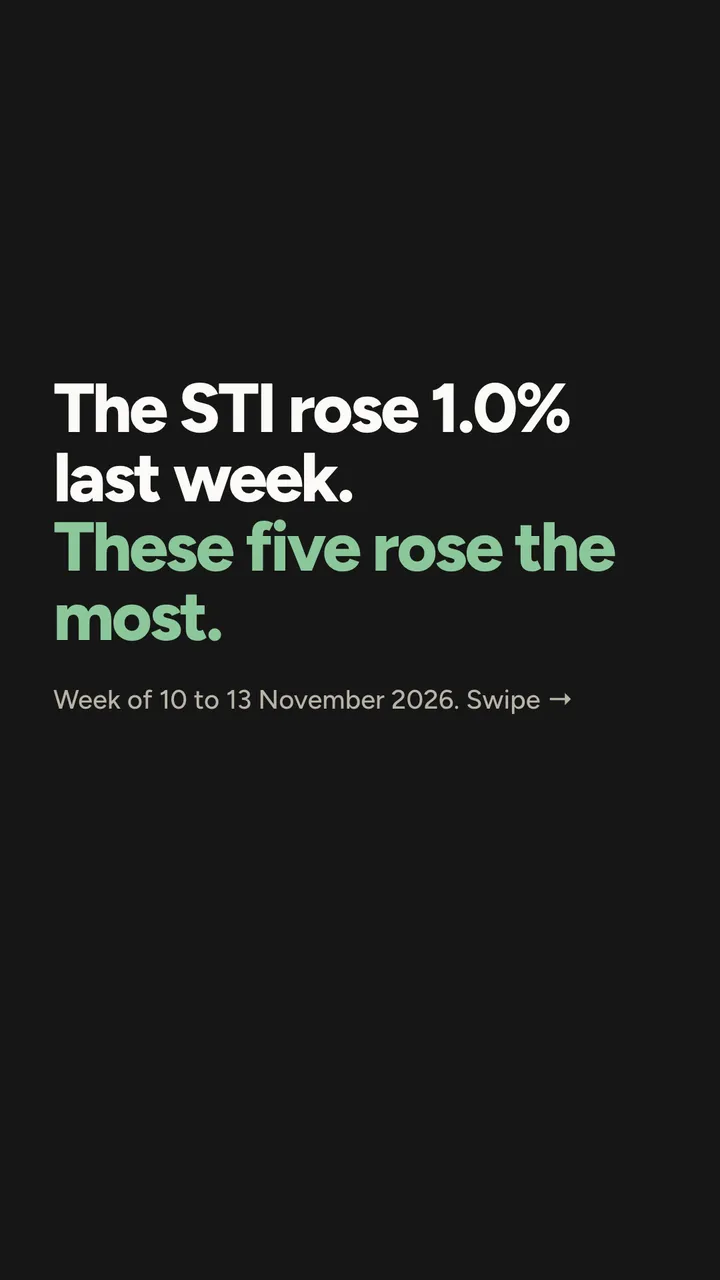
The Straits Times Index tracks 30 of the biggest companies listed on SGX, the Singapore Exchange. This week it went from 5,179.17 to 5,231.84. S$1,000 spread exactly like the index would have become about S$1,010.17, before fees and dividends.
To find the top five, we compare each stock's closing price (the last traded price when the market shuts) on the two Fridays, using Yahoo Finance, and rank all 30 ourselves. This week there were only four trading days, Tuesday to Friday.
Tuesday did most of the work
On Monday, while SGX was shut, the Dow rose 2.2% as US tech stocks rebounded from the week before and oil fell, CNBC reported. CNBC also reported Asian tech stocks tracking that rebound on Tuesday. The STI rose 1.5% that day, its biggest move of the week. I couldn't find a Singapore report that gave its own reason for Tuesday, so the honest version is: it was the first chance to trade after a big day elsewhere.
MT Newswires put Wednesday's 0.6% gain down to fuel prices continuing to fall. Friday's 1.0% fall, it reported, tracked regional losses on worries over Nvidia's leadership.
Thirteen of the 30 rose. The two biggest falls both came with results. City Developments fell 8.0% after warning that its second-half profit will be "significantly weaker" than a year earlier, partly because planned property sales have slipped into next year, EdgeProp reported. Genting Singapore fell 5.7%, almost all of it on Friday, after reporting a 42% fall in third-quarter profit.
What this means for you: a market holiday doesn't pause the world. If you hold shares on more than one exchange, the day after a holiday can carry two days of news.
SATS rose 9.1%, around its results
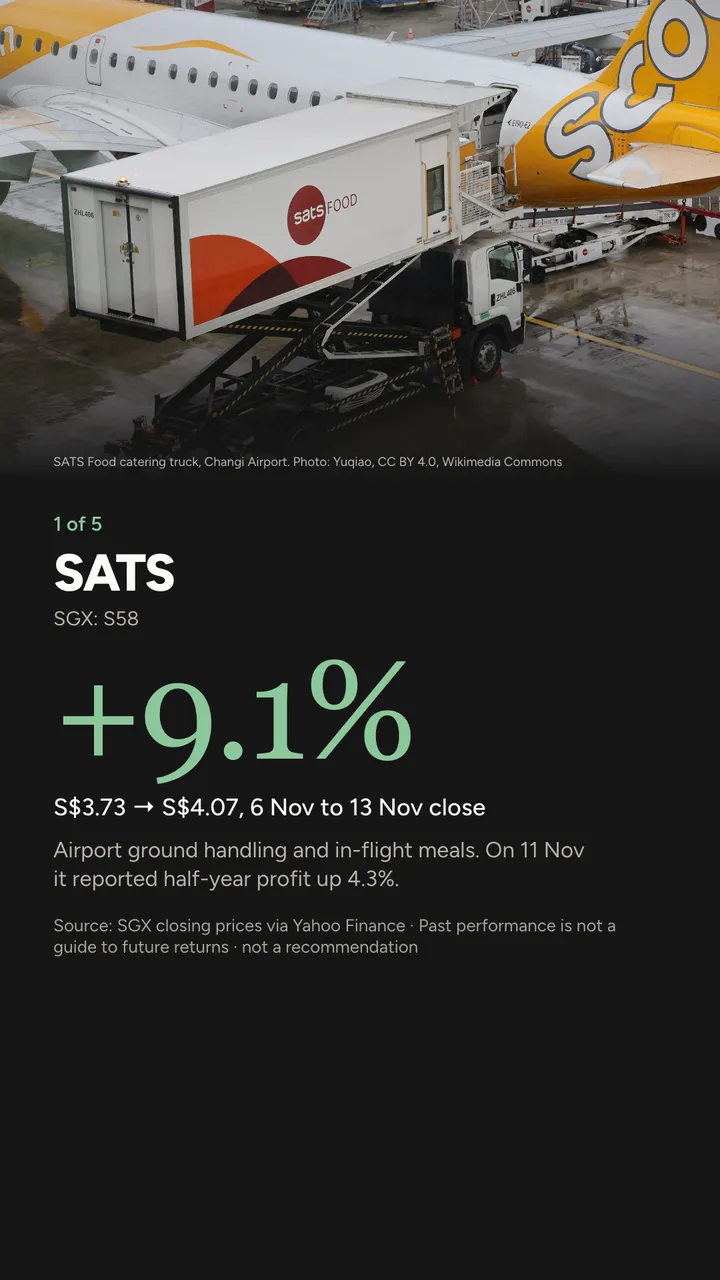
SATS handles cargo and ground services at airports and makes in-flight meals.
On Wednesday evening, after the market closed, it reported its results. Second-quarter profit was S$81.1 million, up 2.8%, on revenue up 9% to S$1.71 billion, lifted by more cargo and more meals, The Edge Singapore reported. That made half-year profit S$156.2 million, up 4.3%. It kept its interim dividend at 2 cents a share. The shares rose 4.3% on Thursday, the first day they could react.
Here's the part I find more interesting. Before the results came out, the shares had already gone from S$3.73 to S$4.00. No reason was reported for that part.
Why companies report after the close
Results are usually released outside trading hours so everyone gets the same information at the same time, and the market reacts the next morning. That's why you'll often see a big move the day after a results date, not on it.
The arithmetic
- S$1,000 of SATS shares would have become about S$1,091.15.
- One board lot (100 shares, the standard trading size on SGX): S$373 became S$407, a gain of S$34 before fees.
- The 2-cent interim dividend on that board lot is S$2. On 1,000 shares, S$20.
What this means for you: when a stock moves before its results, the results may not be the whole story. It's worth checking what moved on which day.
ST Engineering rose 4.4%, and slipped on results day
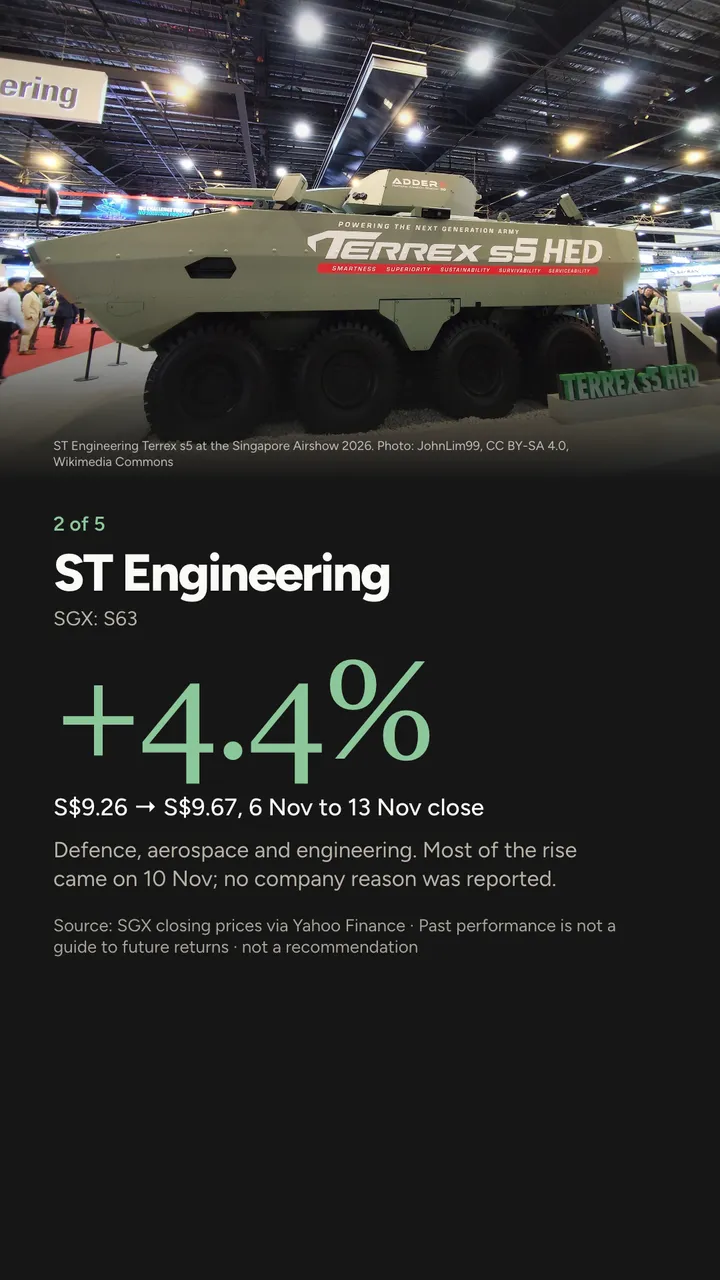
ST Engineering builds and maintains things: aircraft, defence vehicles, satellite and city systems. No single reason was reported for its rise. Most of it, 2.9%, came on Tuesday, when the whole market rose.
Its third-quarter update came out early on Friday. Revenue was up 9% to S$3.4 billion, and its order book, the work customers have signed for but that hasn't been done yet, reached a record S$37.7 billion, The Edge Singapore reported. The shares fell 0.9% that day.
Reading an order book
An order book is useful because it tells you how much future work is already agreed. A rough way to size it: revenue for the first nine months was S$10 billion, which is about S$13.3 billion a year. S$37.7 billion divided by S$13.3 billion is about 2.8 years of work at that pace. That's my rough arithmetic, not the company's figure.
The arithmetic
- S$1,000 of ST Engineering shares would have become about S$1,044.28.
- One board lot: S$926 became S$967, a gain of S$41 before fees.
What this means for you: good results and a rising share price don't always arrive on the same day. Here, most of the rise came three days before the results.
Keppel rose 3.9%, with no company news
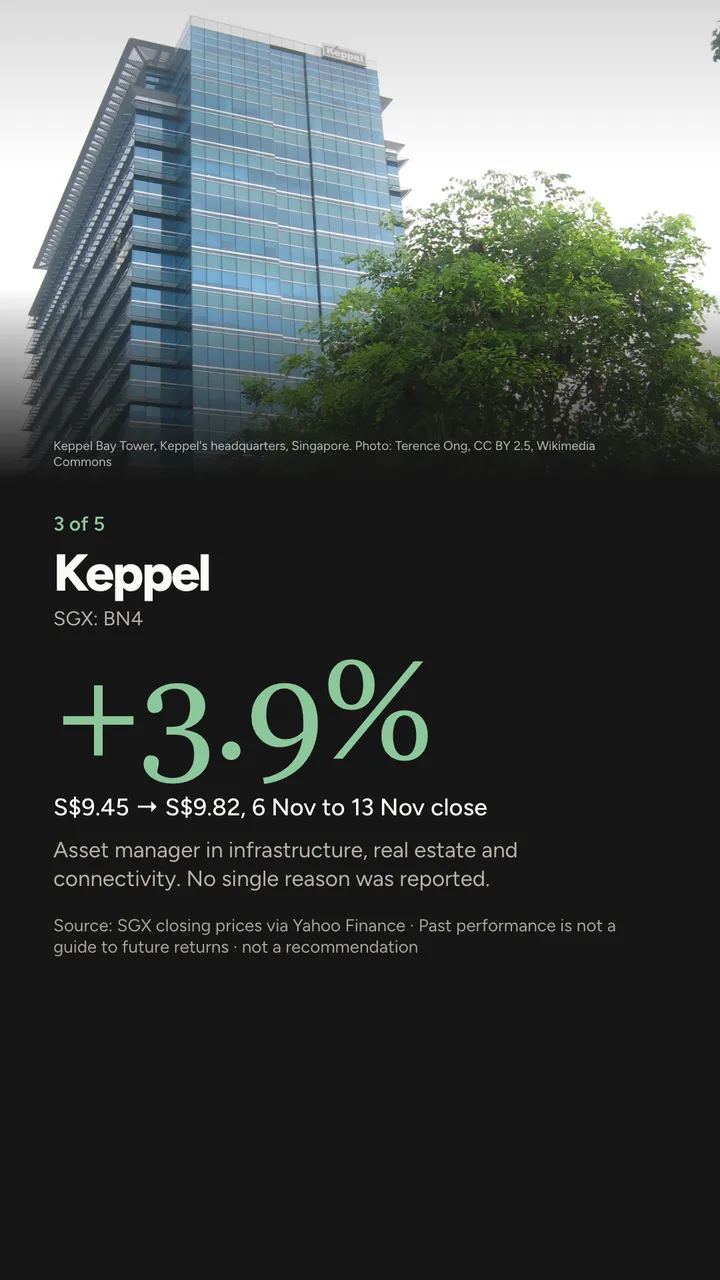
Keppel used to be known for building oil rigs. Today it describes itself as an asset manager and operator in infrastructure, real estate and connectivity: it runs and invests in things like power plants, buildings and data centres, often with other investors' money alongside its own. It had no announcement that week, and no single reason was reported for its rise.
Most of it came on Tuesday, when it rose 3.3% while the index rose 1.5%.
Moving more than the market
Some stocks tend to move more than the index on the same day, up and down. The textbook name for this is beta: a stock with a beta above 1 has historically moved more than the market, below 1 less. The idea is enough here: on a day when everything rises, some things rise further.
The arithmetic
- S$1,000 of Keppel shares would have become about S$1,039.15.
- One board lot: S$945 became S$982, a gain of S$37 before fees.
What this means for you: "no single reason was reported" is a real answer. A stock can rise because the whole market did.
Singapore Airlines rose 3.0%, back in profit for the quarter
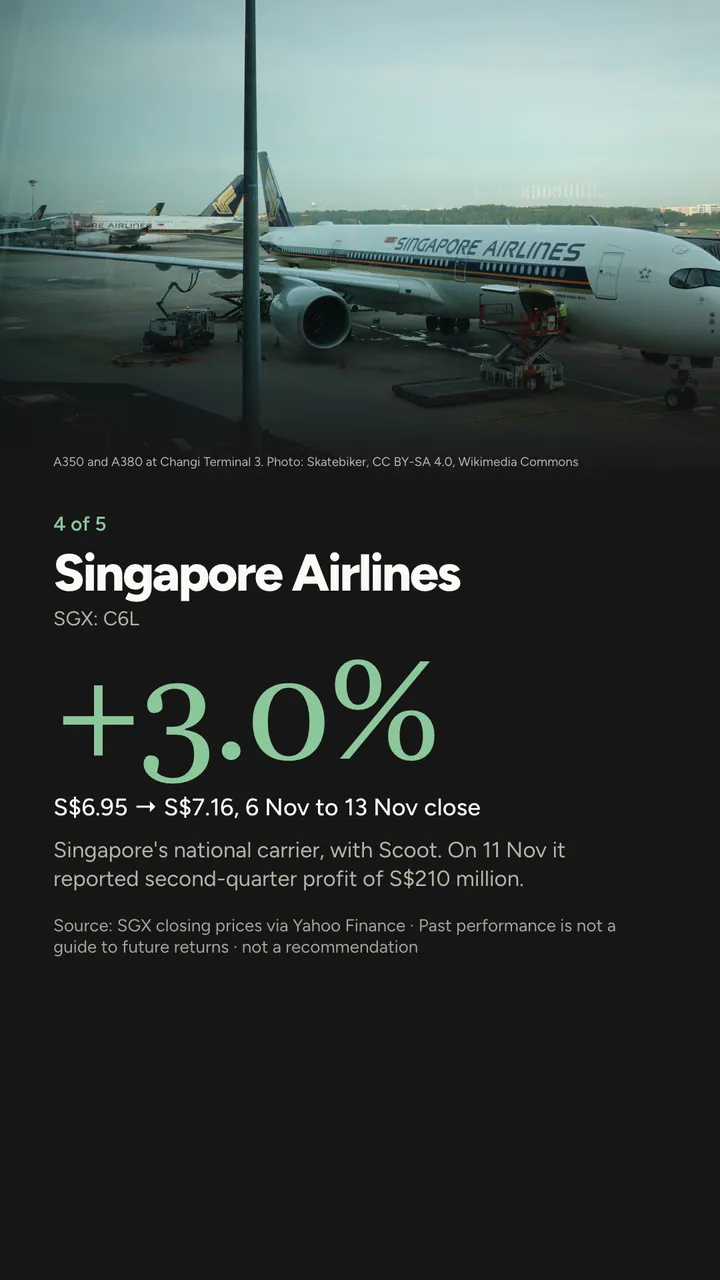
Singapore Airlines (SIA) flies under its own name and as Scoot. On Wednesday morning it reported second-quarter net profit of S$210 million, four times what it made a year earlier, on revenue up 14% to S$5.6 billion, Bloomberg reported. Strong travel and cargo demand helped, while fuel cost it S$436 million more than a year before.
Its biggest daily rise, 2.7%, came on Tuesday, before the results. The shares added a little on Wednesday and more on Thursday.
What a special dividend is
SIA declared a first-half dividend of 7 cents a share, of which 5 cents is a special dividend. A special dividend is a one-off payment on top of the usual one. It isn't a promise to pay the same next time, which is why companies label it separately.
The arithmetic
- S$1,000 of SIA shares would have become about S$1,030.22.
- One board lot: S$695 became S$716, a gain of S$21 before fees.
- The 7-cent dividend on that board lot is S$7, of which S$5 is the special part.
What this means for you: when you look at a dividend, check how much of it is special. The regular part is the better guide to what a company usually pays, though even that can change.
OCBC rose 2.9%, all of it on Tuesday
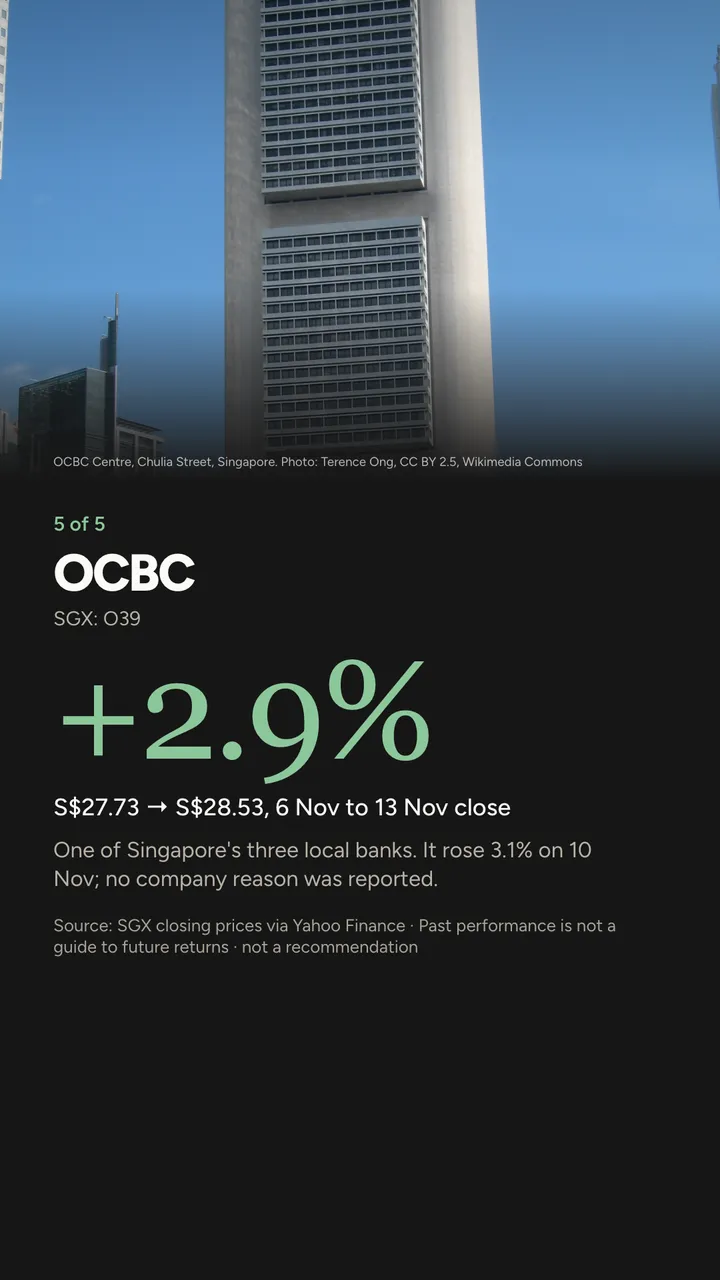
OCBC is one of Singapore's three local banks. Its third-quarter results came the week before, and no single reason was reported for this week's rise. It rose 3.1% on Tuesday, a little more on Wednesday, then gave some of that back by Friday. It only just made the top five: Venture rose by almost exactly the same amount, and OCBC was ahead by a few hundredths of a percentage point.
Why a fall and a rise don't cancel out
Last week OCBC fell 5.3%, from S$29.29 to S$27.73. This week it rose 2.9%. It's tempting to say it got half of it back. It got back less than that. To return to S$29.29 from S$27.73, it needs to rise 5.6%, because the rise is measured from a smaller number. At S$28.53, it's still about 2.6% below where it was two Fridays ago.
The arithmetic
- S$1,000 of OCBC shares would have become about S$1,028.85.
- One board lot: S$2,773 became S$2,853, a gain of S$80 before fees.
What this means for you: after a fall, it takes a bigger percentage rise to get back to where you started. It's worth doing the sum from the original price, not adding up the weekly percentages.
The week in one table
| Stock | Ticker | Close, 6 Nov to 13 Nov | Change | S$1,000 became |
|---|---|---|---|---|
| SATS | SGX: S58 | S$3.73 to S$4.07 | +9.1% | S$1,091.15 |
| ST Engineering | SGX: S63 | S$9.26 to S$9.67 | +4.4% | S$1,044.28 |
| Keppel | SGX: BN4 | S$9.45 to S$9.82 | +3.9% | S$1,039.15 |
| Singapore Airlines | SGX: C6L | S$6.95 to S$7.16 | +3.0% | S$1,030.22 |
| OCBC | SGX: O39 | S$27.73 to S$28.53 | +2.9% | S$1,028.85 |
| Straits Times Index | STI | 5,179.17 to 5,231.84 | +1.0% | about S$1,010.17 |
All before fees and dividends. One week tells you what happened, and nothing about what comes next.
If you only remember three things
- A market holiday pauses trading, not the news. The next day can carry two days of it.
- Results explain two of this week's five. The other three rose mostly on one day, with the market, and no one reported a reason.
- A fall and a rise of similar sizes don't cancel out. Do the sum from the original price.
How I keep track of this
The index tells me about the index. What I want to know is what my own money did, which needs everything in one place: savings, CPF, the flat, and any shares, in proportion.
In Sum, SGX shares in your CDP account sit inside your net worth beside your bank accounts, CPF and HDB flat. Stocks and CDP holdings are on the Essential plan; live prices, profit and loss, and dividends are on Pro. If you hold US shares too, the Dow's top five for the same week had a very different story, including a chief executive resigning. Last week's STI, when the banks fell, is in the STI's top five for 2 to 6 November.
On Saturday I took the empty murukku tin back next door. Mr Pillai asked whether his bank shares had "woken up properly" after their day off. Mostly, I said. He said that was enough for him, and asked if we wanted more kesari.
Talk soon, Brandon

Sum is launching in Singapore soon.
Your banks, cards, CPF and HDB flat, added up into one net worth. Statements sorted, card caps tracked, bills remembered.
Brandon · Finance team, Sum
Brandon is on Sum's finance team in Singapore. Brandon reads the CPF Board, IRAS and MAS updates so you don't have to, and turns our carousels into the longer version. Questions, corrections or something to share? Email Brandon at [email protected].
Got something interesting to share?
A money story, a question, something we got wrong, or a tip other Singaporeans should hear. Reach out to me at [email protected], or leave your email and I'll write to you.
Sources: Yahoo Finance, Straits Times Index price history; MT Newswires via Yahoo Finance, Singapore Shares Surge As Fuel Prices Continue Falling, 11 Nov 2026; MT Newswires via Yahoo Finance, Singapore Stocks Close Nearly 1% Lower, Tracking Regional Losses on Nvidia Jitters, 13 Nov 2026; CNBC, SoftBank Group shares surge 14% as Asian tech stocks track Wall Street rebound, 10 Nov 2026; CNBC, Dow surges 1,100 points, Nasdaq climbs more than 2% as tech rebounds from last week's tumult, 9 Nov 2026; The Edge Singapore, Sats reports 2QFY2027 earnings of $81.1 mil, up 2.8% y-o-y, 11 Nov 2026; The Edge Singapore, ST Engineering's 3QFY2026 revenue up 9% y-o-y to $3.4 bil; eyes nuclear energy sector for future growth, 13 Nov 2026; Bloomberg via Yahoo Finance, Singapore Air returns to profit on travel, cargo demand, 11 Nov 2026; EdgeProp Singapore, Weaker 2H2026 for CDL as asset sales delayed; offices, malls stay strong, 14 Nov 2026; The Edge Singapore via Yahoo Finance, Genting Singapore 3QFY2026 earnings down 42% y-o-y on weaker gaming revenue, 12 Nov 2026.
Any app screens shown use sample data, not a real person's. Sum is free to start; some features need a paid plan.
Information only, not financial advice.