The financial planning pyramid: the order planners build a money plan in
Cash, cover, goals, CPF, tax reliefs and your estate: how planners in Singapore build a money plan from the bottom up, with worked examples.

Last Sunday, after dinner at my parents' place, my younger sister pulled her chair over while my mum was cutting the oranges. She's a nurse, and she'd spent a few night-shift breaks reading about investing on her phone. "All my colleagues invest already," she said. "Which app do you use? What should I buy first?"
I didn't answer the question she asked. Partly because picking investments for someone is a job for a licensed adviser, not a brother with an opinion. But mostly because of what I asked her back: "If the car broke down, or you couldn't work for two months, what would you pay the bills with?"
She thought about it. "Savings, I guess. How much is enough?"
So I turned over my mum's shopping list (always on the back of an envelope) and drew a triangle. Four layers. I wrote "cash" at the bottom, and "investing" somewhere in the middle, and told her that most of us, me included, start in the middle.
That triangle is what planners call the financial planning pyramid. It's the order money plans are usually built in, from the ground up. This post goes through it layer by layer, the way our carousel does, with the numbers that sit behind each one and a worked example for each. None of it is a rule for you in particular. It's how the structure works, so you can see where your own money sits in it.

Four layers, built from the bottom up
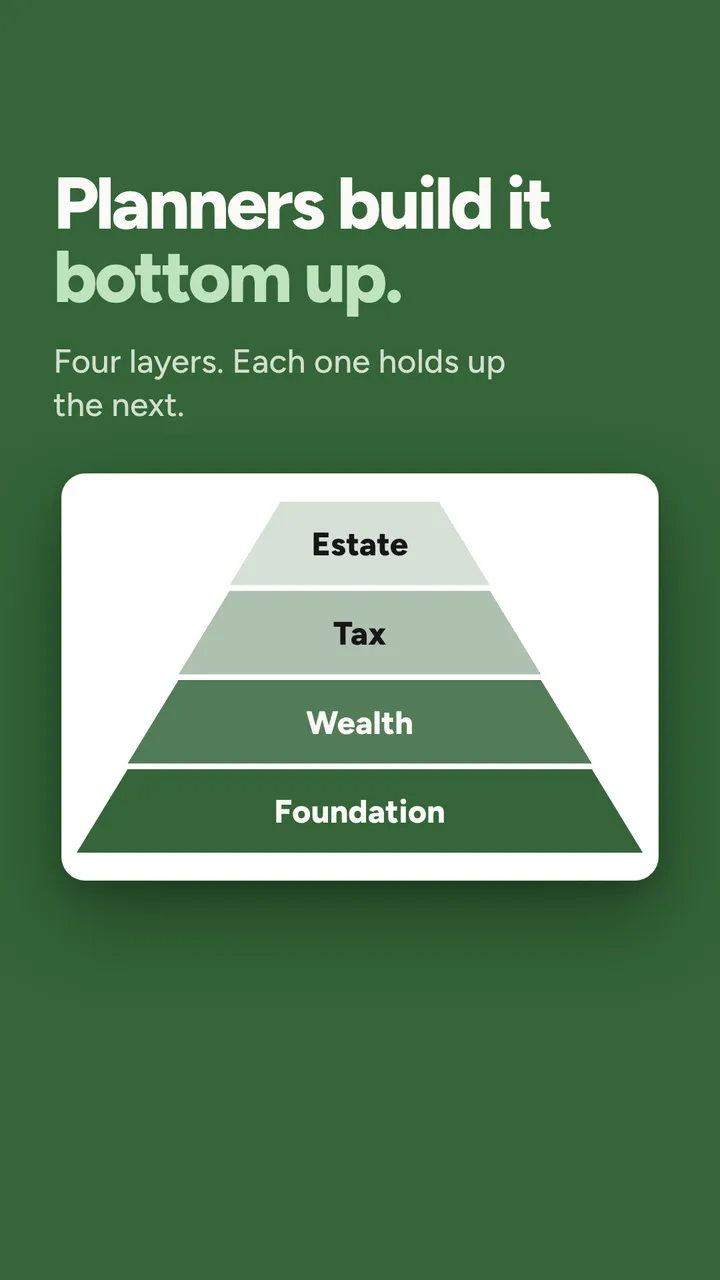
Here's the pyramid in one table, from the bottom:
| Layer | What's in it | The question it answers |
|---|---|---|
| Foundation | Cash, insurance cover, no expensive debt | Can I get through a bad month? |
| Wealth | Goals with dates, investing, CPF | Am I building towards something? |
| Tax | Reliefs such as SRS and CPF top-ups | Am I paying more tax than I need to? |
| Estate | A will, a CPF nomination, an LPA | What happens if I can't decide, or I'm gone? |
It's a pyramid, not a list, because each layer leans on the one below. Investments are meant to be left alone for years. With no cash underneath, the first emergency means selling at whatever the price is that week. With no cover, one diagnosis can take out the cash and the investments together.
What this means for you: it's worth noticing which layer you've spent the most time on. For a lot of people it's the second one, because that's where the interesting conversations are.
Layer 1: cash comes first

An emergency fund is cash set aside for things you didn't plan: a job loss, a medical bill, a parent who needs help, a laptop that dies the week of a deadline. MoneySense's guideline is three to six months of spending, in money you can reach within a day. If your income varies (commission, freelance, shift allowances that change month to month), the guideline goes up to six months or more.
Note the word "spending", not income: it's what you need to keep living, not what you earn.
The Singapore Deposit Insurance Corporation (SDIC) insures deposits up to S$100,000 per depositor per bank. For most emergency funds that's comfortably enough, but it's worth knowing the limit is per bank, not per account.
A worked example
Say Darren is 31 and spends about $3,200 a month, including his share of the rent, food, transport and insurance. This is made up, but it's an ordinary picture.
- Three months: $3,200 × 3 = $9,600
- Six months: $3,200 × 6 = $19,200
I keep mine in a separate savings account whose app isn't on my home screen, on purpose. Out of sight, but reachable in a day.
What this means for you: work out your own number from last month's real spending, not a guess. It's usually higher than people think, because the yearly bills (insurance, road tax, the aircon servicing) hide.
Then, cover for the worst
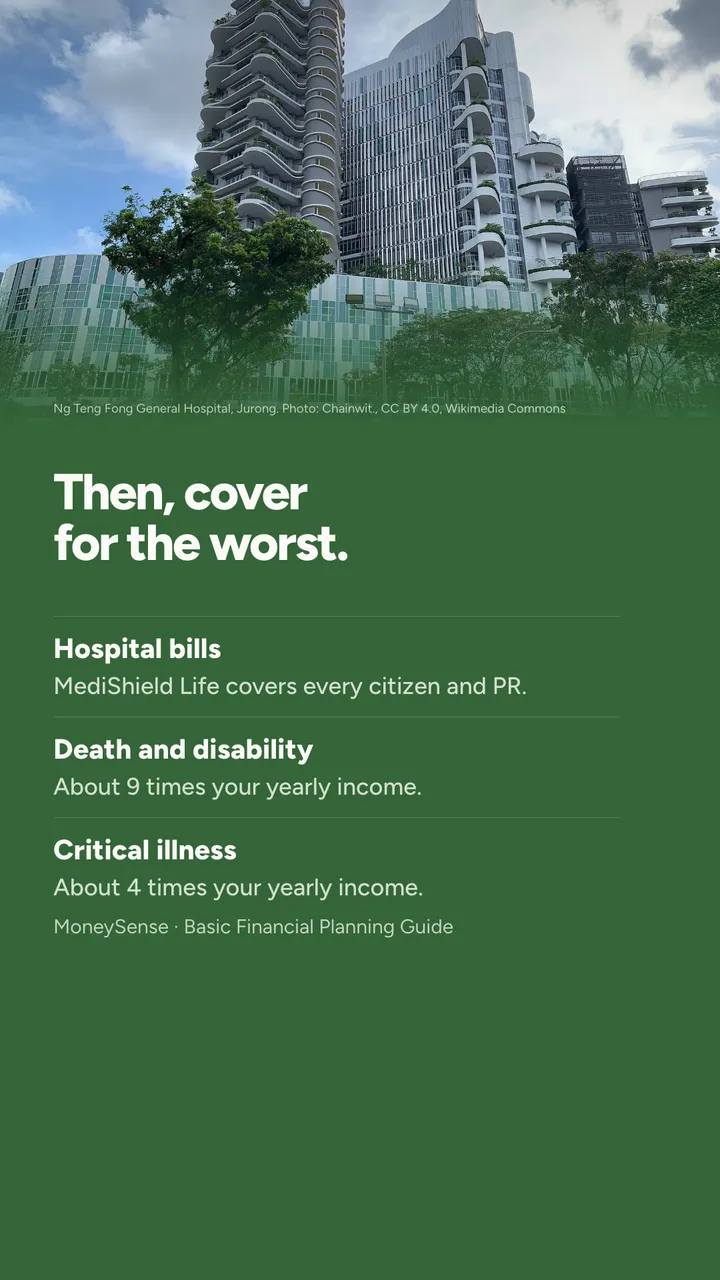
Cash handles the small emergencies. Insurance is for the ones cash can't.
- Hospital bills. MediShield Life is basic health insurance that covers every Singapore citizen and PR for large hospital bills. Many people add a private plan on top; that's a choice, and the details depend on the ward and hospital you'd want.
- Death and disability. MoneySense's Basic Financial Planning Guide puts cover at about 9 times your yearly income. The idea is that the people who depend on your income could keep going for years if it stopped.
- Critical illness. About 4 times your yearly income, to cover the years you might not be able to work while being treated.
The same guide suggests keeping premiums to no more than 15% of take-home pay, so the cover doesn't crowd out the rest of the plan.
A worked example
Say Darren earns $60,000 a year.
- Death and disability: $60,000 × 9 = $540,000
- Critical illness: $60,000 × 4 = $240,000
Those are guidelines, not targets to the dollar: someone with no dependants may need less death cover, someone with young kids and a home loan more. I wrote about the cover you may already have, from NS and CPF, in my post on life insurance, and there's no "best plan" in it, on purpose.
What this means for you: find your policies and add up what they'd actually pay. I once found one in a folder at my parents' place and couldn't tell what it covered. Knowing the number is the first step, whatever you decide after.
Card debt sits in the foundation too

This one surprises people, because debt feels like its own separate problem. Planners put it in the foundation for a simple reason: credit card balances cost about 27% a year. No ordinary investment reliably earns that. So money that goes to investing while a card balance rolls over is, in effect, earning less than the card is charging.
A worked example
Say Darren has $5,000 rolling over on a card at about 27% a year.
- $5,000 × 27% = roughly $1,350 a year in interest (a bit more in practice, since it compounds monthly).
Compare that with the same $5,000 in CPF's Special Account at 4%: $5,000 × 4% = $200 a year. The card costs nearly seven times what the safe option earns. That's the whole argument.
If there's more than one debt, the usual order is costliest first: the card at 27% before a personal loan at a lower rate, while paying at least the minimum on everything.
What this means for you: if you pay your cards in full every month, this layer is already done. If not, it's worth knowing the rate on each balance. It's on the statement, usually in small print near the bottom.
Layer 2: goals with dates

Once the foundation holds, the second layer is where money starts working towards something. Planners turn every "someday" into three numbers: an amount, a year and a monthly figure.
"I want to buy a home" is a wish. "$40,000 for the downpayment and fees, by 2030, which means setting aside $833 a month" is a plan.
A worked example
Say Darren wants $40,000 in four years for a flat.
- Four years is 4 × 12 = 48 months.
- $40,000 ÷ 48 = $833.33 a month.
If $833 doesn't fit, he has three levers: a later year, a smaller amount, or money found elsewhere in the budget. The date is what makes the trade-off visible.
What this means for you: pick your one most important goal and give it all three numbers. Most people find that the monthly figure is the one they'd never worked out.
CPF counts too

Here's the thing a lot of us miss: CPF is part of your wealth. The first time I counted properly, my net worth was higher than I expected, because I'd never counted CPF as "mine".
For 1 October to 31 December 2026, CPF Board pays:
| Account | What it's for | Interest |
|---|---|---|
| Ordinary Account (OA) | Housing, education, investing | At least 2.5% a year |
| Special Account (SA) | Retirement | At least 4% a year |
| MediSave Account (MA) | Healthcare | At least 4% a year |
| Retirement Account (RA) | Retirement, from 55 | At least 4% a year |
CPF Board has also said the 4% floor on the SA, MA and RA is extended until 31 December 2027. These rates are reviewed every quarter, so they're worth re-checking on the official page.
A worked example
Say Darren has $20,000 in his OA and $20,000 in his SA.
- OA: $20,000 × 2.5% = $500 a year
- SA: $20,000 × 4% = $800 a year
That's $1,300 a year of interest that a lot of people leave out when they ask "how much have I invested?" Someone with a large CPF balance and a small brokerage account may be further along than they feel.
What this means for you: next time you add up your savings and investments, put CPF in the same sum. Our CPF calculator shows how the accounts grow.
Layer 3: tax reliefs, up to S$80,000 a year
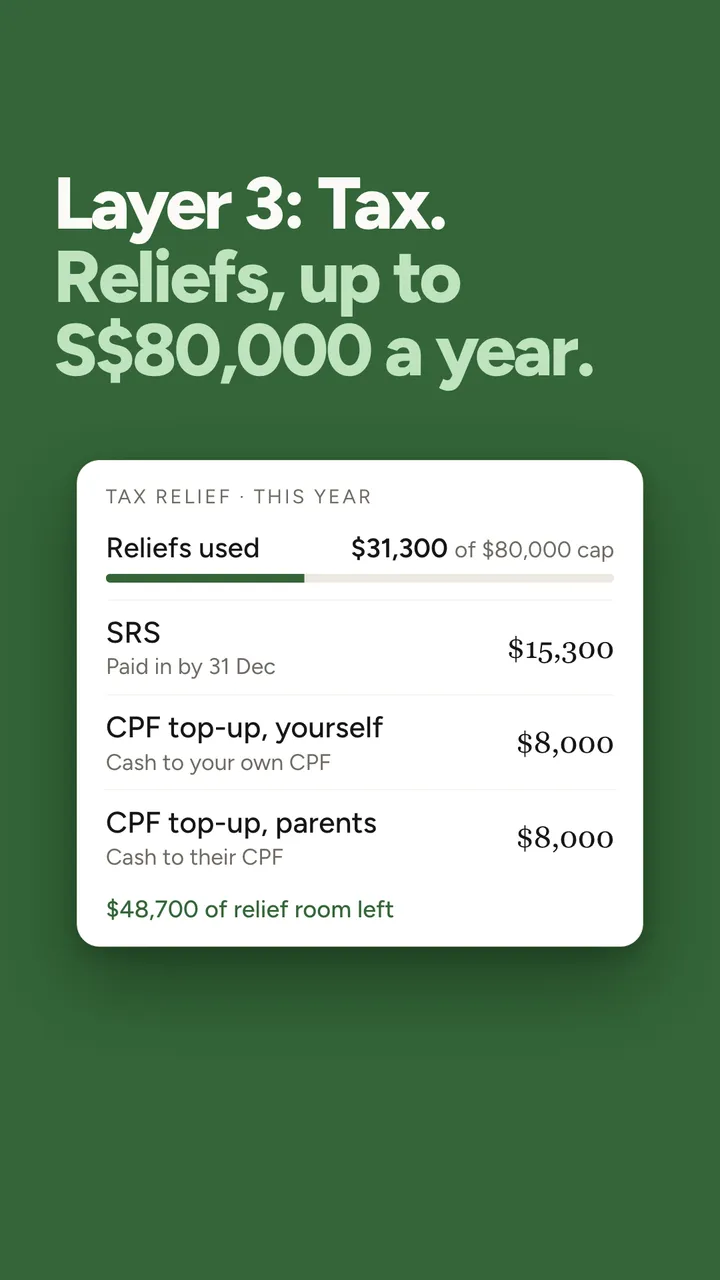
A tax relief reduces the income you're taxed on. In Singapore, all personal reliefs together are capped at S$80,000 a year (IRAS). Past that, more relief saves no more tax.
Two reliefs come up in almost every plan, because they also build towards retirement:
- SRS, the Supplementary Retirement Scheme. Money you pay in, up to S$15,300 a year for citizens and PRs, comes off your taxable income. It's meant for retirement: from the statutory retirement age, only half of each withdrawal is taxed. Take it out earlier and the whole amount is taxed, plus a penalty. To count for a year, it has to be paid in by 31 December.
- CPF cash top-ups. Cash you top up to your own Special or Retirement Account takes up to S$8,000 off your taxable income, and up to another S$8,000 for topping up parents, grandparents, a spouse or siblings. The money stays in CPF for retirement, so it's a long-term decision, not a short-term saving.
The arithmetic on the slide
The card is sample data, but the sums are real:
- $15,300 (SRS) + $8,000 (own CPF) + $8,000 (parents' CPF) = $31,300 of reliefs.
- $80,000 − $31,300 = $48,700 of room left under the cap.
Tax sits third, not first, because SRS and CPF top-ups both lock money away for years. A tax saving isn't much use if it leaves you short for an emergency in March.
What this means for you: it's worth knowing which reliefs you already get (many come automatically) before thinking about adding any. Our income tax calculator shows how reliefs change the bill.
Layer 4: estate, the part nobody wants to talk about
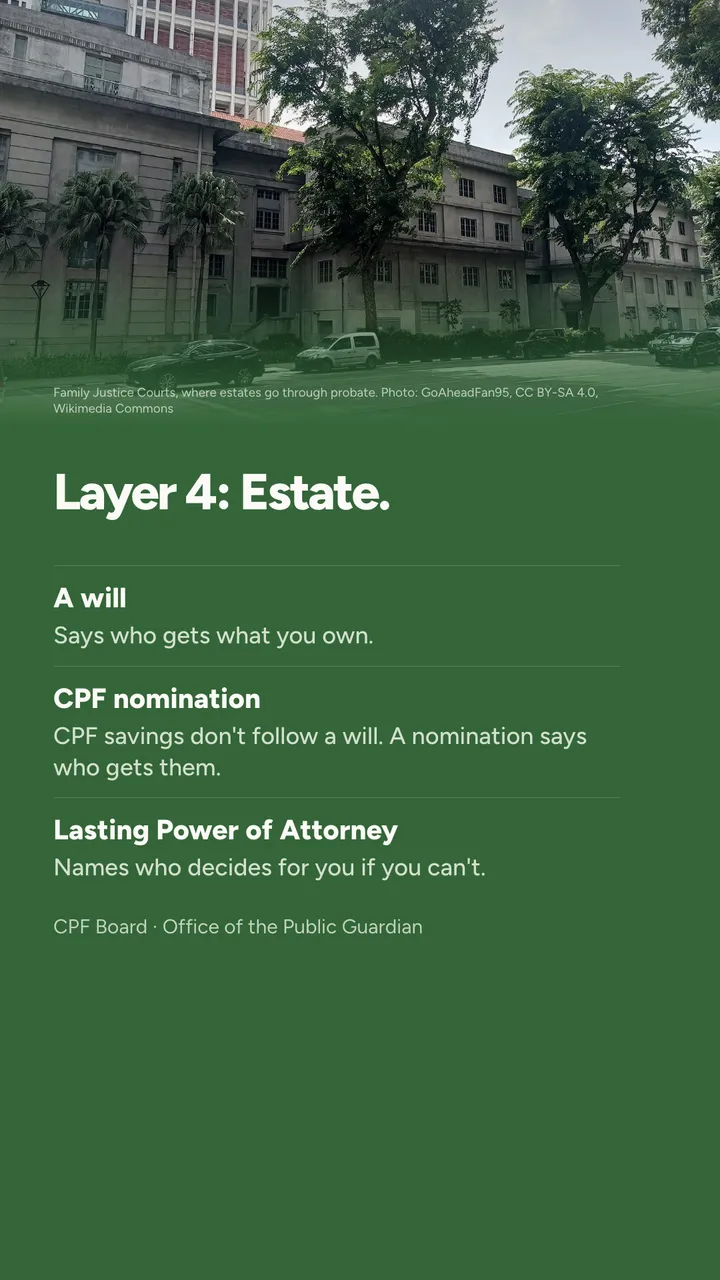
The top of the pyramid is about two situations: you're gone, or you're here but can't make decisions. Three documents cover most of it.
- A will says who gets what you own. Without one, the law decides (the Intestate Succession Act, or Faraid for Muslims). Getting married cancels an earlier will, so a new one is written after marriage.
- A CPF nomination says who gets your CPF savings. This is the one people miss: CPF savings don't follow a will, because they aren't part of your estate. Without a valid nomination, CPF Board transfers them to the Public Trustee's Office to be shared out under intestacy law, which takes longer and carries a fee.
- A Lasting Power of Attorney (LPA) names who decides on your money and your care if you lose mental capacity. Without one, your family has to apply to court to act for you, which takes months. It's made through the Office of the Public Guardian.
Divorce, on the other hand, doesn't revoke one, according to the same CPF Board page.
What this means for you: if you've married since you made a CPF nomination, it's worth checking whether you have a valid one now. It takes a few minutes on the CPF website.
Your numbers, beside the rules
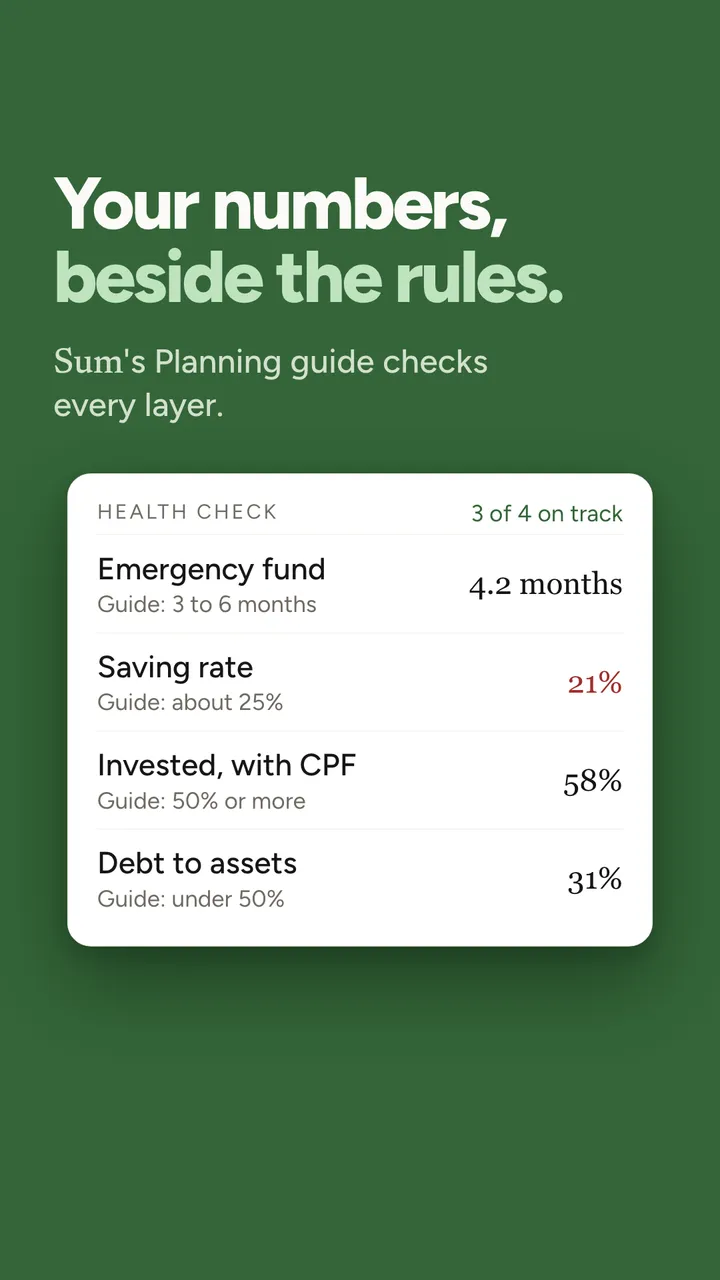
A pyramid on an envelope becomes useful when your own numbers sit next to each layer. That's what the health check in Sum's Planning guide does: four numbers, each beside a rule of thumb.
| Check | Rule of thumb | Sample | On track? |
|---|---|---|---|
| Emergency fund | 3 to 6 months of spending | 4.2 months | Yes |
| Saving rate | About 25% of income | 21% | Not yet |
| Invested, with CPF | 50% or more of what you have | 58% | Yes |
| Debt to assets | Under 50% | 31% | Yes |
Saving rate is the share of income that isn't spent: saving $1,050 of $5,000 take-home pay is $1,050 ÷ $5,000 = 21%. Debt to assets is everything you owe divided by everything you own.
The sample person is 3 of 4 on track, and the one that isn't is close. It isn't a grade. It's a pointer to which layer to look at next.
What this means for you: if you only check one number this month, make it the emergency fund in months. It's the base everything else stands on.
If you only remember three things
- Build from the bottom up. Cash, cover and no expensive debt come before investing, because they're what lets investments be left alone.
- Count CPF. It's part of your wealth, earning at least 2.5% to 4% a year (October to December 2026), and it changes how far along you really are.
- Check your CPF nomination after any big life change. Marriage revokes it, and CPF savings don't follow a will.
How I keep track of this
Sum is free to start, and budgets and goals are on the free plan. Most of this pyramid is just numbers I already have in Sum: my spending by category gives me the monthly figure for the emergency fund, my goals each have an amount and a year, and CPF sits in my net worth next to everything else.
On the 1st of the month, with a kopi, I import last month's card statements, check the three biggest categories, and look at the net worth line. Lately I've added one more stop: the Planning guide's health check, to see if any of the four numbers has moved. It takes a minute, and it tells me which layer to think about, without anyone telling me what to buy.
As for my sister: she took the envelope home. On Wednesday she sent me a photo of it on her fridge, under the polyclinic magnet, next to the old Post-it that says "MIN SPEND = the bank's goal. Not mine." Underneath the triangle she'd written one line: "Bottom first."
If there's a layer you'd like me to go deeper on, tell me at [email protected].
Talk soon, Brandon
Questions people ask
What is the financial planning pyramid?
A way planners describe the order a money plan is built in, from the bottom up: a foundation of cash, insurance cover and no expensive debt; then wealth (goals with dates, investing, CPF); then tax (reliefs such as SRS and CPF cash top-ups); then estate (a will, a CPF nomination and a Lasting Power of Attorney). Each layer holds up the one above it.
How big should an emergency fund be in Singapore?
MoneySense's guideline is three to six months of spending in cash you can reach within a day, or six months or more if your income varies. SDIC insures up to S$100,000 per depositor per bank.
Does getting married cancel my CPF nomination?
Yes. CPF Board says any existing CPF nomination is revoked upon marriage, so a new one has to be made. Without a valid nomination, CPF savings go to the Public Trustee's Office to be distributed under intestacy law. Checked on cpf.gov.sg on 15 Nov 2026.
What is the cap on personal income tax reliefs in Singapore?
All personal reliefs together are capped at S$80,000 a year (IRAS). Reliefs past the cap save no more tax.
Try the numbers yourself

Sum is launching in Singapore soon.
Your banks, cards, CPF and HDB flat, added up into one net worth. Statements sorted, card caps tracked, bills remembered.
Brandon · Finance team, Sum
Brandon is on Sum's finance team in Singapore. Brandon reads the CPF Board, IRAS and MAS updates so you don't have to, and turns our carousels into the longer version. Questions, corrections or something to share? Email Brandon at [email protected].
Got something interesting to share?
A money story, a question, something we got wrong, or a tip other Singaporeans should hear. Reach out to me at [email protected], or leave your email and I'll write to you.
Sources: MoneySense: Basic Financial Planning Guide; SDIC: deposit insurance; CPF Board: interest rates (updated 6 Nov 2026); CPF Board: making a CPF nomination; CPF Board: on your passing away; IRAS: personal reliefs and the S$80,000 cap; Office of the Public Guardian: Lasting Power of Attorney.
Any app screens shown use sample data, not a real person's. Sum is free to start; some features need a paid plan.
Information only, not financial advice.