Life insurance in Singapore: what you may already have, and what's out there
The life cover NS and CPF may already give you, MoneySense's 9x income guideline, and every insurer's no-commission term plan on compareFIRST, A to Z.

A few years after I finished NS, I found an insurance policy in a folder at my parents' place. It had my name on it. I sat on the floor of my old room in our HDB flat and tried to read it, and I honestly could not tell you what it covered. There was a "sum assured", a "policy term", a "rider", and a table of figures that seemed to mean something important to someone.
Around the same time, I learned something else that surprised me: while I was serving, I'd had life cover through MINDEF without ever applying for it, and it had ended when my service did. I hadn't known I had it, and I hadn't noticed it stop.
That pretty much sums up how most of us meet life insurance. It's not fun to think about, the documents are written for lawyers, and the conversation usually starts with someone trying to sell you something.
So this post isn't going to sell you anything. There's no "best plan" here and no "most popular" list. Partly because nobody publishes plan-by-plan sales figures in Singapore, and partly because recommending a life policy is a regulated activity in Singapore, for licensed advisers rather than a blog post.
What I can do is lay out the facts: the cover you may already have without realising it, a guideline for thinking about how much is enough, and the plans you can buy on your own, from every insurer that offers one.

A few words first
These are the terms I couldn't read on my bedroom floor, in plain English:
- Death cover, or life cover, pays a lump sum to the people you leave behind if you die while the policy is in force.
- Sum assured is that lump sum: the amount the policy pays out.
- Premium is what you pay for the cover, monthly or yearly.
- Term life covers you for a fixed period, say until 65, and pays out only if something happens within that period. It has no savings or investment element, which is why MoneySense describes term plans as generally cheaper.
- Whole life covers you for life and builds a cash value, and is typically more expensive for that reason.
Everything below is about death cover, mostly term life.
The life cover you get while serving NS
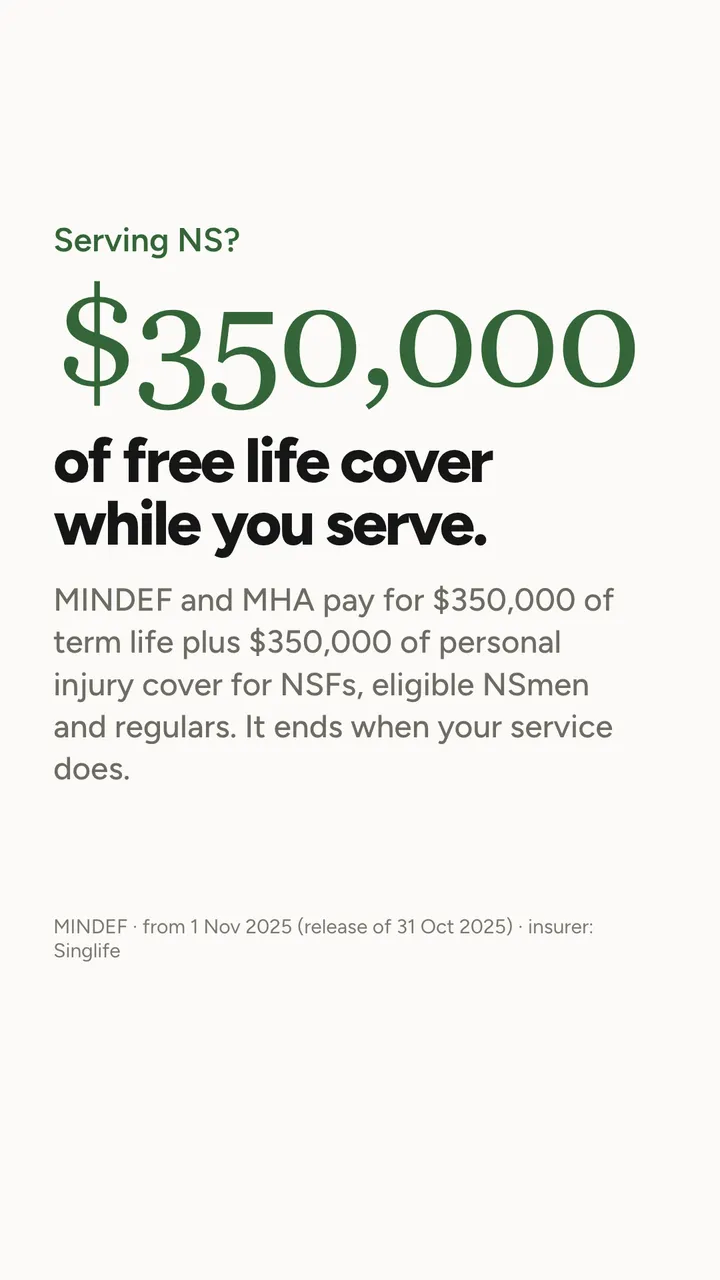
From 1 November 2025, MINDEF and MHA pay for $350,000 of term life cover plus $350,000 of personal injury cover for full-time national servicemen (NSFs), eligible NSmen and regulars. You don't apply or pay for it. The current insurer is Singlife.
Personal injury cover is separate from life cover: it pays out for certain injuries, rather than on death. Which injuries, and how much each pays, is set out on Singlife's MINDEF and MHA page.
What it looks like for an NSF
Here's an illustration. Say Ryan is 19 and serving his NS. While he serves:
- Life cover: $350,000, paid for by MINDEF
- Personal injury cover: up to $350,000, also paid for
- His own cost: $0
The day his full-time service ends, the core cover stops being his. That's the line on the slide: it ends when your service does.
What this means for you: if you're serving, it's worth knowing this is there. And if you've just finished, it's worth knowing it's gone. That was the part I missed. I didn't need cover urgently at that age, but I'd have liked to know that what I had was temporary.
Buying more cover through the same scheme
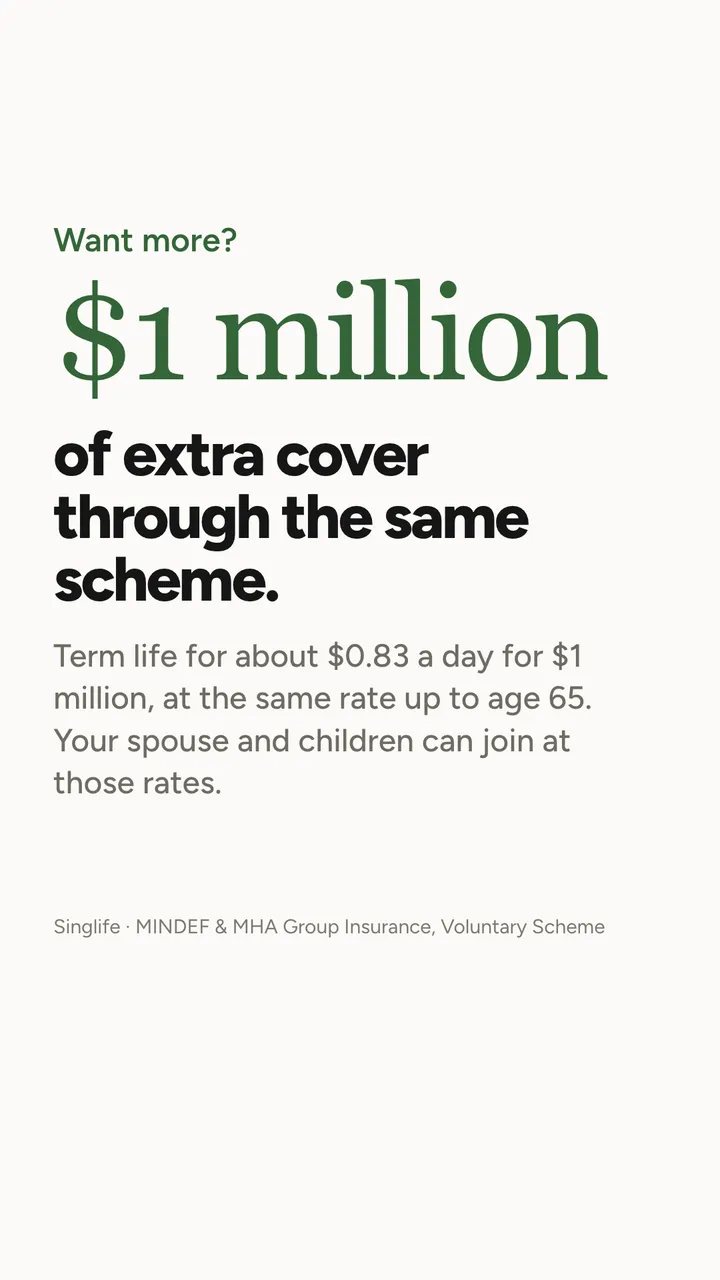
Through the same group scheme, servicemen can buy more term life cover themselves: up to $1 million, for about $0.83 a day for $1 million of cover, at the same rate up to age 65. Spouses and children can join at those rates too.
"Group" insurance means one policy covers a whole group of people, here servicemen and their families, with the price set for the group.
What $0.83 a day comes to
- Per year: $0.83 × 365 = about $303
- Per month: $303 ÷ 12 = about $25
"At the same rate up to age 65" means the price doesn't rise each year as you get older, which is unusual for term life (you'll see why in the next section).
What this means for you: if you're eligible, it's one more option to know about when you compare. Eligibility, how long you can keep it, and what happens when you leave are all set out on Singlife's MINDEF and MHA page, so read that rather than assuming.
The cover CPF gives you automatically: DPS
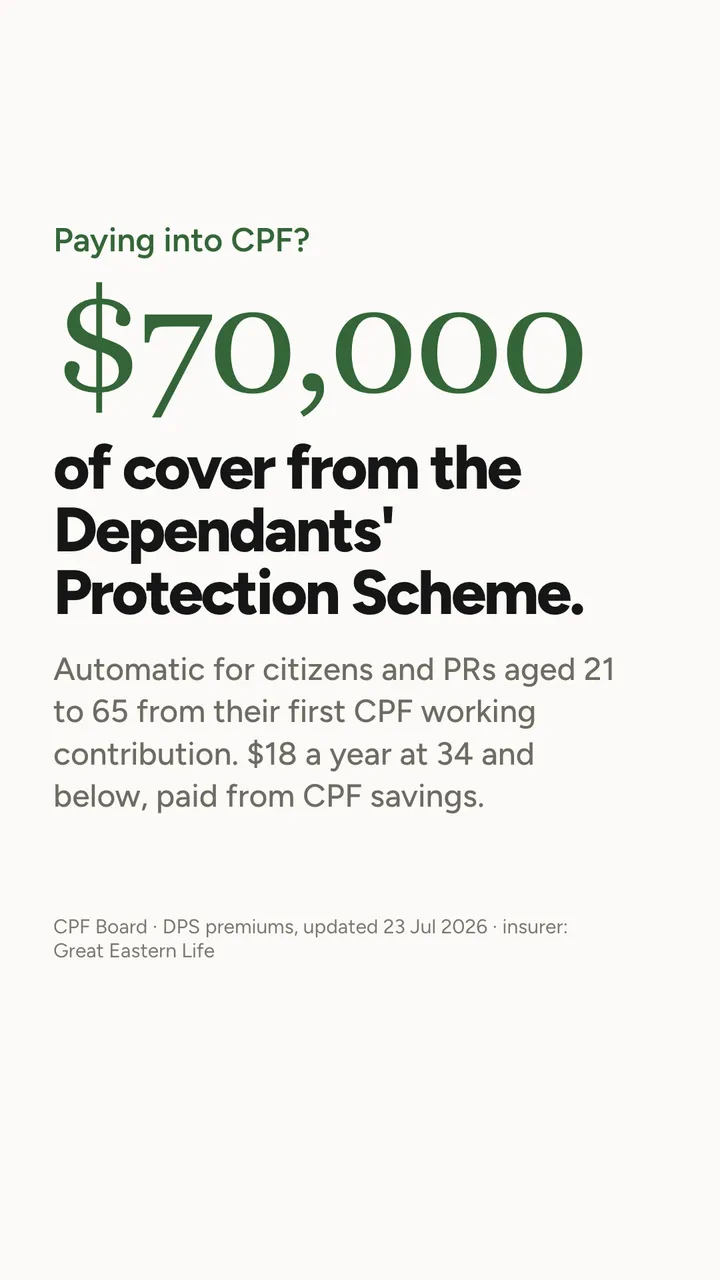
This is the one that surprises people most. The Dependants' Protection Scheme (DPS) is term life cover that starts automatically for Singapore citizens and PRs aged 21 to 65 from their first CPF contribution from work. Great Eastern Life is the insurer, with its contract extended to 2028.
It covers you for $70,000. The premium is paid from your CPF savings, so you may never have noticed it. I hadn't, until I went looking.
How the premium rises with age
Here's CPF Board's yearly premium table (updated 23 July 2026), with one extra column I worked out: the cost per $1,000 of cover.
| Age | Yearly premium | Cover | Per $1,000 of cover |
|---|---|---|---|
| 34 and below | $18 | $70,000 | about $0.26 |
| 35 to 39 | $30 | $70,000 | about $0.43 |
| 40 to 44 | $50 | $70,000 | about $0.71 |
| 45 to 49 | $93 | $70,000 | about $1.33 |
| 50 to 54 | $188 | $70,000 | about $2.69 |
| 55 to 59 | $298 | $70,000 | about $4.26 |
| 60 to 64 | $298 | $55,000 | about $5.42 |
The arithmetic is simply premium ÷ cover × 1,000. At 34 and below, $18 ÷ $70,000 × 1,000 = about $0.26. At 60 to 64, $298 ÷ $55,000 × 1,000 = about $5.42, more than twenty times as much per dollar of cover.
That's the pattern behind almost all term life: the older you are, the more likely a claim, so the more each dollar of cover costs.
What this means for you: check your CPF transaction history for the DPS premium so you know it's there. And notice that at 60 to 64, the cover drops to $55,000 while the premium stays at $298.
How much life cover is enough? The 9x guideline
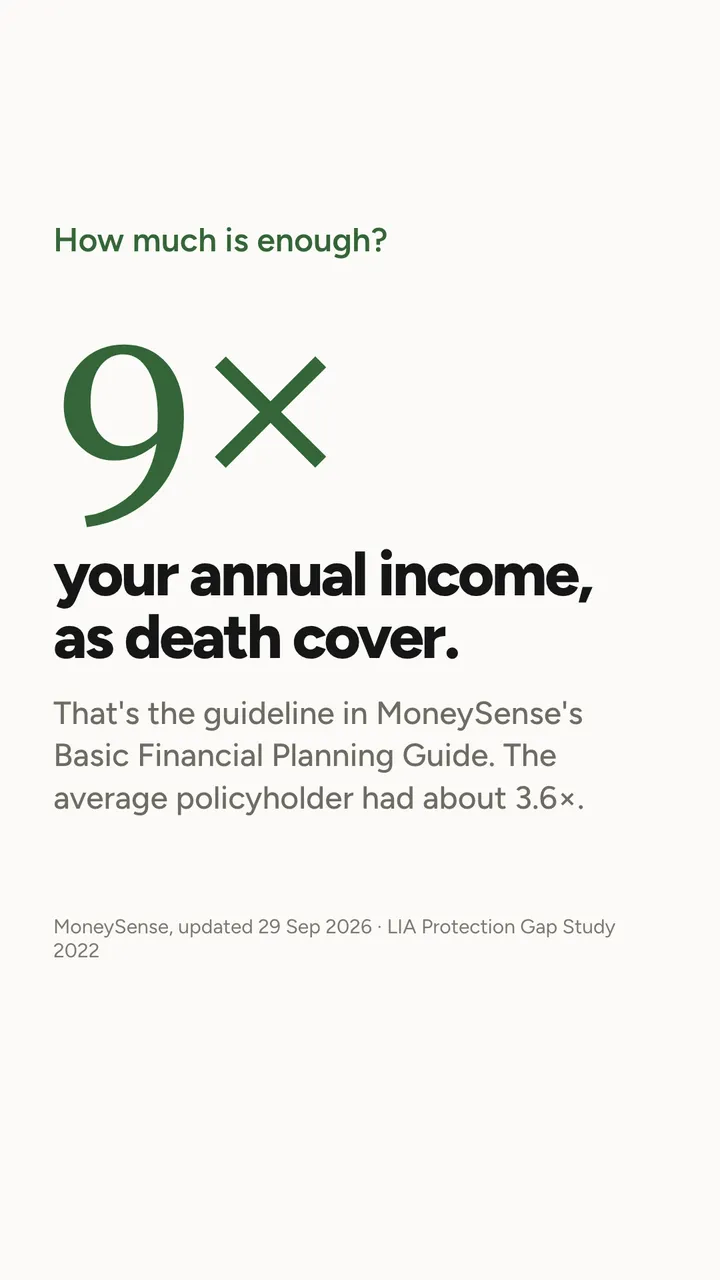
MoneySense, the government's financial education programme, has a simple guideline in its Basic Financial Planning Guide: death and total permanent disability (TPD) cover of 9 times your annual income. TPD means being permanently unable to work. The same guide suggests 4 times your income for critical illness, and spending at most 15% of your income on protection.
For comparison, the Life Insurance Association's 2022 Protection Gap Study found the average policyholder had about 3.6 times their income.
A worked example
Say Wei Ling earns $4,500 a month, and we use her monthly pay times 12 for simplicity:
- Annual income: $4,500 × 12 = $54,000
- Death and TPD guideline: $54,000 × 9 = $486,000
- Critical illness guideline: $54,000 × 4 = $216,000
- Most she'd spend on all protection, per the guide: $54,000 × 15% = $8,100 a year
- For comparison, 3.6 times her income: $54,000 × 3.6 = $194,400
Now subtract what she may already have. With DPS at $70,000, the distance to the death cover guideline is $486,000 − $70,000 = $416,000.
That's a reference point, not a target she must hit. A guideline can't see the things that actually decide the number: who depends on her income, whether she has a home loan, what she has saved, and any cover from her employer.
What this means for you: the useful first step isn't buying anything. It's adding up the cover you already have, NS, DPS, employer and any old policies in a folder at your parents' place, and seeing where that leaves you.
Term plans you can buy without an adviser
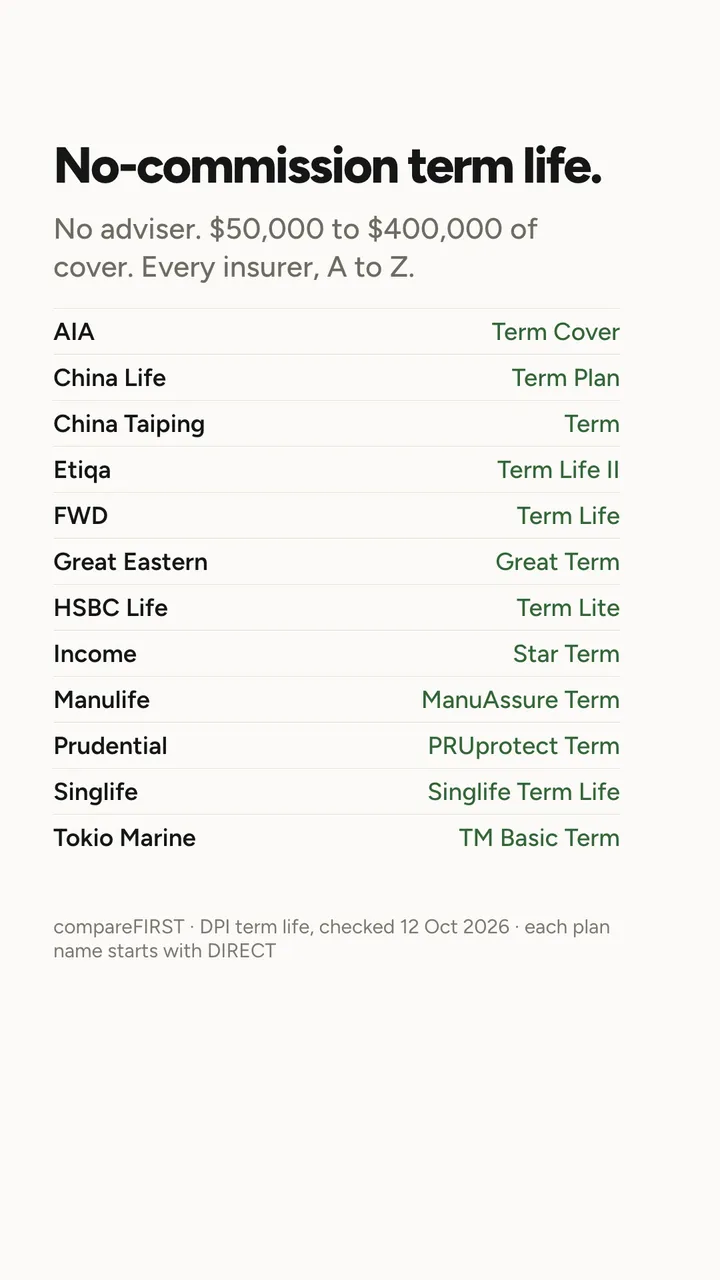
Most life insurers in Singapore offer Direct Purchase Insurance (DPI): simple plans you buy yourself, without an adviser. Because there's no advice, there's no commission, and MoneySense notes you pay lower premiums as a result. DPI term life covers $50,000 to $400,000 per insurer, and every plan's name starts with "DIRECT". You can compare them side by side on compareFIRST, an official comparison portal.
Here's every DPI term life plan listed on compareFIRST, one per insurer, as checked on 12 October 2026, in alphabetical order:
| Insurer | Plan (each starts with DIRECT) |
|---|---|
| AIA | Term Cover |
| China Life | Term Plan |
| China Taiping | Term |
| Etiqa | Term Life II |
| FWD | Term Life |
| Great Eastern | Great Term |
| HSBC Life | Term Lite |
| Income | Star Term |
| Manulife | ManuAssure Term |
| Prudential | PRUprotect Term |
| Singlife | Singlife Term Life |
| Tokio Marine | TM Basic Term |
The list is in alphabetical order on purpose. I'm not ranking them. Premiums depend on your age, gender, smoking status and how much cover you choose, so the only useful comparison is the one you run with your own details.
How the numbers fit together
Using Wei Ling's example again: the DPI range is $50,000 to $400,000 per insurer, and her reference figure after DPS was $416,000. So in her case, DPI alone from one insurer wouldn't reach the guideline figure. That isn't a recommendation either way. It's just the kind of arithmetic worth doing before you start comparing.
What this means for you: when you compare on compareFIRST, keep everything else the same (cover amount, term, smoker status) so you're comparing premiums like for like. If you'd like help deciding, a licensed financial adviser can give advice that fits your situation. That's what they're there for.
If you only remember three things
- You may already have some cover. NS cover while you serve, and DPS from your first CPF working contribution.
- NS cover ends when your service does. Know the date it stops.
- 9 times your income is a guideline, not a rule. Start by adding up what you already have.
How I keep track of this
Here's the thing about insurance that I find genuinely tricky: you buy it once, then it disappears into a drawer (or a folder at your parents' place). Premiums come out yearly or monthly, sometimes from different accounts, and it's easy to lose track of what you're paying for and when.
In Sum, I keep my premiums as bills, so I get a reminder before each one is due. Bill reminders are on the free plan. The premiums I pay from my bank show up in my spending by category, which is how I finally saw, in one place, what my cover costs me over a year. And that old policy from my parents' folder? It's in there too, with its renewal date, so it never surprises me again.
If you've got a question about any of the schemes above, email me at [email protected]. I can't tell you which plan to buy, but I'm always happy to help you find the official page that answers it.
Take care, Brandon

Sum is launching in Singapore soon.
Your banks, cards, CPF and HDB flat, added up into one net worth. Statements sorted, card caps tracked, bills remembered.
Brandon · Finance team, Sum
Brandon is on Sum's finance team in Singapore. Brandon reads the CPF Board, IRAS and MAS updates so you don't have to, and turns our carousels into the longer version. Questions, corrections or something to share? Email Brandon at [email protected].
Got something interesting to share?
A money story, a question, something we got wrong, or a tip other Singaporeans should hear. Reach out to me at [email protected], or leave your email and I'll write to you.
Sources: MINDEF: news release of 31 Oct 2025 (core cover from 1 Nov 2025); Singlife: MINDEF & MHA Group Insurance; CPF Board: DPS premiums (updated 23 Jul 2026); CPF Board: Great Eastern Life's DPS contract extended to 2028; MoneySense: Your financial basics; LIA: Protection Gap Study 2022, key findings (PDF); compareFIRST: Direct Purchase Insurance, term life; MoneySense: Buying direct purchase insurance.
Any app screens shown use sample data, not a real person's. Sum is free to start; some features need a paid plan.
Information only, not financial advice.