Overwhelmed by your finances? You might be keeping track of 13 bills
Two cards per adult, 13 bills in an example household, and 42% of what we own is our home. Why money in Singapore feels like a lot to track, and what helps.

A few years ago I paid a credit card bill four days late. Not because I didn't have the money. It was sitting in my savings account at a different bank, doing nothing. I just forgot.
I remember the moment I noticed. I was on the MRT, scrolling through my email, and there was the statement for the next month, with a late fee and interest sitting at the top like a little fine for not paying attention. I worked it out on the train: the fee and the interest together were more than that card had given me in cashback over the previous few months. I'd been carefully earning a few dollars a month and then gave it all back, plus some, in one go.
What bothered me most wasn't the money. It was that I'd thought I was on top of things. I had the apps. I had the spreadsheet (updated, admittedly, around Chinese New Year). I just had too many separate things to hold in my head, and one of them slipped.
If money sometimes feels like a lot to keep track of, it's not because you're bad with it. There genuinely is a lot. So for this carousel we tried to put numbers on how much, from official sources where they exist and from a clearly labelled example where they don't. This post goes through it one slide at a time, then what actually helps.
Why money feels like a lot to keep track of
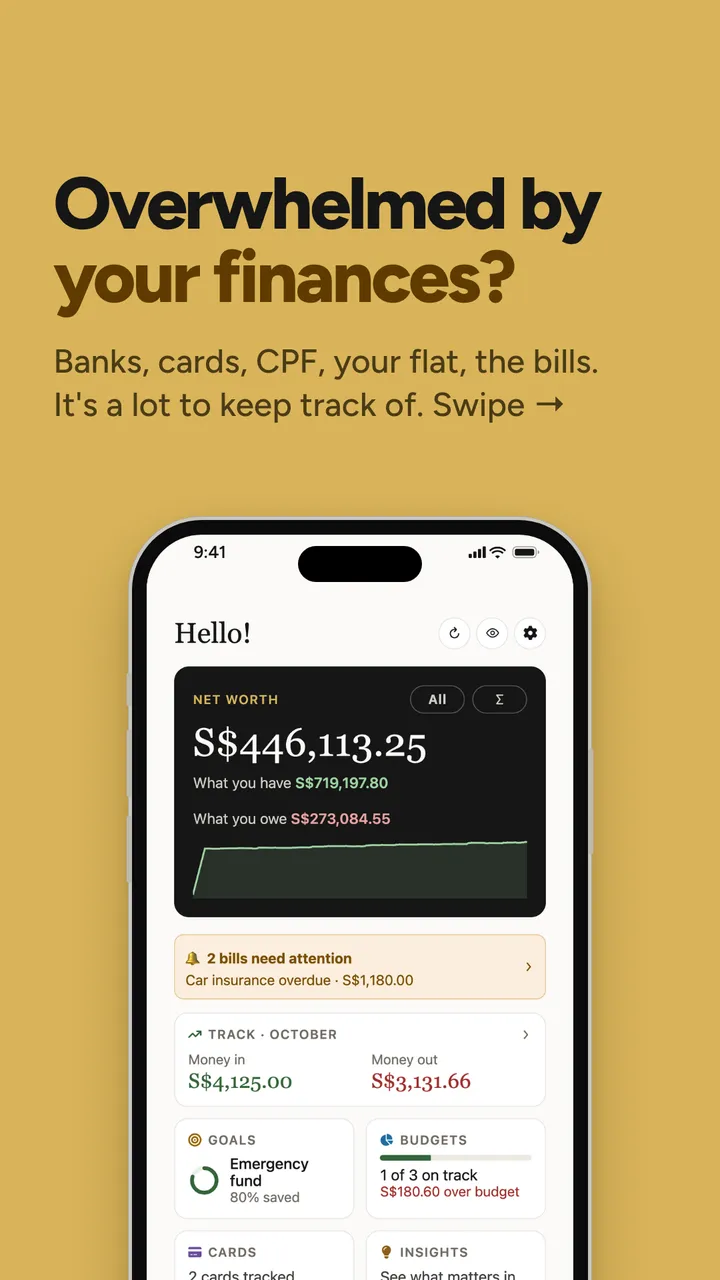
The cover lists five things: banks, cards, CPF, your flat and the bills. Each one, on its own, is manageable. The trouble is that each lives somewhere different and runs on its own clock.
- Banks have their own apps and logins.
- Cards have their own statement cycles and due dates, which rarely line up.
- CPF has its own website, and you probably visit it a couple of times a year.
- Your flat doesn't show up anywhere, except as a loan.
- Bills come from a dozen organisations, some monthly and some once a year.
A worked example: counting the places
Here's my own count, roughly, from the time I wrote it down: four banking apps, one CPF login, a brokerage account, two credit cards and a spreadsheet. That's nine separate places to look before I could say anything about my money with confidence. And that's before a single bill.
What this means for you
Feeling overwhelmed by money is often a sign of fragmentation, not of having too little or doing it wrong. The fix for fragmentation isn't more willpower. It's fewer places to look.
Your home is about 42% of what households own
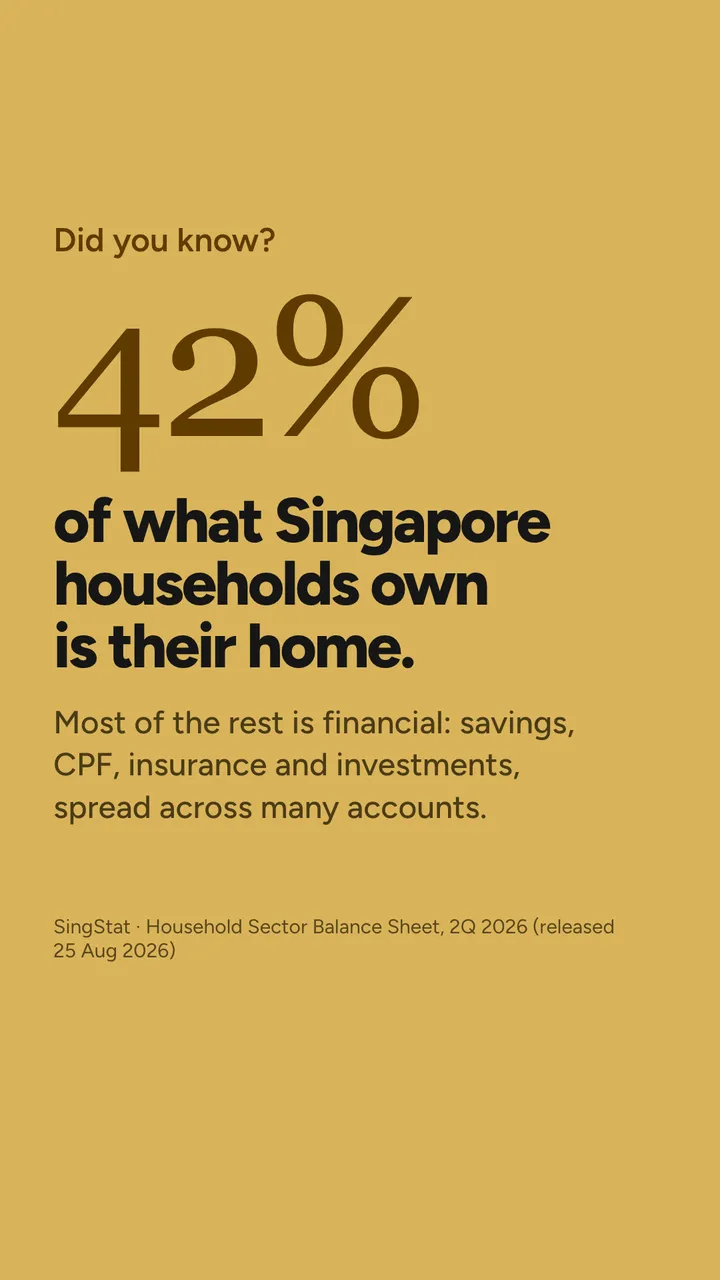
Every quarter, SingStat publishes the Household Sector Balance Sheet: a snapshot of everything Singapore households own and owe, added up across the whole country. In the release for the second quarter of 2026 (published 25 Aug 2026), residential property made up 42.3% of household assets.
In plain English: for every $100 that households own, about $42 is the home itself. Most of the rest is financial: bank deposits, CPF, insurance and investments.
That has two consequences. First, your flat is probably the single biggest thing you own, so any picture of your money that leaves it out is missing a lot. Second, the other half is scattered: savings at one bank, CPF on another website, insurance policies in a drawer, investments on a brokerage app.
A worked example: your split can look very different
The 42% is an average across every household in Singapore. Yours may look nothing like it. Take an example young couple who've just collected the keys to their flat:
- Flat (their estimate): $450,000
- CPF across both of them: $90,000
- Savings: $30,000
- Total assets: $570,000
Their flat's share: $450,000 ÷ $570,000 = 79%.
Much higher than 42%, and that's completely normal early on. Over the years, as CPF and savings grow, the split usually shifts. The point isn't to match the national number. It's to know your own.
What this means for you
Put a realistic value on your flat, and use the same method every time you check so the trend is honest. Our HDB resale value tool uses recorded resales to give you a starting point. Don't forget the loan on the other side: the flat is an asset, the outstanding loan is what you owe against it.
About two credit cards for every adult
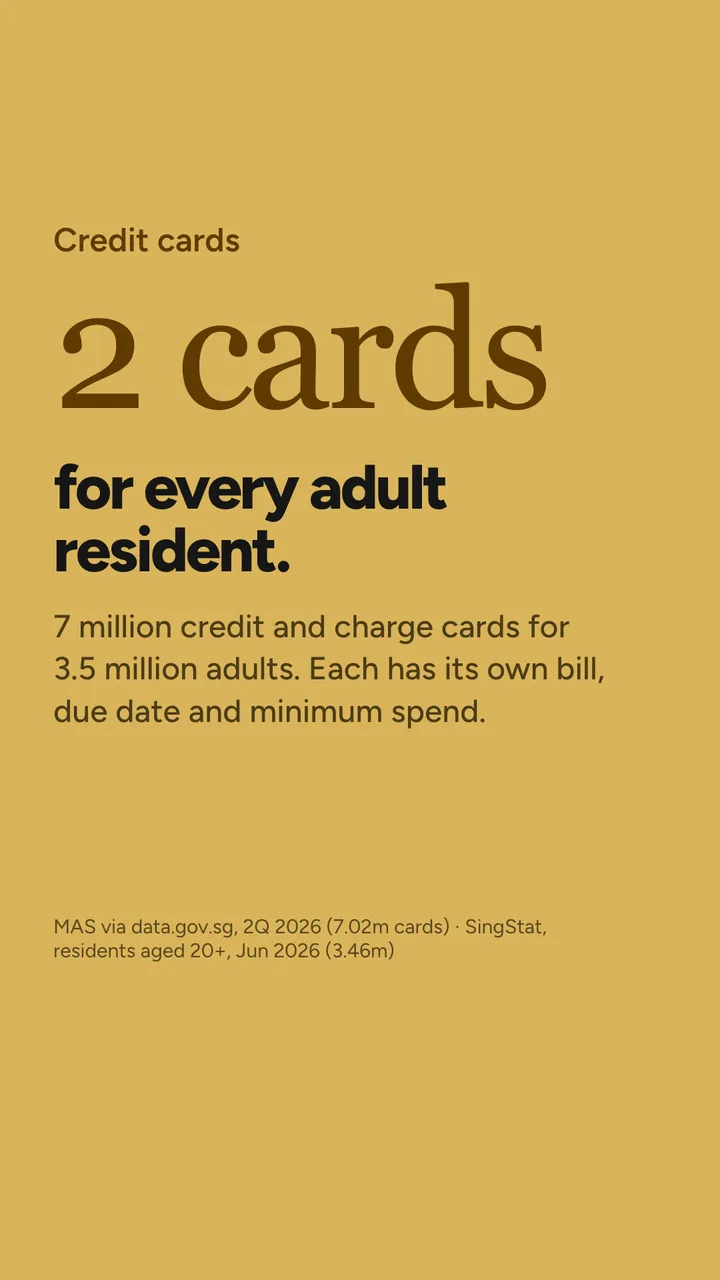
MAS publishes how many credit and charge cards there are in Singapore. In the second quarter of 2026 it was 6,151,986 main cards plus 863,831 supplementary cards: 7,015,817 in all. SingStat counts 3,457,500 residents aged 20 and above at the end of June 2026.
7,015,817 ÷ 3,457,500 = 2.03.
I want to be careful with this one. It's a ratio, not "every adult holds two cards". Some people hold several, plenty hold none, and some cards belong to people who aren't residents. MAS doesn't publish how many people actually hold a card. But as a feel for the scale, two per adult is a useful number.
Why two cards is more than twice the work
Each card brings three things to track:
- A due date. Pay the full statement balance by then, or you're charged interest, and usually a late fee if you miss the minimum payment.
- A statement cycle. The cycle decides which month a purchase counts in, and it rarely matches the calendar month.
- Rules for its rewards. Many cashback and miles cards need a minimum spend in the statement month to unlock the headline rate, and stop at a cap.
A worked example: my two cards
My two cards have due dates about two weeks apart, and statement cycles that close on different days. So in any given month there are two due dates to remember, two cycles to keep straight, and two sets of minimum-spend rules. Six moving parts from just two pieces of plastic. My late payment was on the card whose due date fell in the same week as a busy work deadline. Not a coincidence, I suspect.
What this means for you
If you can, set every card to pay the full statement balance automatically from an account that will have the money. And if you're weighing up whether a card's rewards are worth the extra bill, our card rewards calculator shows what each card would earn on your actual spending, with caps and minimums applied.
An example household pays 13 bills
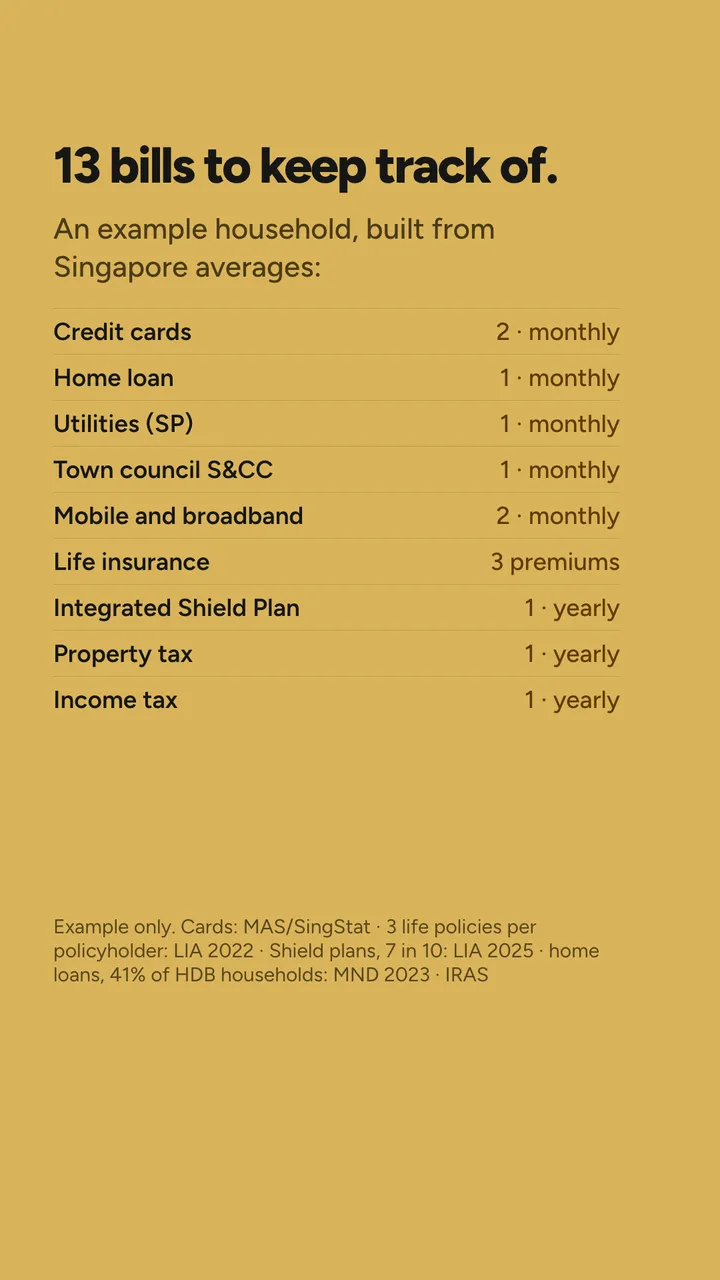
Here's where I have to be upfront. Nobody publishes an official count of how many bills a Singapore household pays. We looked. So instead we built an example household from national figures and counted. It came to 13:
| Bill | How many | How often | Where the number comes from |
|---|---|---|---|
| Credit cards | 2 | Monthly | MAS and SingStat, about two per adult |
| Home loan | 1 | Monthly | About 41% of HDB households had an outstanding housing loan (MND, July 2023) |
| SP utilities | 1 | Monthly | Electricity, water and gas |
| Town council S&CC | 1 | Monthly | Service and conservancy charges for your estate |
| Mobile and broadband | 2 | Monthly | Counted as two bills |
| Life insurance | 3 | Per policy | LIA's 2022 Protection Gap Study: an average of three policies for death cover |
| Integrated Shield Plan | 1 | Yearly | About 7 in 10 residents had one at end-2025 (LIA) |
| Property tax | 1 | Yearly | IRAS |
| Income tax | 1 | Yearly | IRAS |
An Integrated Shield Plan, if the name is new to you, is private hospital insurance that sits on top of MediShield Life, the basic national cover.
A worked example: 13 bills is about 90 payments
Thirteen bills sounds manageable. Count the payments instead:
- Monthly bills: 2 cards + 1 loan + 1 SP + 1 S&CC + 2 telco = 7 bills.
- 7 × 12 months = 84 payments a year.
- Yearly bills: 3 life premiums (if paid yearly) + 1 Shield + 1 property tax + 1 income tax = 6 payments.
- Total: 84 + 6 = 90 payments a year.
Ninety dates. Most go out by GIRO and you never think about them. But a few need you to act, a few need money in the right account on the right day, and the yearly ones are the sneaky ones, because a year is just long enough to forget.
Your household might have fewer. Many have more: a car loan, a second phone line, enrichment classes, a season parking pass. The exact number isn't the point. Even a fairly ordinary household is keeping a dozen or so due dates alive, some monthly and some once a year.
What this means for you
Write your own list. It takes about ten minutes and is oddly calming. For each bill note three things: roughly how much, when it's due, and which account pays it. The third column is the one that catches people out.
Seeing it all in one net worth
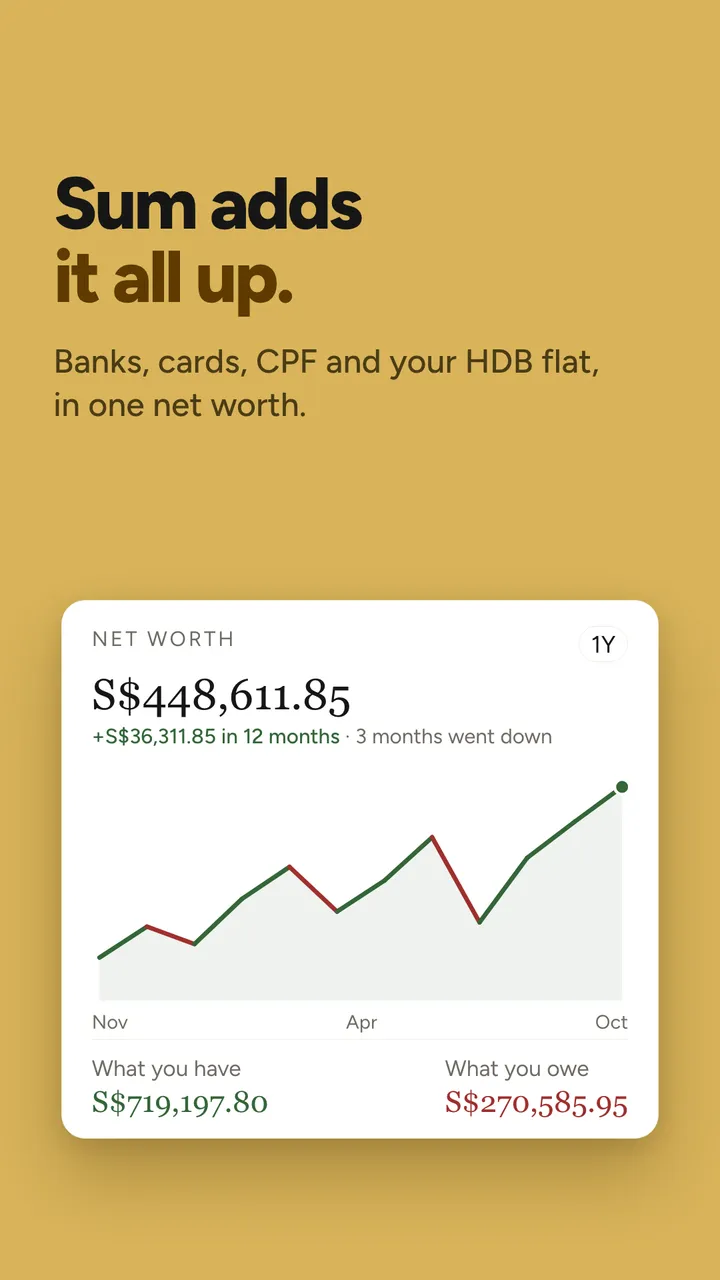
When something feels overwhelming, the instinct is to look away. I get it; I did it for years. But in my experience the relief comes from the opposite direction: putting it all in one place, once, so you can stop holding it in your head.
The slide shows one number built from everything: banks, cards, CPF and your flat. That number is your net worth, which is just what you have minus what you owe.
A worked example: the young couple, all in
Back to our example couple. Assets of $570,000 (flat, CPF, savings). Say they owe $360,000 on the home loan and have $1,500 on their two cards this cycle.
$570,000 − $360,000 − $1,500 = $208,500.
That's their net worth. One number, instead of nine places to look. And next month, when they've paid down some of the loan and their CPF has had another month of contributions, it'll be a little different. The chart on the slide is sample data, but notice that some months go down. That's normal: an insurance premium, a holiday, a big repair. What matters is the direction over a year.
What this means for you
Calculate your net worth once, by hand if you like, and write down the date. The first number isn't the useful one. The comparison six months later is.
Catching the bill before it's late
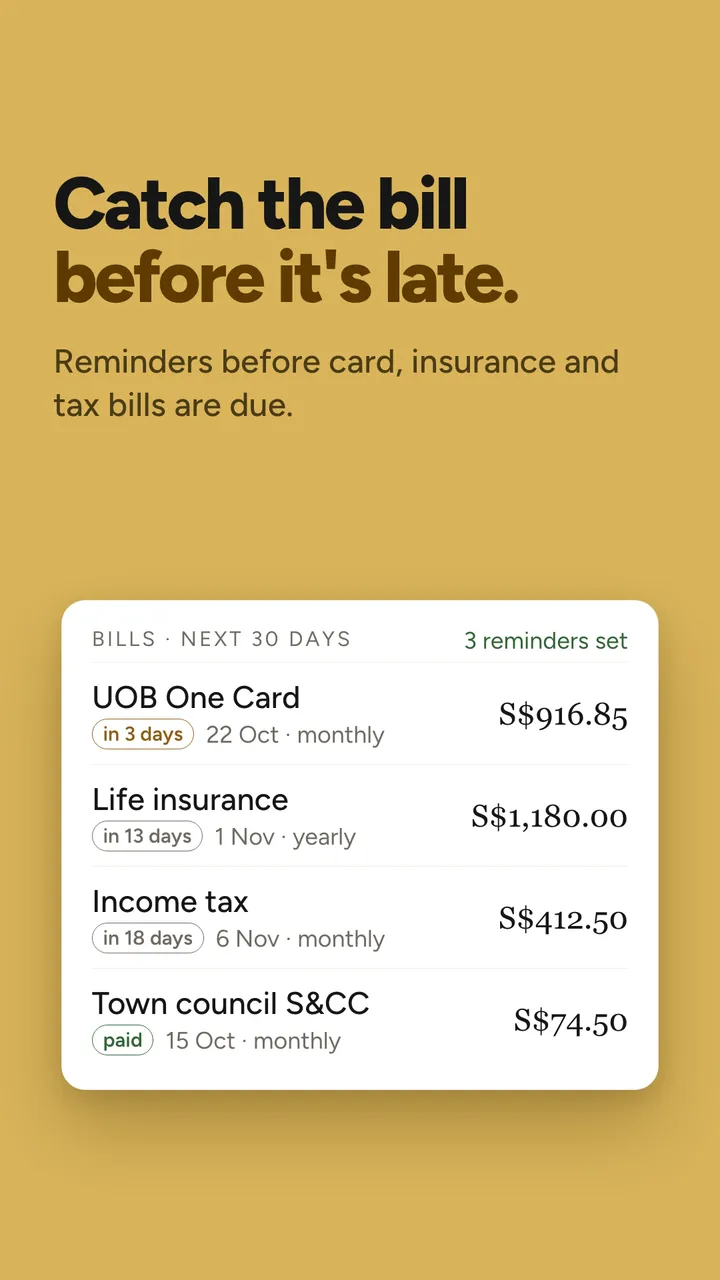
The slide shows the next 30 days for an example household: a card bill in 3 days, a yearly life insurance premium in 13 days, a monthly income tax instalment in 18 days, and the town council charges already paid.
That income tax line is due on the 6th, and that's how IRAS works: if you pay by GIRO, you can spread your income tax over up to 12 monthly instalments, deducted on the 6th of each month. If you don't use GIRO, the bill is due within one month of the date on your Notice of Assessment.
A worked example: what one missed bill costs
Late bills cost differently depending on who sends them:
- Income tax: IRAS adds a 5% late payment penalty on the unpaid tax (unless you're on an approved instalment plan), with further penalties possible if it stays unpaid. On an example bill of $2,400, that's $2,400 × 5% = $120, for nothing.
- Credit cards: usually a late fee plus interest on the balance. Check your own card's terms for the amounts, because they differ by bank.
- Insurance: policies usually have a grace period for premiums, but miss that too and the policy can be at risk. Your policy document says how long yours is.
My four-days-late card bill is the cheap version of this lesson. The yearly ones, like an insurance premium, are the expensive version.
What this means for you
Put reminders on the yearly bills first. You'll probably remember the monthly card bill because it comes round so often. It's the once-a-year premium and the tax bill that ambush you.
If you only remember three things
- Money feels like a lot because it's spread across many places, each on its own clock. That's fragmentation, not failure.
- Your flat is likely your biggest asset, and the rest is scattered. One net worth puts it back together.
- Thirteen bills can mean about 90 payments a year. Write the list, note which account pays each, and put reminders on the yearly ones.
How I keep track of this
After the late fee, I tried a few systems: calendar alerts, a sticky note, a very ambitious spreadsheet tab called "Bills". They each lasted a while. What finally stuck was having it all in one place that I didn't have to rebuild every month.
That's how I use Sum now. It doesn't manage, invest or move my money; it's read-only, so it can see balances and transactions but never make a payment. It keeps track:
- One net worth. My banks, cards, CPF and loans in one number, with a 12-month line. You can link up to two banks on the free plan, or import a PDF or CSV statement, and Sum reads your statement and sorts every line into a category.
- One list of bills. Every card, insurance and tax bill across all my banks, with a reminder before each is due. The yearly insurance premium gets the same reminder as the monthly card bill, which is exactly the one I'd have missed. Mark it paid, snooze it, done.
- My cards, tracked. For each card: how much I've spent this cycle, how close I am to the minimum spend, and when I've hit the cap.
- My CPF, beside the rest. CPF balances next to my bank accounts, with my progress to the Full Retirement Sum.
All of that is on the free plan, and Sum is free to start. Pulling your CPF and HDB details in automatically, and net worth projections, are on the paid Essential plan.
If today's the day you'd like to start, don't try to do all 13 at once. Write the bill list first. If you'd like the step-by-step version, I wrote one on how to start tracking your expenses. And if your banking apps are part of the problem, here's why they only show part of the picture.
Haven't paid a card late since. Touch wood.
Talk soon, Brandon
Try the numbers yourself

Sum is launching in Singapore soon.
Your banks, cards, CPF and HDB flat, added up into one net worth. Statements sorted, card caps tracked, bills remembered.
Brandon · Finance team, Sum
Brandon is on Sum's finance team in Singapore. Brandon reads the CPF Board, IRAS and MAS updates so you don't have to, and turns our carousels into the longer version. Questions, corrections or something to share? Email Brandon at [email protected].
Got something interesting to share?
A money story, a question, something we got wrong, or a tip other Singaporeans should hear. Reach out to me at [email protected], or leave your email and I'll write to you.
Sources: SingStat: Household Sector Balance Sheet, 2Q 2026 (released 25 Aug 2026); MAS via data.gov.sg: credit and charge cards, 2Q 2026; SingStat: resident population by age, June 2026 (M810011); LIA: Protection Gap Study 2022, key findings; LIA: 4Q 2025 results media release (Integrated Shield Plans); MND: written answer on HDB flats with outstanding mortgage loans, 5 Jul 2023; IRAS: property tax; IRAS: paying income tax by GIRO; IRAS: late payment or non-payment of individual income tax.
Any app screens shown use sample data, not a real person's. Sum is free to start; some features need a paid plan.
Information only, not financial advice.