12 money facts every Singaporean should know for 2026
Income tax, the SRS deadline, inflation, SDIC cover, scams, CPF, MediSave, dividends, ABSD, the GST Voucher and job loss support: 12 sourced facts.

A couple of Decembers ago, I sat down on the 30th with a mug of kopi and a very satisfied feeling. I'd finally decided to put some money into my SRS account before the year ended, for the tax relief. I opened my banking app, found the page, and discovered that my bank's cut-off for that year had already passed.
Nothing terrible happened. I just paid a bit more tax than I needed to, and learned a lesson I've never forgotten: money in Singapore has a lot of small print. A rebate that quietly ends. A deadline that only matters in December, and arrives earlier than you think. A limit that changed two years ago and nobody told you.
None of these will make the evening news, but each one can move your money by a few hundred (or a few hundred thousand) dollars. So we put twelve of them into one carousel, each with its source. Here's the longer version, with the sums worked out so you can redo them on your own numbers.

The figures are as at 15 October 2026. Several change every year and one changes every month, so I've flagged those as we go.
Why your income tax bill could be up to $200 higher
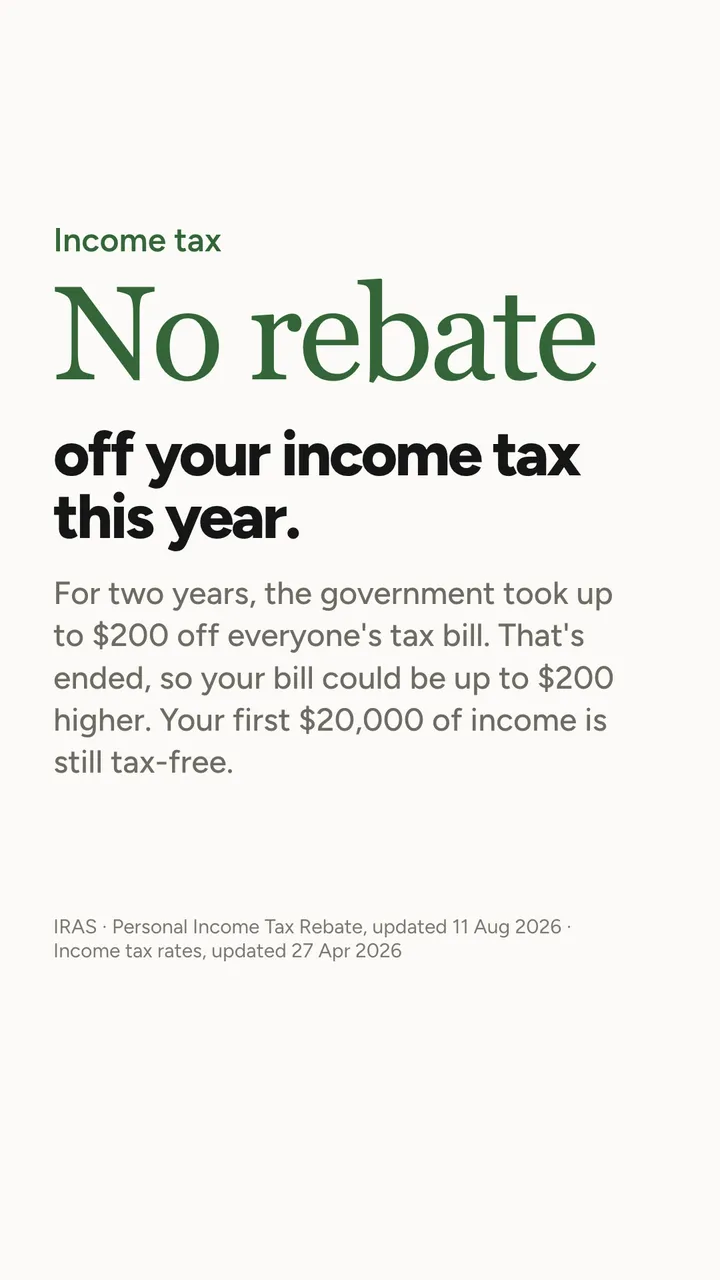
For Year of Assessment (YA) 2024, IRAS took 50% off every tax resident's bill, capped at $200. For YA 2025, it was 60%, again capped at $200. IRAS describes it as a one-off for those two years, and there's no rebate this year. The good news hasn't changed: the first $20,000 of a resident's chargeable income is still taxed at 0%.
A worked example
Say Wei Ling's chargeable income was $60,000 both years. Using IRAS's resident rates:
- First $20,000 at 0%: $0
- Next $10,000 at 2%: $200
- Next $10,000 at 3.5%: $350
- Next $20,000 at 7%: $1,400
- Tax before rebate: $1,950
Last year, 60% of $1,950 is $1,170, but the cap is $200, so she paid $1,750. This year she pays the full $1,950: exactly $200 more for the same income. Someone whose tax was only $150 got 60% of it, $90, off last year, so their bill goes up by $90. That's why the slide says "up to".
What this means for you: if your tax bill went up and your income didn't, this is probably why. Nothing went wrong.
The SRS deadline: 31 December
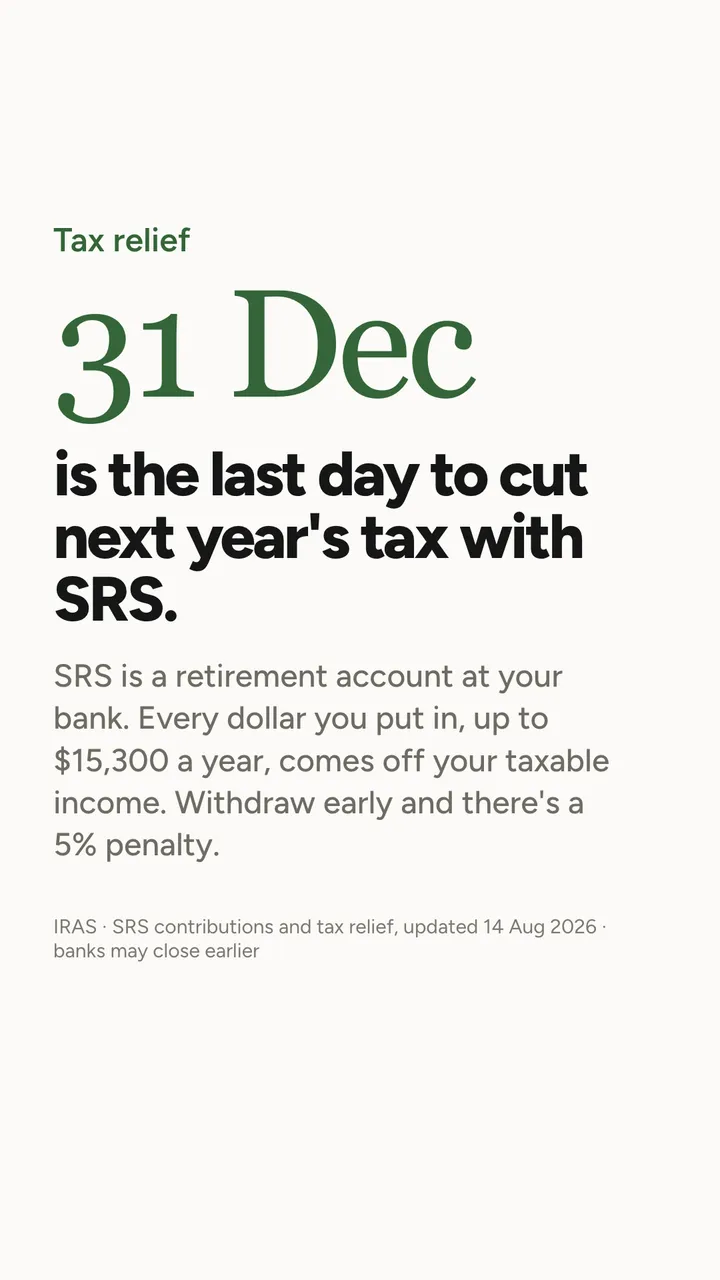
SRS, the Supplementary Retirement Scheme, is a retirement account you open at a bank. Every dollar you put in during the year, up to $15,300 for citizens and PRs ($35,700 for foreigners), comes off next year's chargeable income. Contributions must be made by 31 December, or earlier if your bank sets an earlier cut-off. (Ask me how I know.)
A worked example
Say Wei Ling, with the same $60,000 chargeable income, puts $5,000 into SRS:
- New chargeable income: $60,000 − $5,000 = $55,000
- Tax: $550 on the first $40,000, plus $15,000 × 7% = $1,050
- New tax: $550 + $1,050 = $1,600
- Saving: $1,950 − $1,600 = $350, which is 7%, her top tax rate, of $5,000
The trade-off is at the other end. At the statutory retirement age, only 50% of each SRS withdrawal is taxable. Withdraw before then and there's a 5% penalty. SRS relief also counts towards the $80,000 yearly cap on all personal reliefs.
What this means for you: check your bank's cut-off in November, not on the 30th. Our income tax calculator shows what an SRS contribution would save on your own numbers.
What 2.3% inflation does to your savings
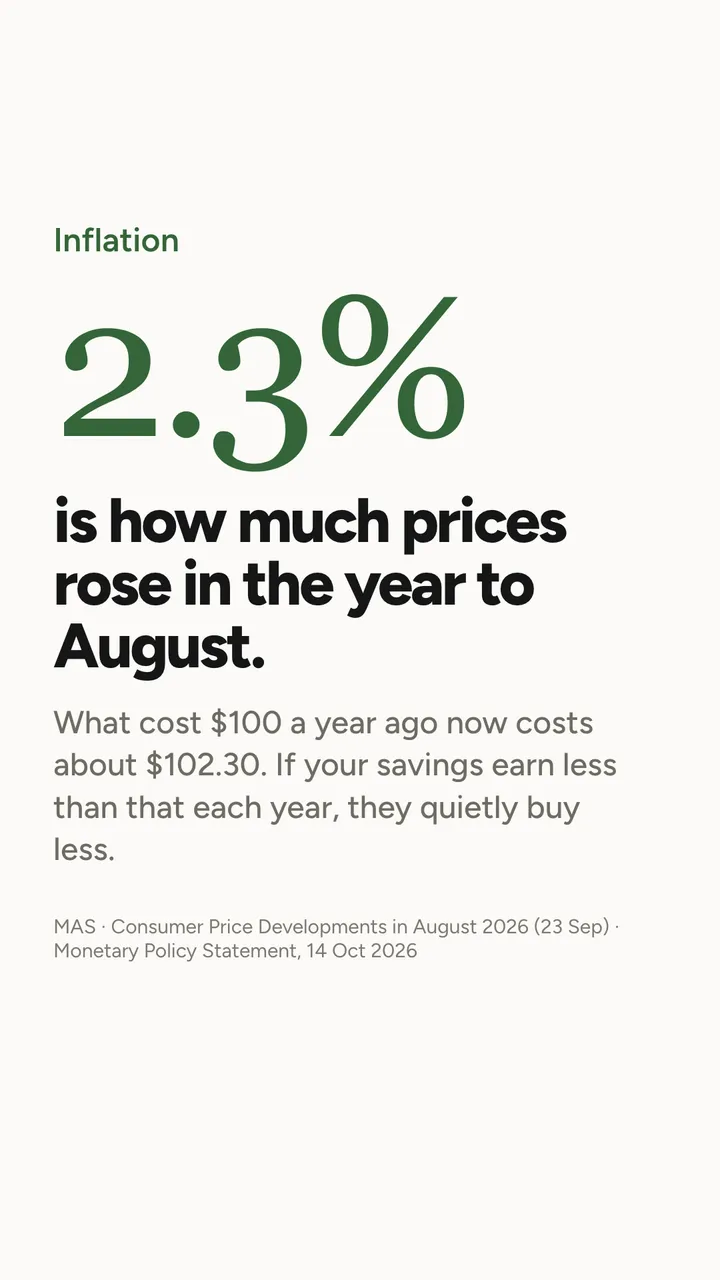
Headline inflation was 2.3% in the year to August, according to MAS's report of 23 September. Inflation is how fast prices rise on average, measured on a basket of things households buy. Put simply, what cost $100 a year ago costs about $102.30 now.
A worked example
Say you have $10,000 in savings earning an illustrative 1% a year:
- After a year: $10,000 × 1.01 = $10,100
- What you'd need to buy the same things: $10,000 × 1.023 = $10,230
- The gap: $10,230 − $10,100 = $130 of buying power lost
The balance went up. What it can buy went down.
What this means for you: compare what your savings earn with the latest inflation figure, not last year's. MAS publishes it every month, so by the time you read this there may be a newer number on its site.
How much of your savings is protected if a bank fails
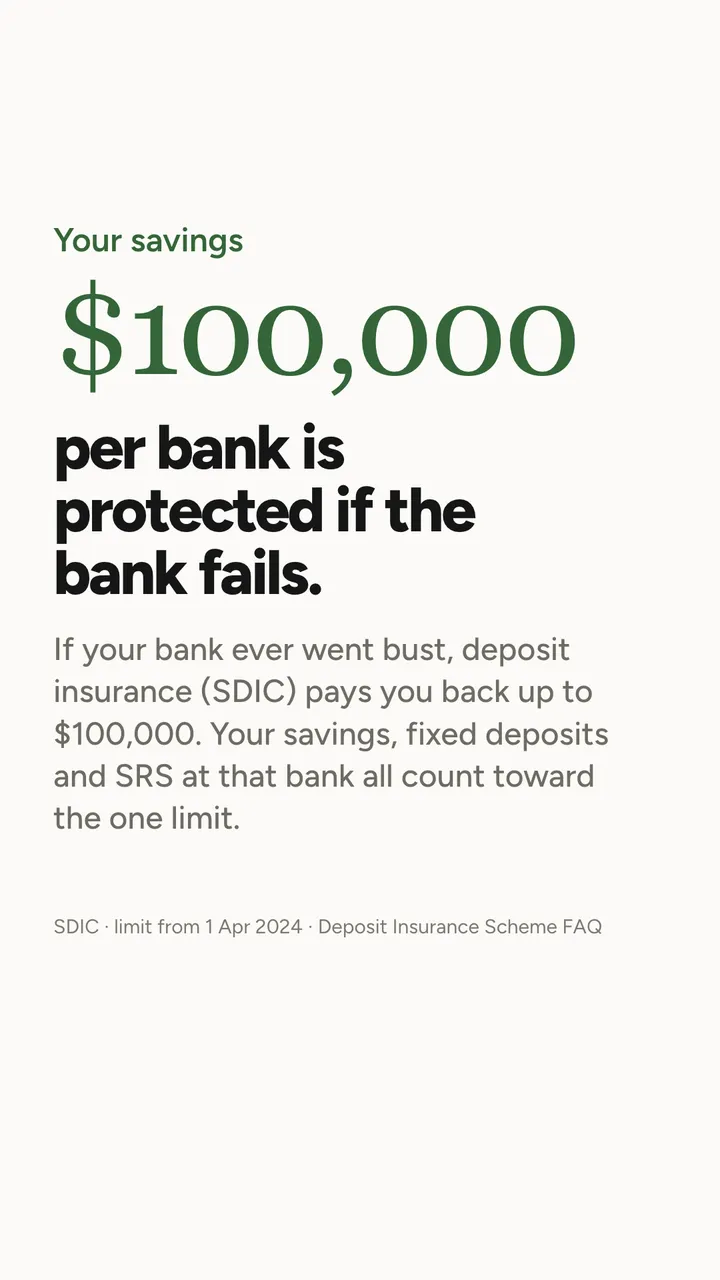
If a bank ever failed, the Singapore Deposit Insurance Corporation (SDIC) would pay you back up to $100,000 of your insured deposits there. The limit is per depositor, per bank. Your savings, current account, fixed deposits and SRS at the same bank all share that one $100,000. It doesn't cover foreign currency deposits, structured deposits or investments like shares and unit trusts.
Two worked examples
- You have $130,000 in SGD savings and fixed deposits at one bank. $100,000 is insured and $30,000 isn't.
- SDIC's own example for joint accounts: a $90,000 joint account counts as $45,000 for each holder. If one holder also has $60,000 in their own account at the same bank, that's $105,000, of which $100,000 is covered.
What this means for you: this only matters once you're near $100,000 at one bank, but that can happen faster than you think if your salary, savings and SRS all sit in the same place. Add it up per bank, not in total.
Scam losses, and what Money Lock does
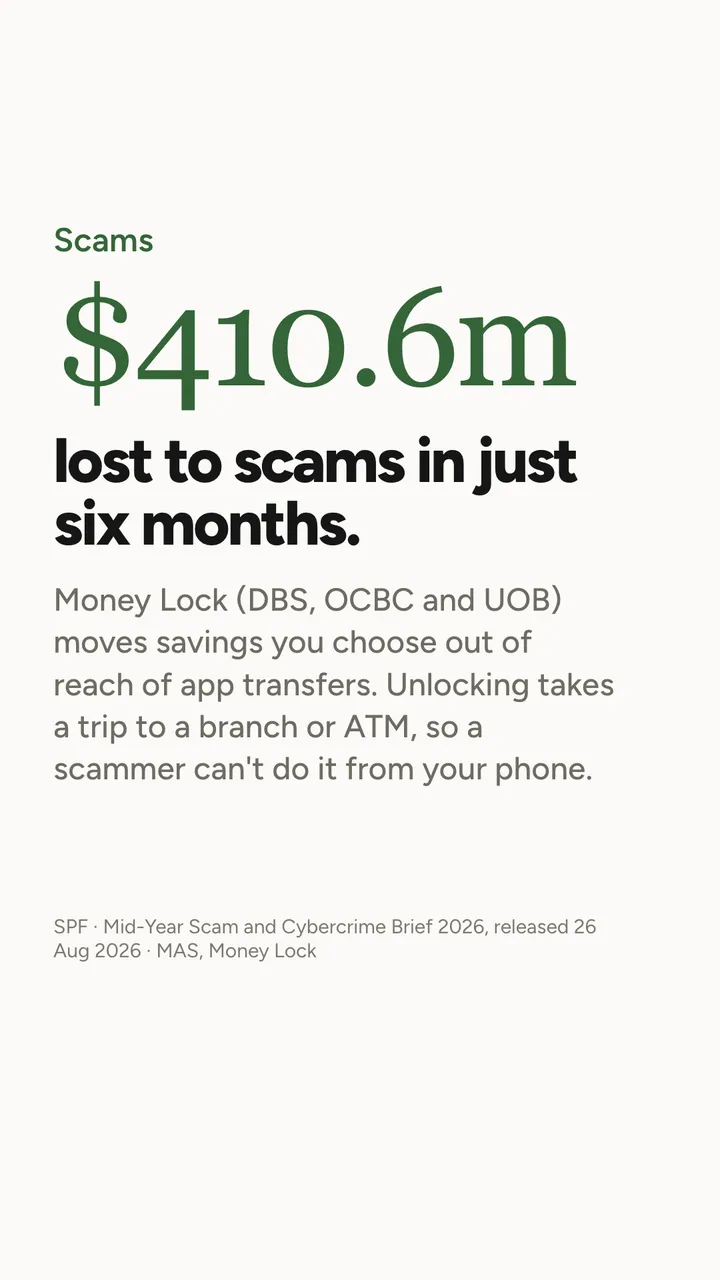
$410.6 million was lost to scams in the first half of 2026, according to the Singapore Police Force. The three local banks offer Money Lock, which moves the savings you choose out of reach of digital transfers. Unlocking it takes a trip to a branch or ATM, so a scammer can't do it from your phone.
An illustration
Say you have $25,000 in savings and lock $20,000 of it. The other $5,000 works as normal in your app for daily spending. The $20,000 can't be sent anywhere from a phone, by you or anyone else, until you unlock it in person.
I set this up after a scam call that sounded convincing for a few seconds longer than I'd like to admit. It doesn't stop you from being talked into sending money yourself, but it does put that pot out of reach of anyone who gets into your banking app.
What this means for you: decide how much you actually need to move quickly, and think about whether the rest needs to be one tap away.
The new CPF wage ceiling: $8,000
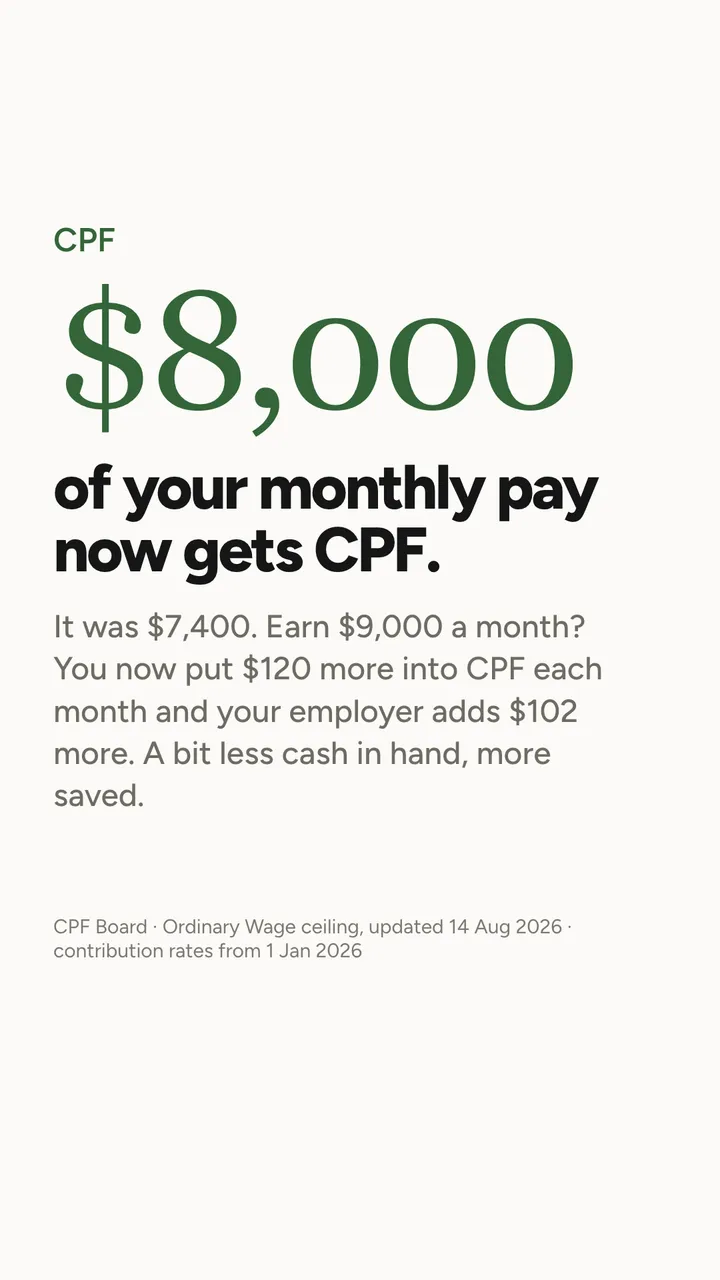
CPF contributions apply only up to a cap on your monthly pay, called the Ordinary Wage ceiling. It went up from $7,400 to $8,000 on 1 January 2026.
A worked example
Say you're 55 or below and earn $9,000 a month:
- Before: contributions on $7,400. You: $7,400 × 20% = $1,480. Employer: $7,400 × 17% = $1,258.
- Now: contributions on $8,000. You: $8,000 × 20% = $1,600. Employer: $8,000 × 17% = $1,360.
- The change: you put in $120 more, and your employer adds $102 more, every month.
That's $222 a month, or $2,664 a year, more into your CPF. A bit less cash in hand, a bit more saved.
What this means for you: if your take-home pay dipped in January with no change in salary, this is likely why. If you earn under $7,400, nothing changed for you.
How much MediSave can hold in 2026
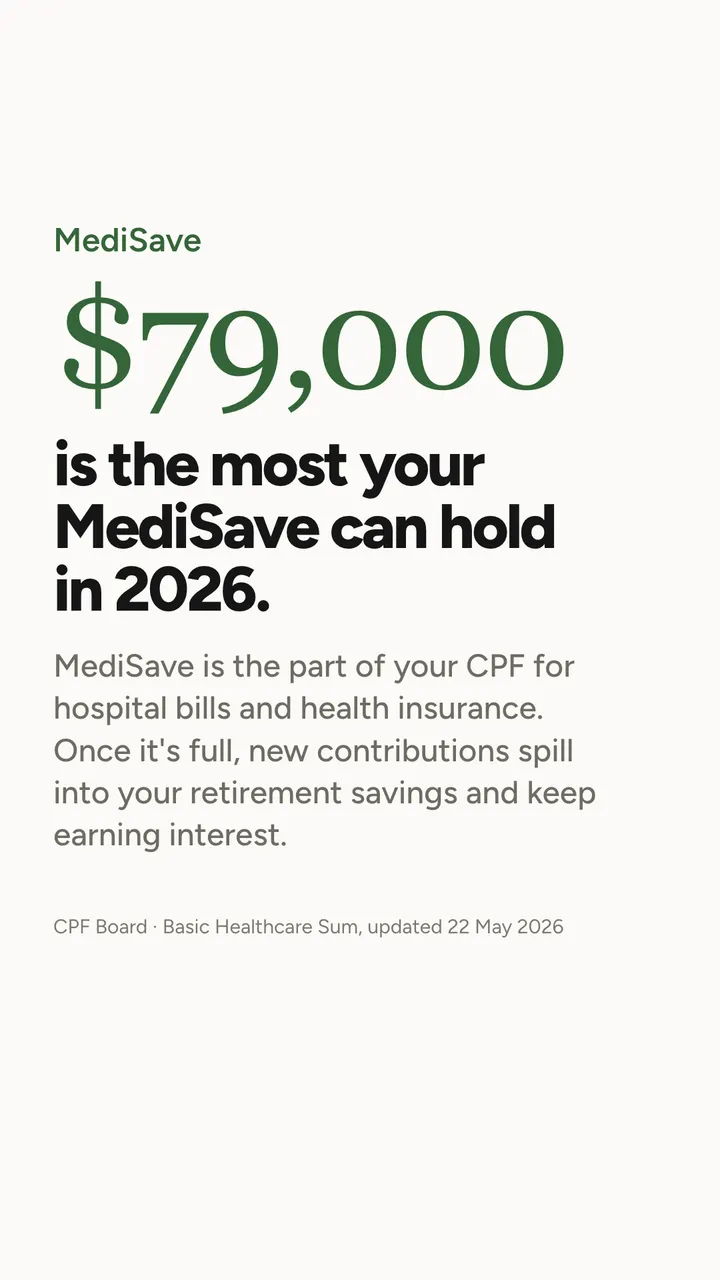
MediSave is the part of your CPF for hospital bills and approved medical insurance. The most it can hold is the Basic Healthcare Sum (BHS), which is $79,000 in 2026. It's adjusted every year until you turn 65, then fixed for life. Once your MediSave is full, new MediSave contributions flow into your other CPF accounts and keep earning interest there.
An illustration
Say your MediSave is already at $79,000 and $480 of MediSave contribution arrives this month. Instead of going into MediSave, that $480 goes into your other CPF accounts. Then if a premium of, say, $300 is paid from MediSave, the balance drops to $78,700 and has $300 of room again.
What this means for you: if your MediSave is near the cap, more of your monthly CPF is building your retirement savings than the usual split suggests. If the four accounts are still a blur, our CPF calculator shows where your contributions go each month.
Singapore dividends: 0% tax
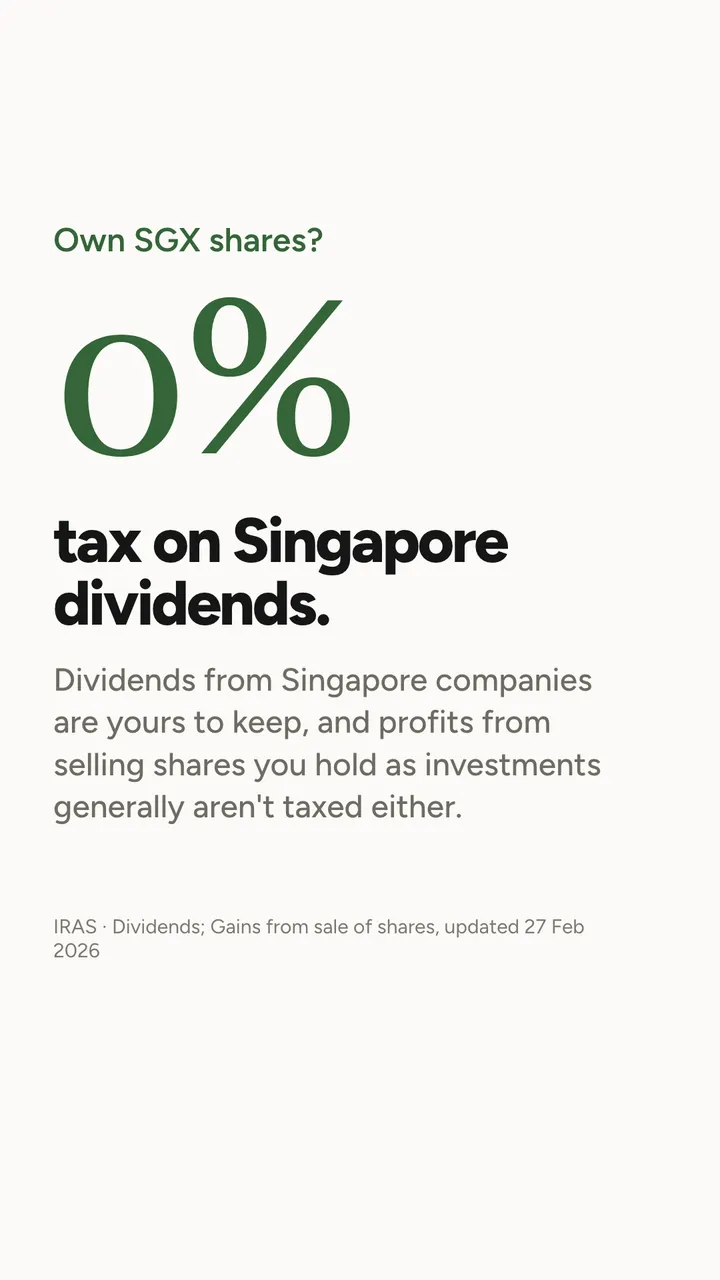
Dividends from Singapore companies are yours to keep, and profits from selling shares you hold as investments generally aren't taxed either. A dividend is the share of profit a company pays out to its shareholders.
An illustration
Say you hold SGX shares that pay $500 in dividends this year. You receive $500, and you don't declare it as income. (REIT payouts work a little differently; I covered them in what is a REIT.)
What this means for you: this is one reason the tax side of investing looks different depending on where a company is listed. Which brings us to the next one.
US shares: dividend tax and estate tax
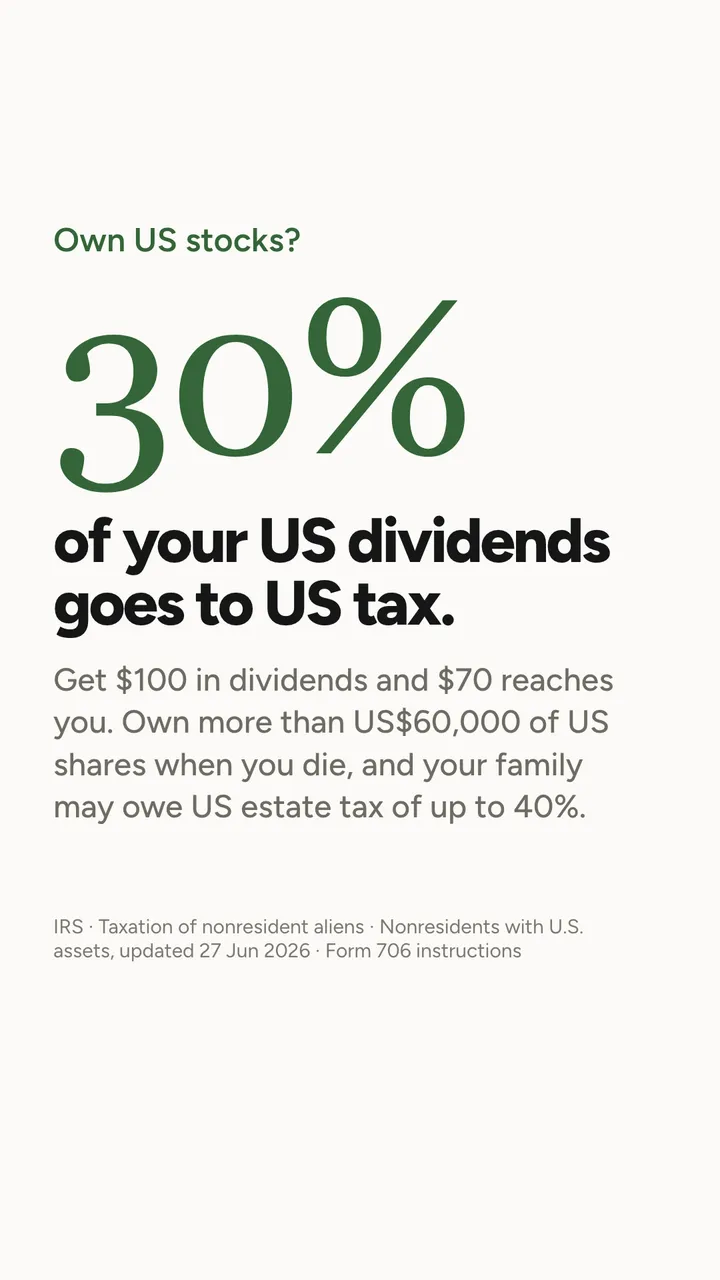
If you hold US shares as a Singapore resident, the US takes 30% of the dividend before it reaches you. This is called withholding tax: it's taken at source, so you never see it.
A worked example
Say your US shares pay US$2,000 in dividends in a year:
- Withheld: US$2,000 × 30% = US$600
- What reaches you: US$2,000 − US$600 = US$1,400
The less-known one is estate tax. If you own more than US$60,000 of US assets, such as US shares, when you die, your family may owe US estate tax of up to 40%. Not a cheerful thought, but a useful one to know about.
What this means for you: if you hold US shares, add up their value now and then. US$60,000 is a line people cross without noticing.
ABSD on a second home: 20%
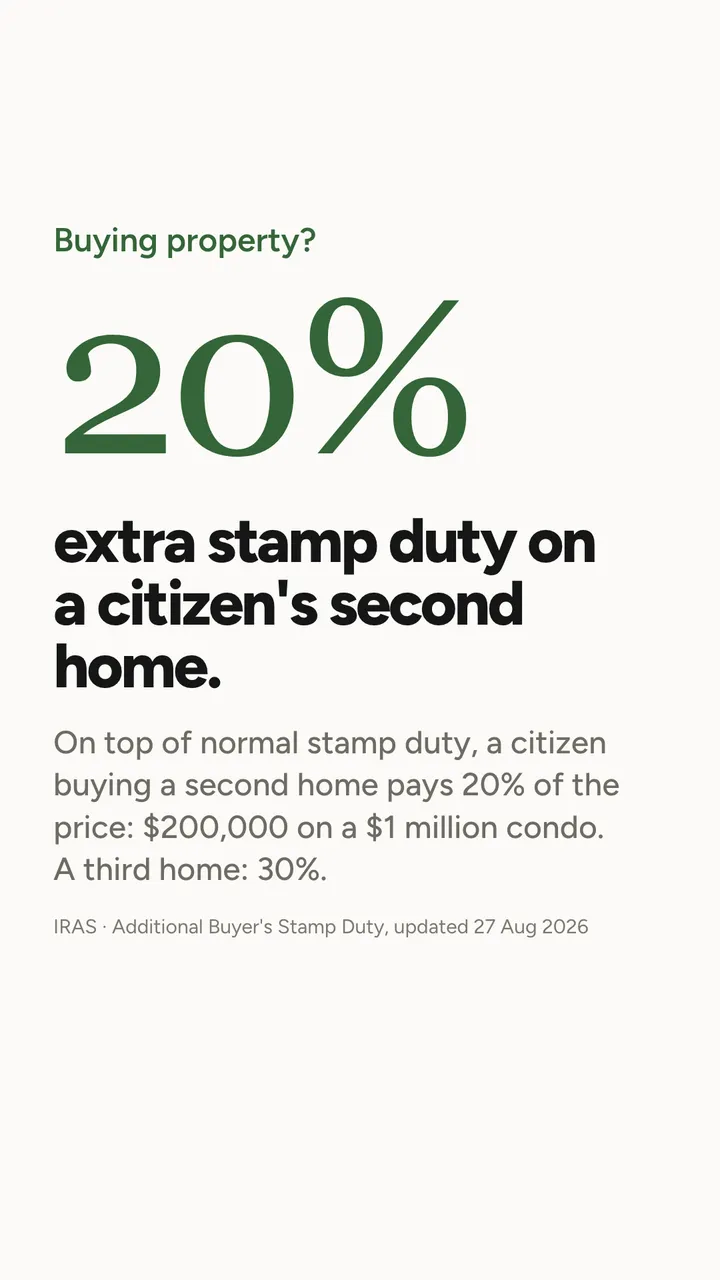
Additional Buyer's Stamp Duty (ABSD) is paid on top of normal stamp duty when you buy residential property. For a Singapore citizen, it's 20% on a second home and 30% on a third and beyond.
A worked example
- A citizen buying a $1 million condo as a second home: $1,000,000 × 20% = $200,000 in ABSD
- The same condo as a third home: $1,000,000 × 30% = $300,000
- Both before the normal buyer's stamp duty, which is separate
What this means for you: ABSD depends on what you already own at the moment you buy, so it shapes the whole plan, not just the final bill. If you're thinking about keeping one home and buying another, IRAS's ABSD page explains how your existing property is counted. (A citizen's first home carries no ABSD.)
Who got $850 from the GST Voucher
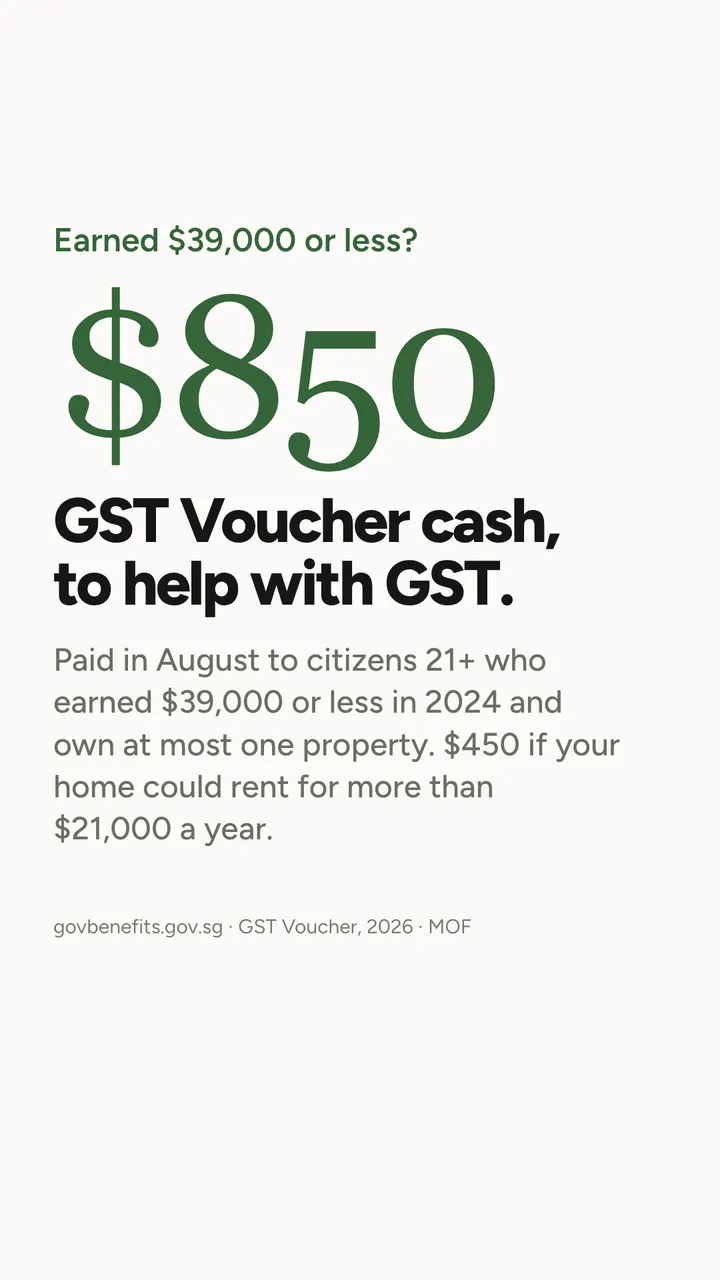
The GST Voucher cash went out in August to citizens aged 21 and above who earned $39,000 or less in 2024 and own at most one property. It's $850 if your home's annual value (roughly what it could rent for in a year) is up to $21,000, and $450 if it's above that, up to $31,000.
An illustration
Say Mdm Lee is 62, earned $30,000 in 2024, and owns one flat with an annual value of $18,000. She qualifies on income ($30,000 is under $39,000), on property (one home), and her annual value is under $21,000, so she gets $850. If her home's annual value were $25,000, she'd get $450.
What this means for you: this is worth checking for parents and grandparents, who are often the ones it's for. The amount depends on income two years back and on the home's annual value, so knowing both answers most questions.
Support if you lose your job
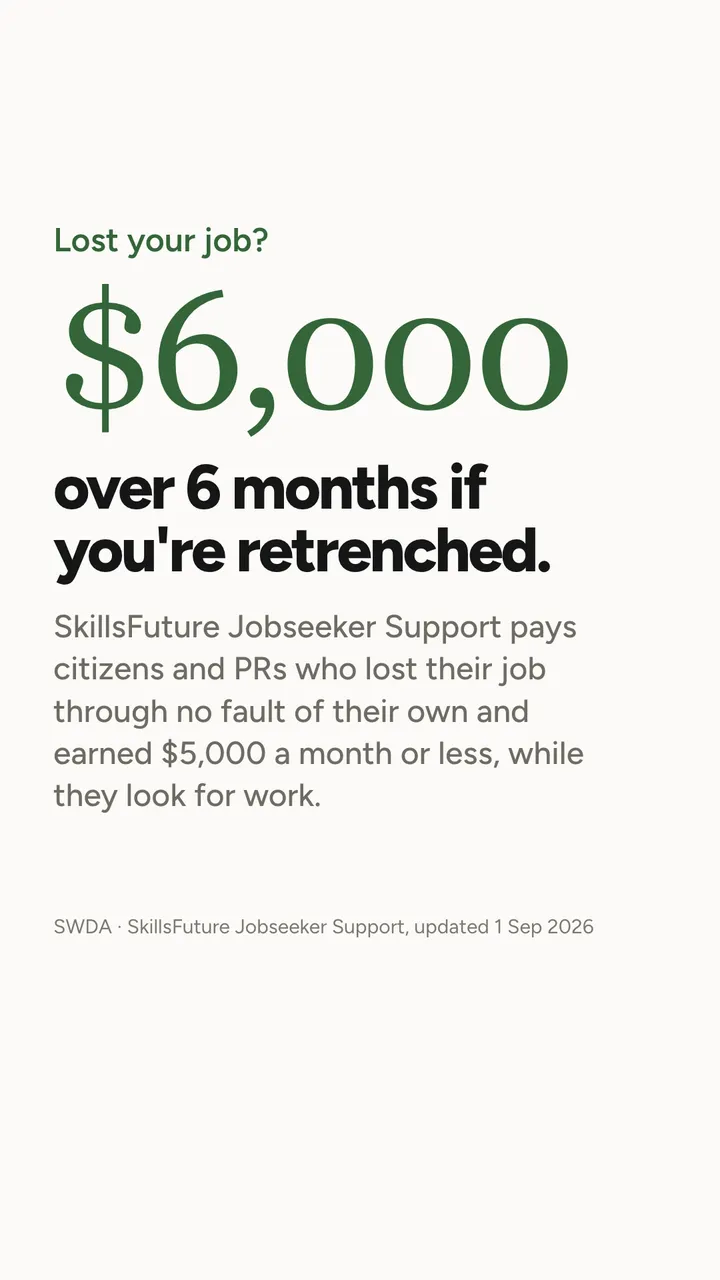
SkillsFuture Jobseeker Support pays up to $6,000 over six months to citizens and PRs who lost their job through no fault of their own, such as retrenchment, and earned $5,000 a month or less. Payouts are tied to job search activities, like career coaching or sending applications, while you look for work.
Spread evenly, $6,000 over six months would be $1,000 a month, though the scheme's own page sets out how the payouts are actually paced.
What this means for you: it's a bridge, not a replacement salary. If you're building an emergency fund, it's one more piece of the picture, not a reason to keep less aside.
If you only remember three things
- 31 December is a hard deadline for SRS relief, and your bank's cut-off may be earlier.
- $100,000 is per bank. Add up your savings, fixed deposits and SRS at each bank separately.
- Your tax bill may be up to $200 higher this year because the rebate ended, not because anything went wrong.
How I keep track of this
I'll be honest: I wrote these down because I can't keep them all in my head either. Most of them only matter when something in your own money crosses a line. More than $100,000 at one bank. MediSave near its cap. US shares creeping past US$60,000. December arriving before your SRS top-up does.
What helps me is seeing everything in one place. In Sum, my banks, cards, CPF and loans sit in one net worth, which is free to start, so I can see the balance at each bank and my CPF accounts side by side. The tax relief optimiser, and stocks and crypto in your net worth, are on the Essential plan; property valuation is on Pro. Spotting which of these twelve lines apply to me is still my job, but it's a lot easier when the numbers aren't spread across six apps.
Which of the twelve was new to you? Tell me at [email protected]. I'm collecting them for next year's list.
Talk soon, Brandon
Try the numbers yourself

Sum is launching in Singapore soon.
Your banks, cards, CPF and HDB flat, added up into one net worth. Statements sorted, card caps tracked, bills remembered.
Brandon · Finance team, Sum
Brandon is on Sum's finance team in Singapore. Brandon reads the CPF Board, IRAS and MAS updates so you don't have to, and turns our carousels into the longer version. Questions, corrections or something to share? Email Brandon at [email protected].
Got something interesting to share?
A money story, a question, something we got wrong, or a tip other Singaporeans should hear. Reach out to me at [email protected], or leave your email and I'll write to you.
Sources: IRAS: Personal Income Tax Rebate; IRAS: Individual income tax rates; IRAS: SRS contributions and tax relief; MAS: Consumer Price Developments in August 2026 (23 Sep 2026); SDIC: Deposit Insurance Scheme FAQ; SPF: Mid-Year Scam and Cybercrime Brief 2026 (26 Aug 2026); MAS: Oral reply to Parliamentary Question on Money Lock; CPF Board: What is the Ordinary Wage (OW) ceiling?; CPF Board: CPF contribution rates from 1 Jan 2026; CPF Board: What is the Basic Healthcare Sum?; IRAS: Dividends; IRS: Taxation of nonresident aliens; IRS: Some nonresidents with U.S. assets must file estate tax returns; IRAS: Additional Buyer's Stamp Duty (ABSD); govbenefits.gov.sg: GST Voucher; SkillsFuture Jobseeker Support.
Any app screens shown use sample data, not a real person's. Sum is free to start; some features need a paid plan.
Information only, not financial advice.