What is a REIT? The mall you shop in might be one
What a REIT is, which Singapore malls and hospitals REITs own, how distributions work with a worked example, the risks, and how to buy with cash, SRS or CPF.

A few Saturdays ago I was riding the long escalator at Plaza Singapura on the way to dinner, holding a bag of groceries, when it occurred to me that I had no idea who actually owned the building. Not the shops. The building itself.
The answer is a trust listed on SGX, and anyone with a brokerage account can buy a small piece of it. Some of its owners were probably on the escalator with me, also holding groceries, also not thinking about it.
That's a REIT. It's one of the most talked-about investments in Singapore, and also one of the most misunderstood. I've heard REITs described as "like a fixed deposit, but better", which they are not, and as "only for rich people", which they also are not. So let's go through it properly, one slide at a time: what a REIT is, which places you know are owned by one, how the payouts work (with a worked example of an imaginary unitholder), how big the market is, the risks, and how people buy them. No recommendations, just how it works.
What is a REIT? Another way to invest
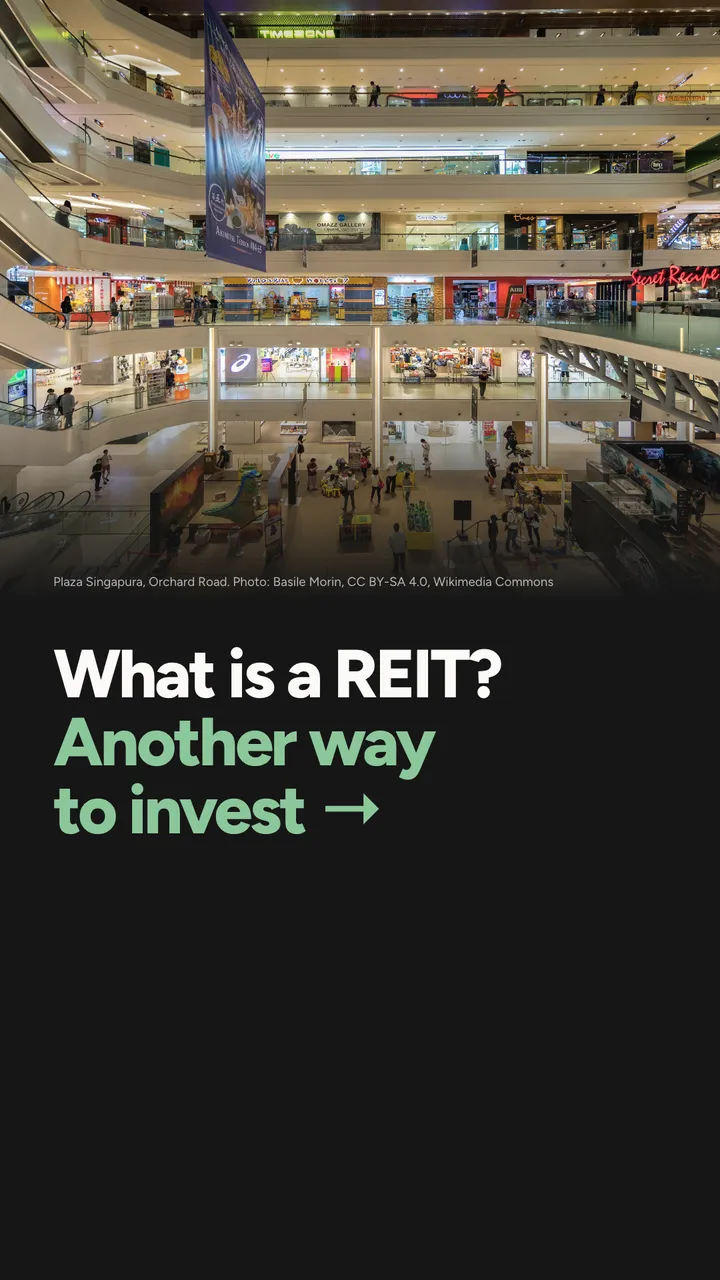
Most of us grow up with two ways of thinking about property. You own your home, usually an HDB flat, or you rent. A REIT is a third way: owning a small slice of property that earns rent from other people, without buying a building yourself.
That matters because commercial property is otherwise out of reach for almost everyone. Nobody I know is buying a shopping mall. But almost anyone can buy a few hundred dollars' worth of the trust that owns one.
What this means for you: a REIT isn't a replacement for your home or your savings. It's a different kind of investment, with its own rules, and the rest of this post is about those rules.
What a Real Estate Investment Trust actually is
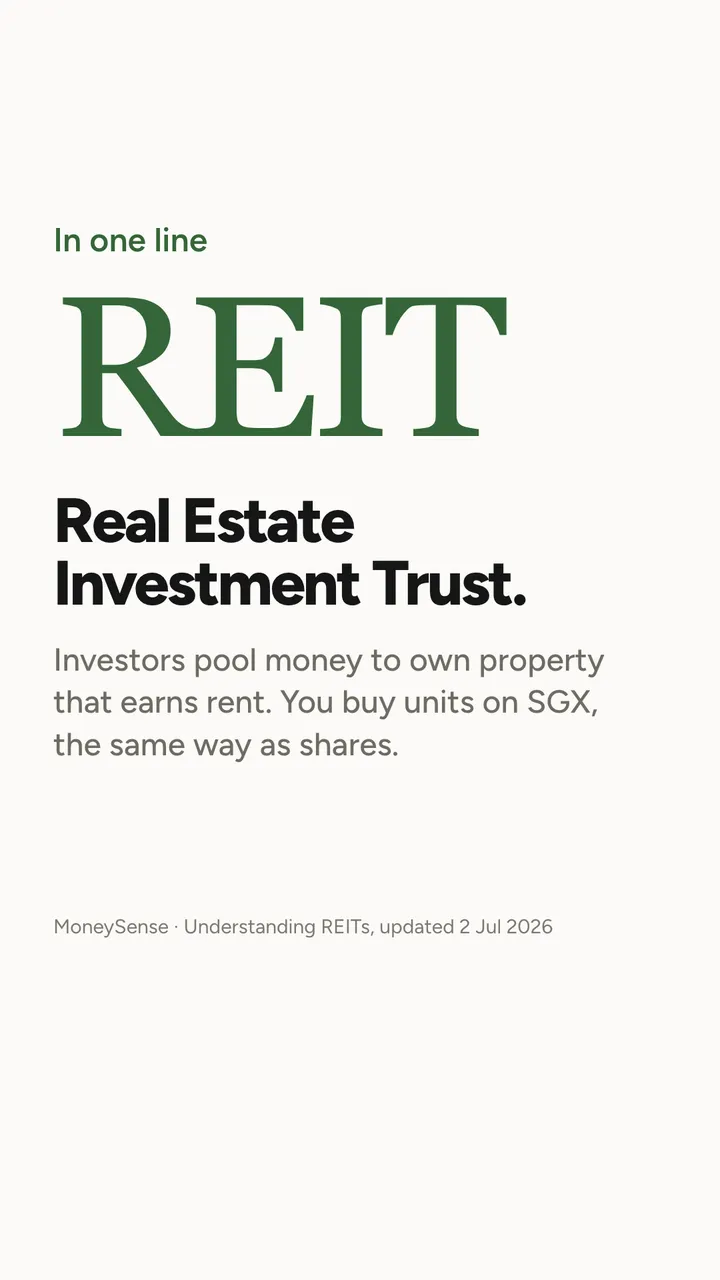
REIT stands for Real Estate Investment Trust. Instead of one person buying a whole mall or office tower, lots of investors pool their money into a trust that owns property earning rent: malls, offices, hospitals, warehouses. That's the definition MoneySense, the government's financial education site, uses.
A few people are involved, and it helps to know who does what:
- The unitholders are the investors. You own units in the trust, the REIT version of shares.
- The REIT manager sets and runs the strategy: which properties to buy or sell, and how to fund them.
- The sponsor is usually the property group that set the REIT up. MoneySense notes the sponsor usually also owns stakes in the REIT manager and the REIT.
- The trustee holds the properties on behalf of unitholders.
You buy units on SGX, the Singapore Exchange, exactly the way you'd buy shares in a company, through a brokerage account. Their price moves up and down during the trading day like any share.
How the money flows
Here's the chain in plain terms. You buy a bowl of ramen at a mall. The ramen shop pays rent to the mall's owner, the REIT. The REIT pays its costs (property management, maintenance, interest on its loans, the manager's fees) and passes most of what's left to unitholders as distributions.
What this means for you: when you look at a REIT, you're really looking at a landlord. The questions worth asking are landlord questions: who are the tenants, how full are the buildings, and how much has it borrowed?
You've probably been inside a REIT this week
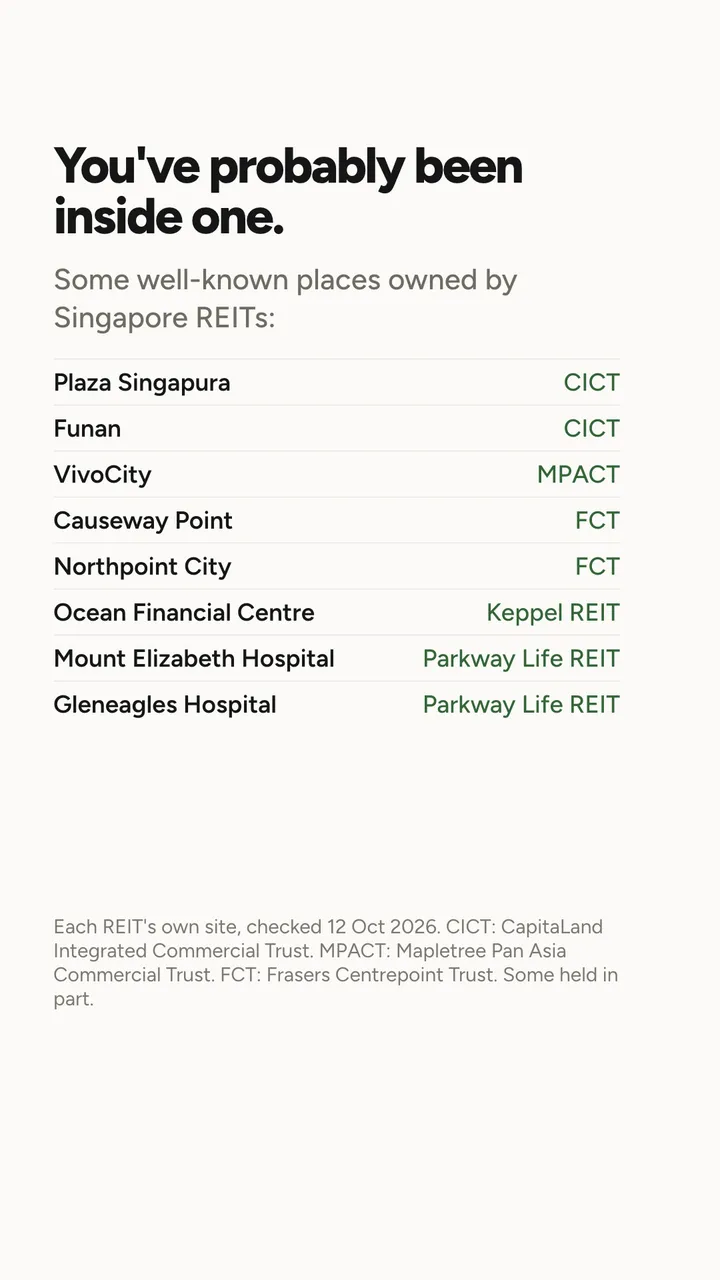
This is my favourite slide in the set, because it makes REITs feel a lot less abstract. Here are some places Singapore REITs own, checked on each REIT's own site on 12 October 2026:
| Place | What it is | Owned by |
|---|---|---|
| Plaza Singapura | Mall, Orchard Road | CapitaLand Integrated Commercial Trust (CICT) |
| Funan | Mall, City Hall | CapitaLand Integrated Commercial Trust (CICT) |
| VivoCity | Mall, HarbourFront | Mapletree Pan Asia Commercial Trust (MPACT) |
| Causeway Point | Mall, Woodlands | Frasers Centrepoint Trust (FCT) |
| Northpoint City | Mall, Yishun | Frasers Centrepoint Trust (FCT) |
| Ocean Financial Centre | Office tower, Raffles Place | Keppel REIT (79.9% of it) |
| Mount Elizabeth Hospital | Hospital | Parkway Life REIT |
| Gleneagles Hospital | Hospital | Parkway Life REIT |
When I first saw this list I realised I'd been inside almost all of them: Funan for a laptop charger, VivoCity before a Sentosa day out, a hospital visit to a relative. That's the point of the slide. These aren't distant assets; they're places you walk through.
Some of these are part stakes, like Keppel REIT's 79.9% of Ocean Financial Centre. That means Keppel REIT receives roughly that share of the building's net income, not all of it.
Notice the variety, too. A mall earns from shops and restaurants. An office tower earns from companies on long leases. A hospital earns from an operator. Each behaves differently when the economy changes.
What this means for you: naming who owns what is just a fact, not a hint about which REIT to buy. A well-known mall doesn't automatically make a good investment; the price you pay and the trust's finances matter just as much.
Why REITs pay out so regularly: the 90% rule
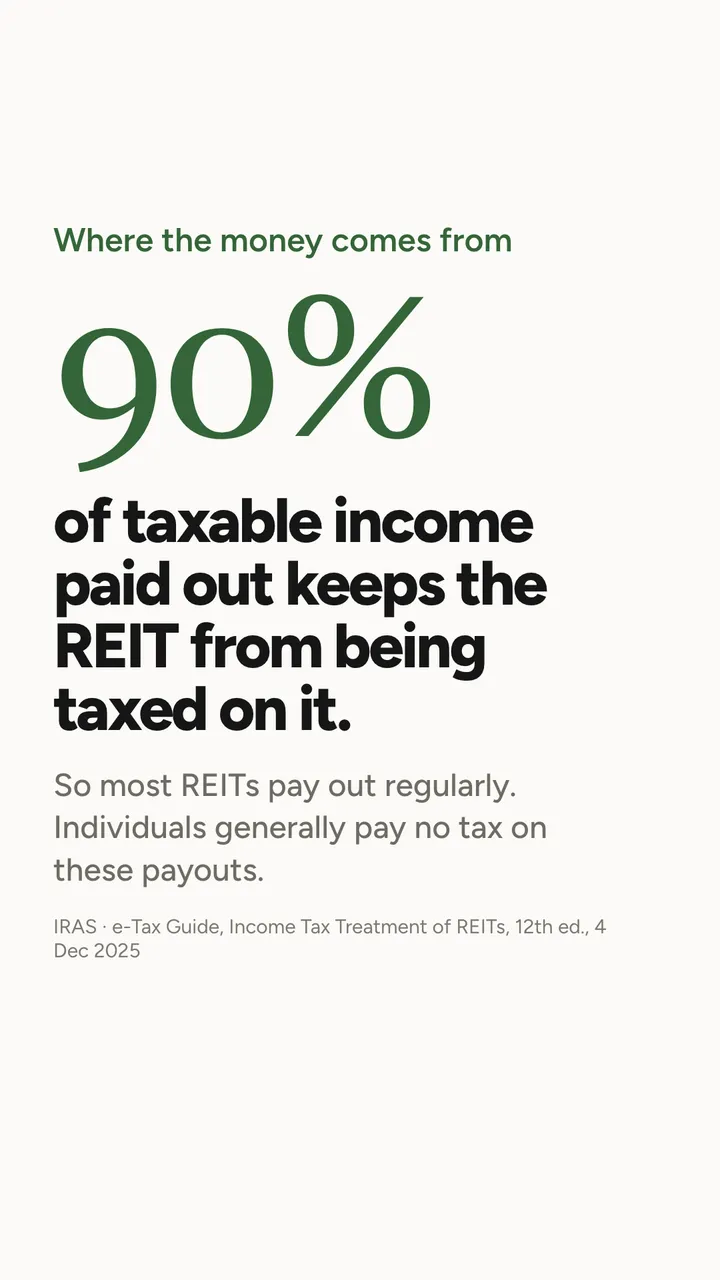
This is the bit most people don't know. Under IRAS rules, if a REIT pays out at least 90% of its taxable income to unitholders, the REIT itself isn't taxed on that distributed income. MoneySense calls this "tax transparency". So most REITs do exactly that, and pay out regularly.
On the receiving end, individuals generally pay no income tax on these payouts. (Technically they're called distributions rather than dividends, but most people use the words interchangeably.)
That's why REITs have a reputation as "the investment that pays you". The reason is a tax rule, not magic.
A worked example: Wei Ling's first distribution
Let's follow an imaginary unitholder. Every number here is made up to show the arithmetic; it isn't a typical or expected payout for any real REIT.
Say Wei Ling buys 1,000 units of "Example Mall Trust" at S$2.00 a unit.
- Her cost: 1,000 x S$2.00 = S$2,000 (plus brokerage fees).
- The trust announces a distribution per unit (DPU) of 3.0 cents for the half-year.
- Her payout: 1,000 x S$0.03 = S$30.
- If the next half-year's DPU is also 3.0 cents, she receives S$60 over the year.
- Her distribution yield on what she paid is S$60 / S$2,000 = 3% a year.
A few things that confused me the first time I read a distribution notice:
- Ex-date: if you buy on or after this date, you don't get the coming distribution. Wei Ling has to own her units before it. Unit prices often drop by around the distribution amount on the ex-date, because new buyers aren't getting it.
- Payment date: when the money actually lands, often weeks later.
- DPU is in cents, per unit. It's easy to misread "3.0 cents" as 3%. They're very different numbers.
Many Singapore REITs pay every quarter or every half-year, and the amount changes each time. MoneySense says plainly that distributions aren't guaranteed and move with the REIT's income.
What this means for you: the "yield" you see quoted is past payouts divided by today's price. It describes what was paid, not what will be paid.
How big is Singapore's REIT market?
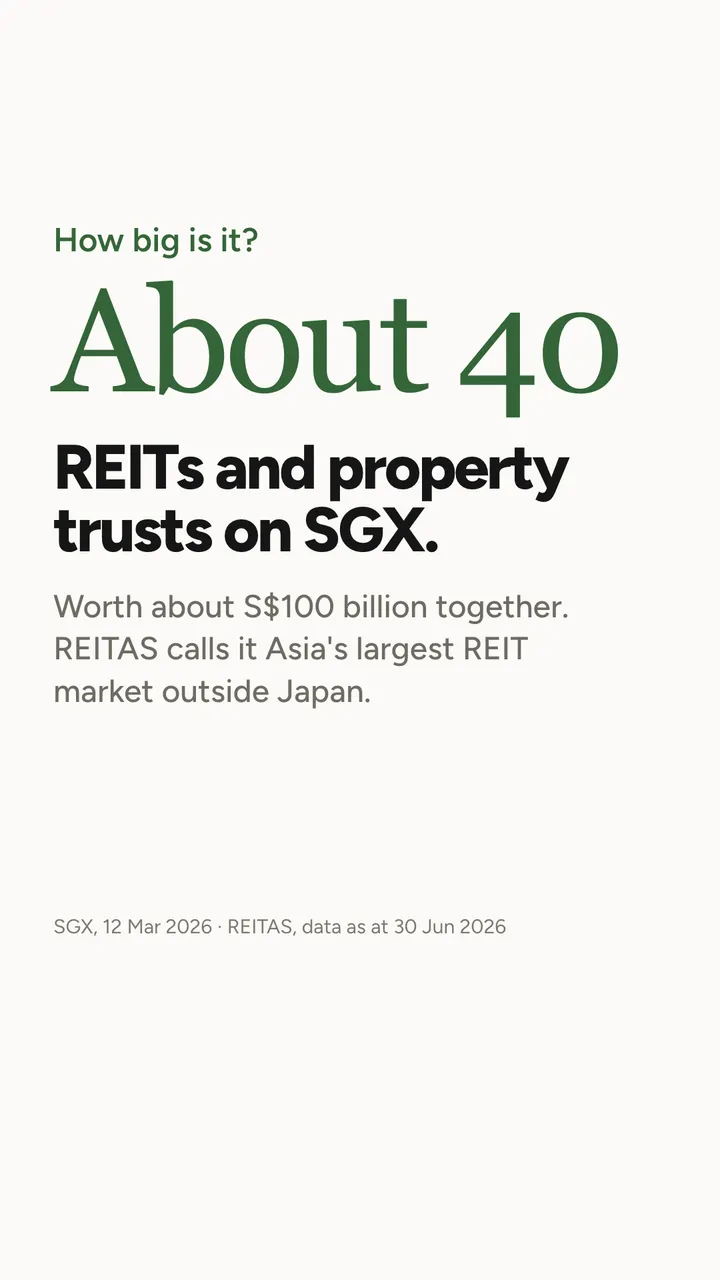
Bigger than most people expect. SGX counted 42 REITs and property trusts in March 2026, and REITAS, the REIT Association of Singapore, counted 39 traded as at 30 June 2026. The two counts differ slightly because they were taken at different times and count slightly different things. Either way, it's about 40, worth roughly S$100 billion together. REITAS calls it Asia's largest REIT market outside Japan.
Quick arithmetic: S$100 billion across about 40 trusts is an average of roughly S$2.5 billion each. In practice they vary a lot in size, from trusts with one or two buildings to ones that own dozens.
Many Singapore REITs also own property overseas. Frasers Logistics & Commercial Trust, for example, owns warehouses and offices in Australia, Europe, Singapore and the UK. So "Singapore REIT" means listed in Singapore, not necessarily owning buildings here.
What this means for you: before you assume a REIT is a bet on Singapore property, check where its buildings actually are. The annual report lists every one.
The risks: payouts and prices can both fall
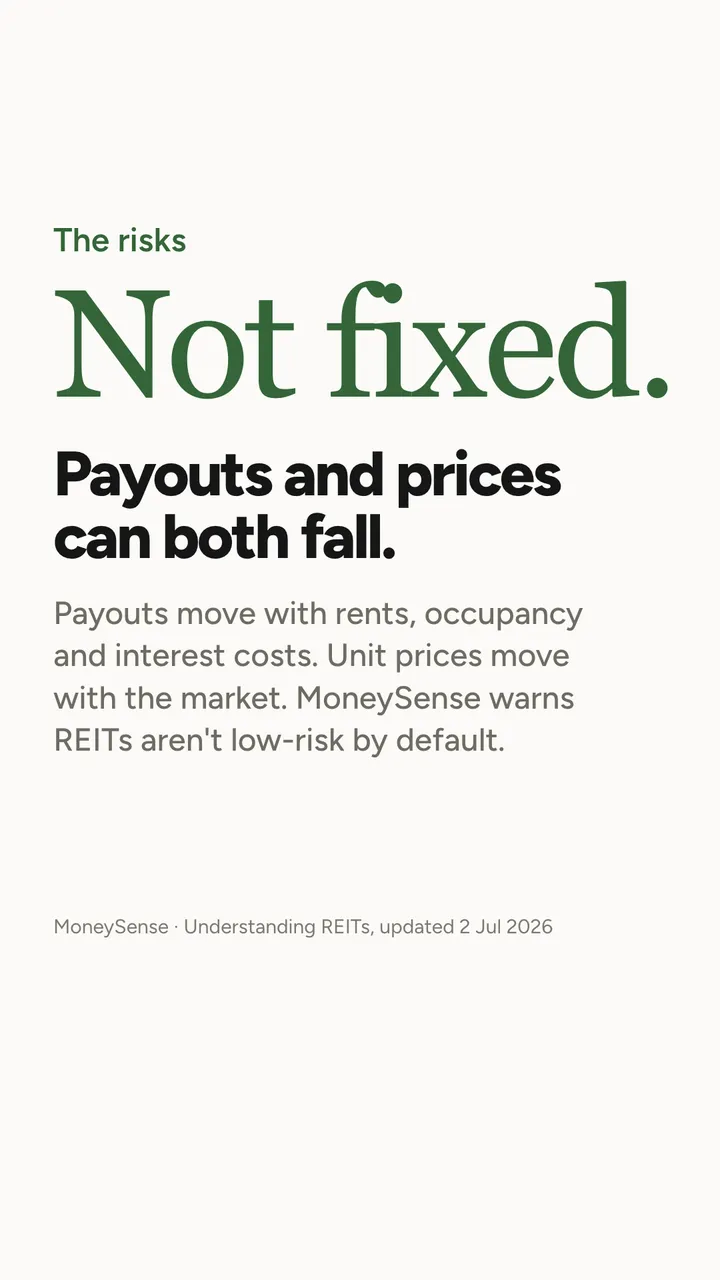
A REIT is not a fixed deposit. Two things can go down.
The payout
It moves with rents, with occupancy (how much of the space is actually let), and with interest costs, because REITs borrow money to buy property. MoneySense points out that a higher cost of debt can reduce distributions, and that refinancing can cost more when loans come up for renewal. There are also fees: most REITs pay manager's fees, property manager's fees and trustee's fees, and some managers charge fees when buying or selling properties.
Back to Wei Ling, with more made-up numbers. Say a big tenant leaves, occupancy falls, and interest costs rise. The next DPU comes in at 2.5 cents instead of 3.0.
- Her payout drops from S$30 to 1,000 x S$0.025 = S$25.
- That's a cut of about 17%, from one bad half-year.
The unit price
REIT units trade on the stock market, so their prices go up and down like shares. If Example Mall Trust's price falls 10%, from S$2.00 to S$1.80, Wei Ling's 1,000 units are worth S$1,800. Her S$30 distribution doesn't come close to covering a S$200 fall in value.
You can see this in any ordinary week. In the week of 12 to 16 October 2026, Frasers Logistics & Commercial Trust rose 1.7% and made the STI's top five that week, while Mapletree Pan Asia Commercial Trust fell 3.4% over the same five days. Two REITs, same week, opposite directions.
MoneySense puts it plainly: don't assume REITs are low risk, or that their income is recurring.
What this means for you: the most common mistake I hear is judging a REIT only by its yield. A high yield can simply mean the price has fallen, sometimes for a good reason. Look at occupancy, borrowing and fees alongside it.
How to start: board lots, odd lots, cash, SRS or CPF
Board lots and odd lots
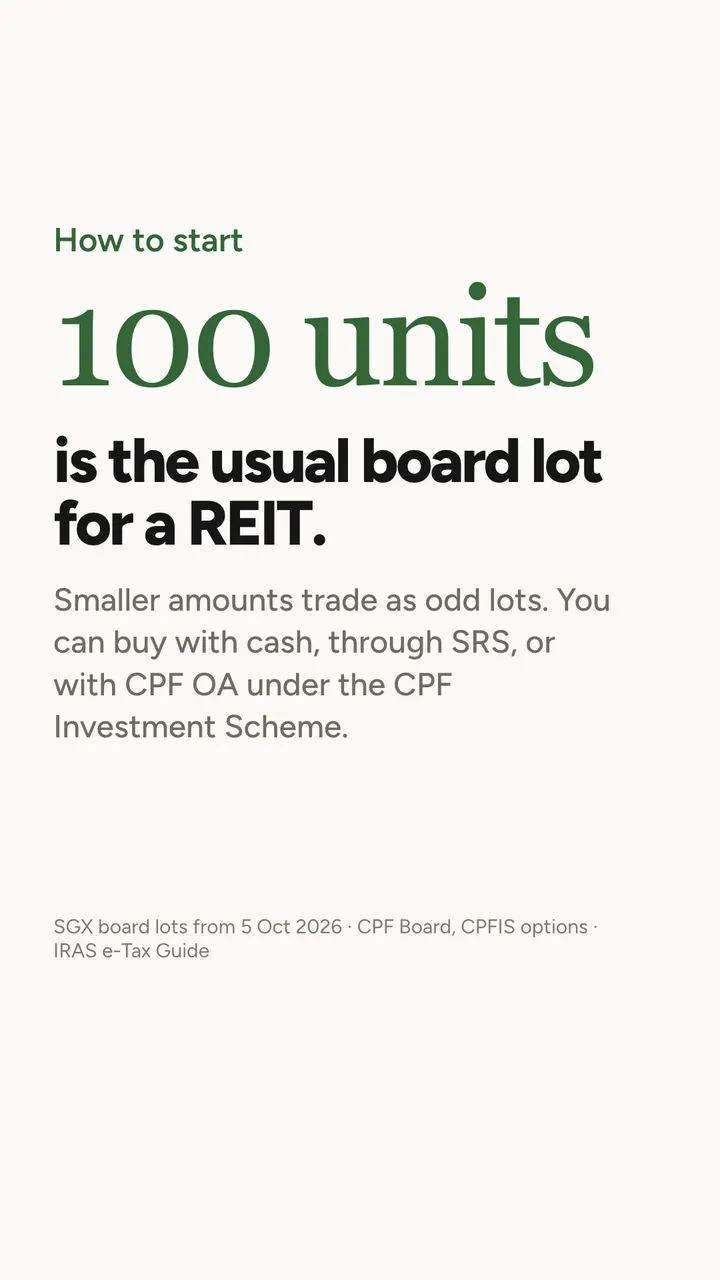
- Board lot: the standard trading size on SGX. Since 5 October 2026, it's 100 units for anything priced up to S$10, which is why 100 units is the usual board lot for a REIT.
- Odd lot: anything smaller than a board lot. You can still buy and sell odd lots; they just trade separately.
With our made-up Example Mall Trust at S$2.00, one board lot is 100 x S$2.00 = S$200. If Wei Ling wanted exactly S$250 worth, she could buy a board lot plus an odd lot of 25 units. In practice brokers charge a minimum fee per trade, so very small orders can lose a noticeable share to fees.
Three common ways to pay
- Cash, through any brokerage account. The units are usually held in your CDP account (the Central Depository, where Singapore shares and units are registered in your name).
- SRS, the Supplementary Retirement Scheme, a voluntary account where your contributions get tax relief and can be invested.
- Your CPF Ordinary Account (OA), under the CPF Investment Scheme (CPFIS), which lets you invest some of your OA savings in approved products. CPF Board says you first need to set aside S$20,000 in your OA, and that up to 35% of your investible savings can go into shares, property funds and corporate bonds.
When I was first reading about CPFIS, the thing I hadn't thought about was this: money you take out of your OA to invest stops earning OA interest, and it isn't guaranteed to earn more. That doesn't make it right or wrong. It just means the comparison isn't "REIT payout versus nothing", it's "REIT payout versus the OA interest you give up". If you'd like a refresher, our CPF calculator shows how your monthly contributions split across your accounts.
What this means for you: before choosing any REIT, read its annual report: what it owns, where, how full the properties are, and how much it has borrowed. None of that is exciting, but all of it shows up in the payout eventually.
If you only remember three things
- A REIT is a listed landlord: it owns property that earns rent, and you buy units on SGX like shares.
- REITs pay out regularly because of a tax rule (pay out at least 90% of taxable income), not because the payout is guaranteed.
- Both the payout and the unit price can fall. A high yield on its own tells you very little.
How I keep track of this
If you hold a few REITs, the payouts land at different times of year, from different trusts, sometimes into different accounts. It's easy to lose track of what you actually received. Say Wei Ling holds three REITs: one pays in February and August, one quarterly, one in March and September. By June she'd struggle to say what she's received this year without digging through statements.
That was me, honestly, until I stopped trying to keep it in the same spreadsheet I update at Chinese New Year.
In Sum, your REITs sit alongside everything else in your net worth, beside your bank accounts, CPF and flat (stocks and CDP holdings are on the Essential plan). On the Pro plan, you also see your REIT payouts by month, the yield on each holding, and how much of your whole portfolio sits in REITs. That last one is the number I find most useful: it's easy to end up with more of your money in property than you realise once you add the flat and the REITs together.
Talk soon, Brandon

Sum is launching in Singapore soon.
Your banks, cards, CPF and HDB flat, added up into one net worth. Statements sorted, card caps tracked, bills remembered.
Brandon · Finance team, Sum
Brandon is on Sum's finance team in Singapore. Brandon reads the CPF Board, IRAS and MAS updates so you don't have to, and turns our carousels into the longer version. Questions, corrections or something to share? Email Brandon at [email protected].
Got something interesting to share?
A money story, a question, something we got wrong, or a tip other Singaporeans should hear. Reach out to me at [email protected], or leave your email and I'll write to you.
Sources: MoneySense, Understanding real estate investment trusts (REITs), updated 2 Jul 2026; IRAS, e-Tax Guide: Income Tax Treatment of REITs and Approved Sub-trusts, 12th ed., 4 Dec 2025; SGX, UI Boustead REIT listing announcement, 12 Mar 2026; REITAS, Overview of the S-REIT industry, data as at 30 Jun 2026; SGX, board lot changes from 5 Oct 2026; CPF Board, CPF Investment Scheme options ($20,000 set aside in OA; up to 35% of investible savings); CapitaLand Integrated Commercial Trust (Plaza Singapura, Funan); Mapletree Pan Asia Commercial Trust, 3Q FY25/26 results (VivoCity); Frasers Centrepoint Trust, portfolio; Keppel REIT, property portfolio (Ocean Financial Centre); Parkway Life REIT.
Any app screens shown use sample data, not a real person's. Sum is free to start; some features need a paid plan.
Information only, not financial advice.