The STI's top 5 stocks, week of 12 to 16 Oct 2026
The STI rose 0.3% as the banks recovered. UOB, DFI Retail, Yangzijiang, Hongkong Land and FLCT led the 30, explained in plain English with the maths.

On Friday evening I was squeezed against the door of a North East Line train, scrolling the market close on my phone, when a friend from my NS days messaged me: "STI up 0.3% only. Nothing happened this week, right?"
I typed "yes lah" and then deleted it, because it wasn't really true. Underneath that tiny number, one of the local banks had climbed 4.1%, the company behind your neighbourhood 7-Eleven topped the index on Thursday, and the worst stock of the 30 fell 7.5%. A quiet index can hide a very busy week.
So here's the long version of our Monday carousel: the five STI stocks that rose the most between Friday 9 and Friday 16 October 2026, what each company does, where you've met it, and what S$1,000 (or US$1,000) held for the week would have become. No predictions, no tips.
What the STI is, and how it moved this week
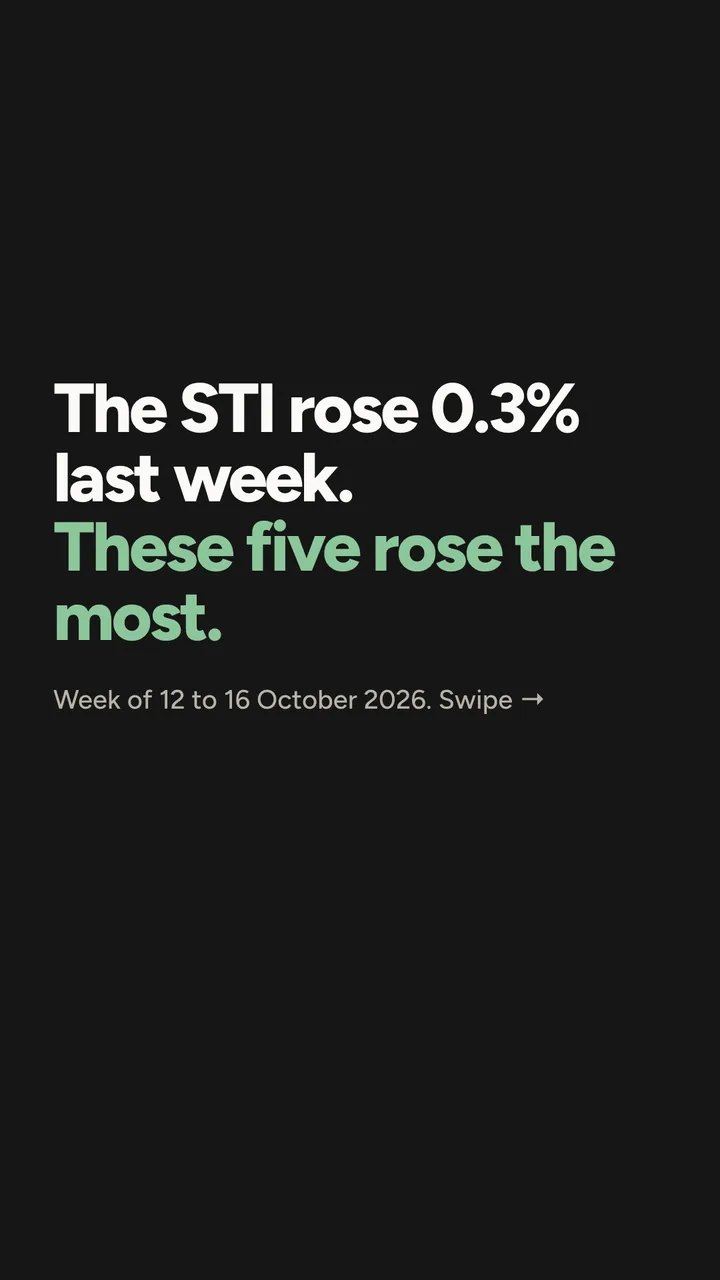
The Straits Times Index tracks 30 of the biggest companies listed on SGX, the Singapore Exchange. Think of it as a thermometer for the local market: one number for roughly how things went, without telling you how any one company did.
This week the thermometer barely moved. The STI went from 5,401.89 to 5,415.53, a rise of 0.3%. If you had S$1,000 spread exactly like the index, you'd have ended the week with about S$1,002.50. That's a kopi and a bit, before any fees.
To find the top five, we take all 30 stocks and compare each one's closing price (the last price it traded at when the market shut) on Friday 9 October with Friday 16 October, using Yahoo Finance. We rank all 30 ourselves; ready-made "top gainers" lists are often partial or cover a single day.
The backdrop: the banks came back
You can't make sense of this week without the week before. In the week to 9 October, the STI fell 4.1%, and the three local banks did most of the damage: OCBC fell 8.4%, UOB 7.3% and DBS 5.0%. The banks are such a large part of the index that when they have a bad week, the whole STI has a bad week.
This week, The Business Times reported on 12 October that the banks had begun to recover from that sell-off. Over the full week UOB rose 4.1% and DBS 1.0%, while OCBC finished flat.
Not everything joined in. A global sell-off in chip stocks weighed on Singapore on Thursday, and Seatrium, the offshore and marine engineering group, fell 7.5%, the worst of the 30, with no company reason reported.
What this means for you: the index tells you the weather, not what's in your umbrella. If you hold mostly bank shares, your week looked very different from someone holding mostly Seatrium. Check your own holdings, not the headline.
UOB rose 4.1% as the banks bounced back
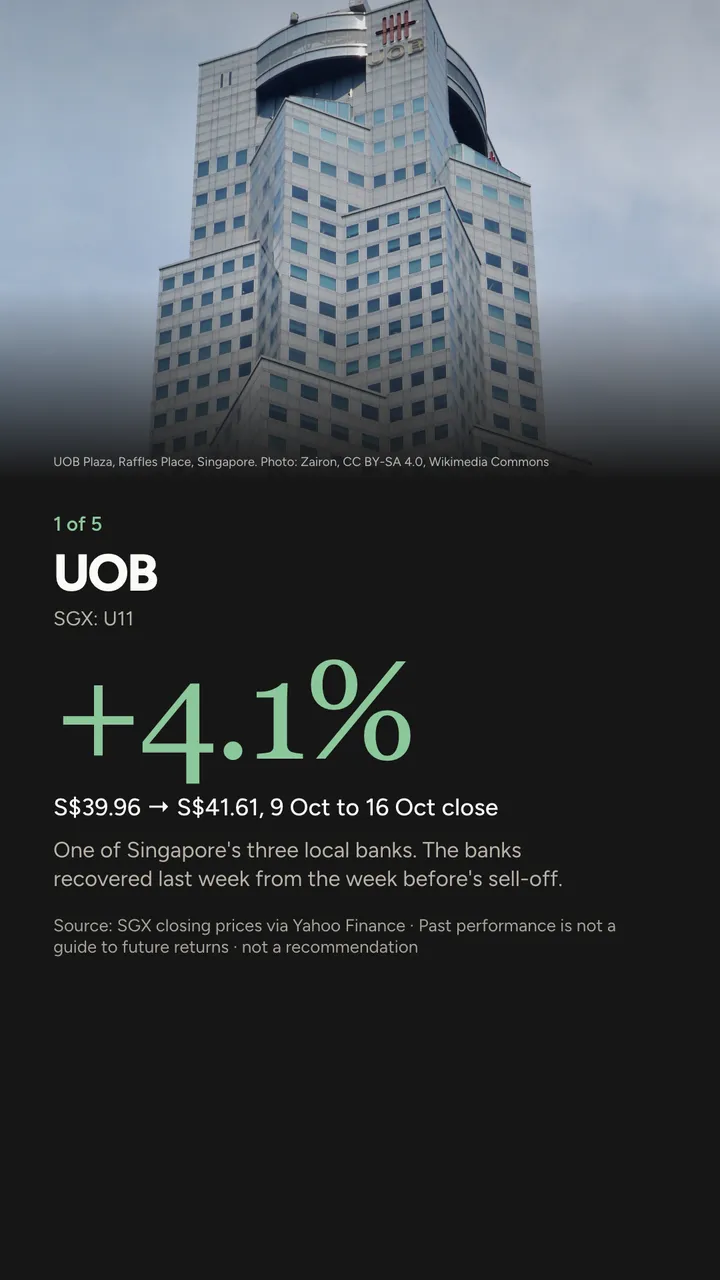
UOB, or United Overseas Bank, is one of Singapore's three local banks, alongside DBS and OCBC. You've almost certainly walked past one of its branches or ATMs, and the twin towers of UOB Plaza are part of the Raffles Place skyline you see from the Esplanade. A UOB share is a tiny slice of a business that takes deposits, lends for homes and businesses, and earns fees on cards and wealth management.
Its shares closed at S$39.96 on 9 October and S$41.61 a week later. This is the one move on the list with a clearly reported reason: the banks bounced back after a sharp fall, as The Business Times reported on 12 October.
The arithmetic
- S$1,000 of UOB shares on 9 October would have been worth about S$1,041.29 on 16 October.
- The gain per share was S$1.65 (S$41.61 minus S$39.96).
Why +4.1% doesn't undo -7.3%
Here's the detail I find most useful. UOB's rise this week doesn't fully undo its 7.3% fall the week before. Percentages don't work symmetrically, because each one is worked out from a different starting point.
Take an example of S$1,000 held over both weeks:
- Down 7.3% in the first week: S$1,000 becomes S$927.
- Up 4.1% in the second week: S$927 becomes about S$965.
- You're still about 3.5% below where you started.
To get all the way back from a 7.3% fall, the price needs to rise about 7.9%. Losses always need a bigger percentage gain to climb back. The first time I worked this out on a napkin, I felt slightly cheated by maths.
What this means for you: when you read "shares rebounded", ask "from where?" A rebound can still leave a stock below where it was a fortnight ago.
DFI Retail Group: the company behind Guardian and 7-Eleven, up 3.8%
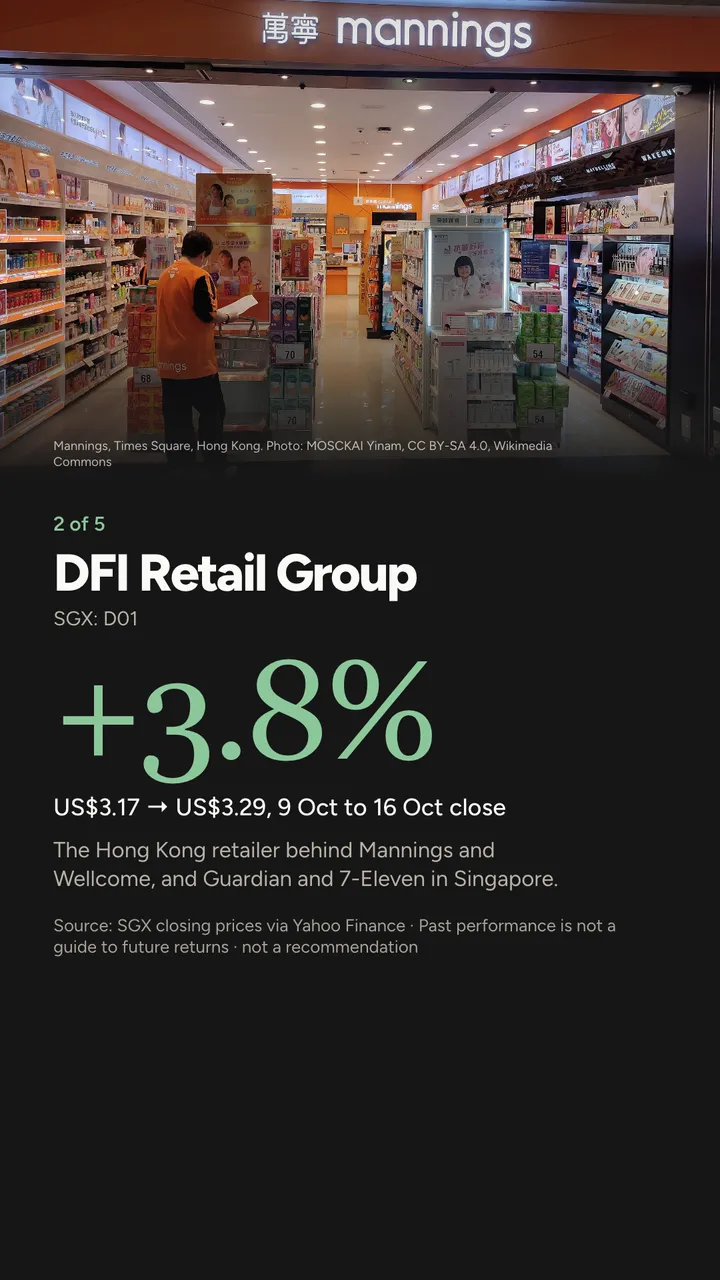
You may not know the name, but there's a good chance you've bought something from DFI this month. It runs Guardian and 7-Eleven in Singapore, and Mannings (health and beauty) and Wellcome (supermarkets) in Hong Kong. The 7-Eleven under your office, the Guardian where you pick up plasters: that's the business. It's part of the Jardine group, like Hongkong Land further down.
One thing that trips people up: DFI is listed on SGX, but its shares are quoted in US dollars. That's why the slide says US$3.17 to US$3.29. You buy it on the Singapore exchange, but the price, and any dividend, is in US dollars.
No single reason was reported for the rise. DFI was the STI's top gainer on Thursday 15 October, but the market reports that day didn't give a cause.
The arithmetic
- US$1,000 of DFI shares on 9 October would have become about US$1,037.85 by 16 October.
- In Singapore dollars, your result also depends on how the US dollar moved against the Singapore dollar that week. A gain in US dollars can be a bit bigger or a bit smaller once you convert it back.
Reading a dividend notice
DFI also paid an interim dividend (one paid partway through the financial year) on 14 October. The first dividend notice you get can be confusing, so here are the dates that matter:
- Ex-dividend date: if you buy on or after this date, you don't get the coming dividend. The share price often drops by about the dividend on this day, because new buyers aren't getting it.
- Payment date: when the money actually lands. 14 October was DFI's payment date, not its ex-date, so it isn't a reason for the share price to move that week.
As a made-up example: if a company pays 5 US cents a share and you hold 200 shares, you receive US$10. For individuals resident in Singapore, IRAS says dividends from Singapore companies under the one-tier system, and foreign dividends received in Singapore, are generally not taxable.
What this means for you: if your shares are quoted in US dollars, note which currency your profit and your dividends are really in. It matters when you add everything up in Singapore dollars.
Yangzijiang Shipbuilding: a shipbuilder listed in Singapore, up 2.2%
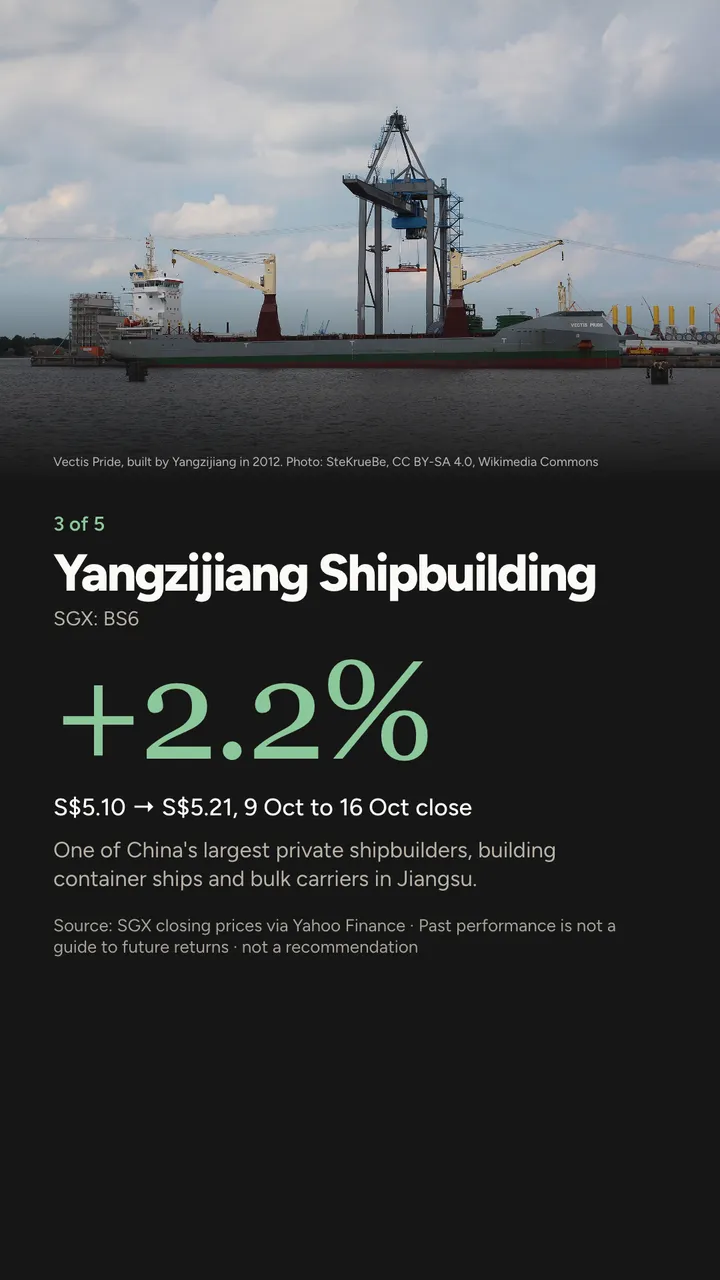
Yangzijiang is one of China's largest private shipbuilders. It builds container ships (stacked with the coloured boxes you see from East Coast Park) and bulk carriers (for loose cargo like grain or coal) in Jiangsu province. It's listed here in Singapore, so it's in the STI even though its yards are in China.
There was no company news. Most of the week's gain came on Friday, when it was the STI's top gainer for the day, up 3.6% to close at S$5.21. Again, no reason was reported.
The arithmetic, and my first board lot
A board lot is the standard trading size on SGX. Since 5 October 2026, it's 100 shares for anything priced up to S$10. So for Yangzijiang:
- 100 shares on 9 October: 100 x S$5.10 = S$510.
- 100 shares on 16 October: 100 x S$5.21 = S$521.
- The difference: S$11, before brokerage fees.
- Per S$1,000 held, that's about S$1,021.57.
I remember the first time I bought a share. I'd opened my CDP account (the Central Depository, where Singapore shares are registered in your name) and sat on the order screen for twenty minutes, checking that I'd pressed "Buy" and not "Sell", and typed 100 and not 1,000. What I learned that day: the fee is a much bigger share of a small trade than a large one.
What this means for you: an S$11 gain on a board lot can disappear entirely into fees if you buy and sell in the same week. Look at what a trade costs you in total, not just the price change.
Hongkong Land: Jardine's property arm, up 1.9%
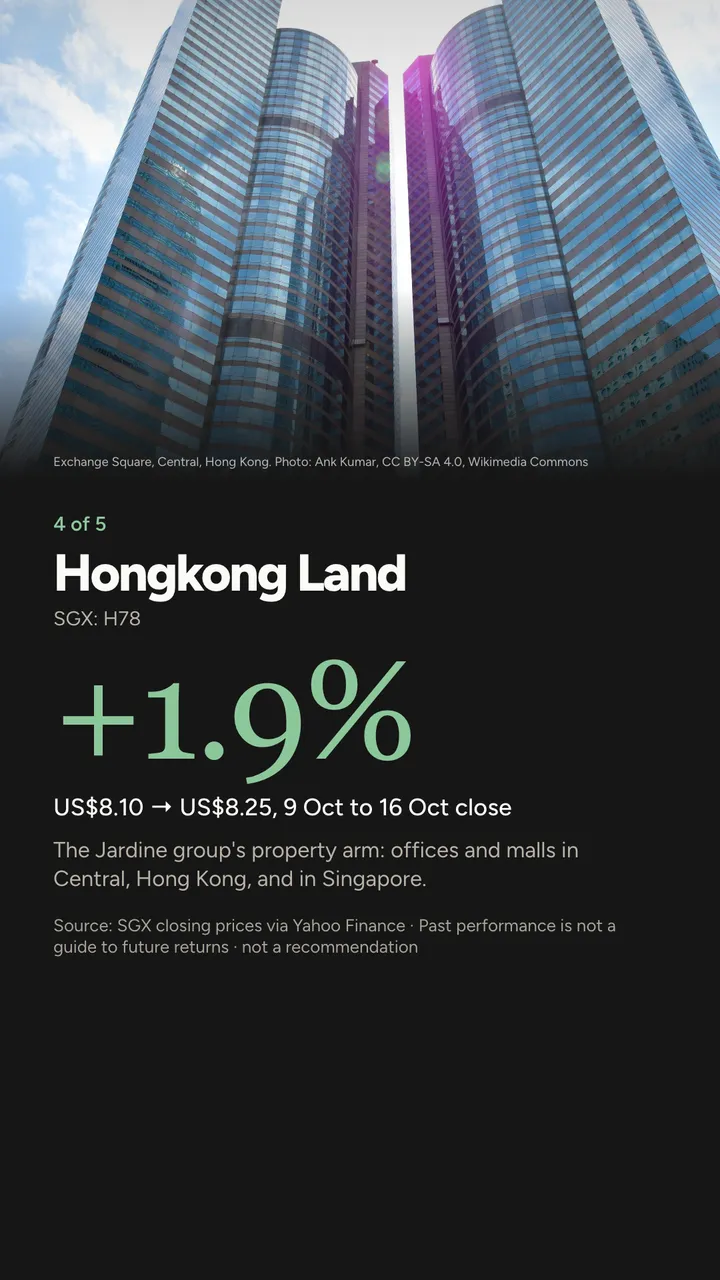
Hongkong Land is the Jardine group's property arm. It owns offices and malls in Central, Hong Kong's business district, and properties in Singapore too. A property company like this earns most of its money from rent: the bank renting a tower floor, the luxury shop renting a ground-floor unit. Like DFI, its shares trade on SGX in US dollars.
Shares went from US$8.10 to US$8.25. No single reason was reported for the share move.
In the week's news, The Straits Times reported on 14 October, citing Bloomberg, that Hongkong Land was in early talks to buy a majority stake in three Orchard Road buildings, and that the talks could still fail. Hotel Properties, the other party, said the same day it had made no decision. Nothing I read linked that report to the share price, so I file it under "things that happened that week", not "the reason".
The arithmetic
- US$1,000 of Hongkong Land on 9 October would have become about US$1,018.52.
- That's US$0.15 a share.
News is not the same as a reason
I'll admit a habit: when I see a headline about a company, I open the share price to "see the effect". Usually there isn't a clear one. A report of talks that might fail is exactly the kind of news that's easy to over-read.
What this means for you: before you connect a headline to a price, check whether the report itself says the two are linked. If it doesn't, treat it as background.
Frasers Logistics & Commercial Trust: warehouses and offices, up 1.7%
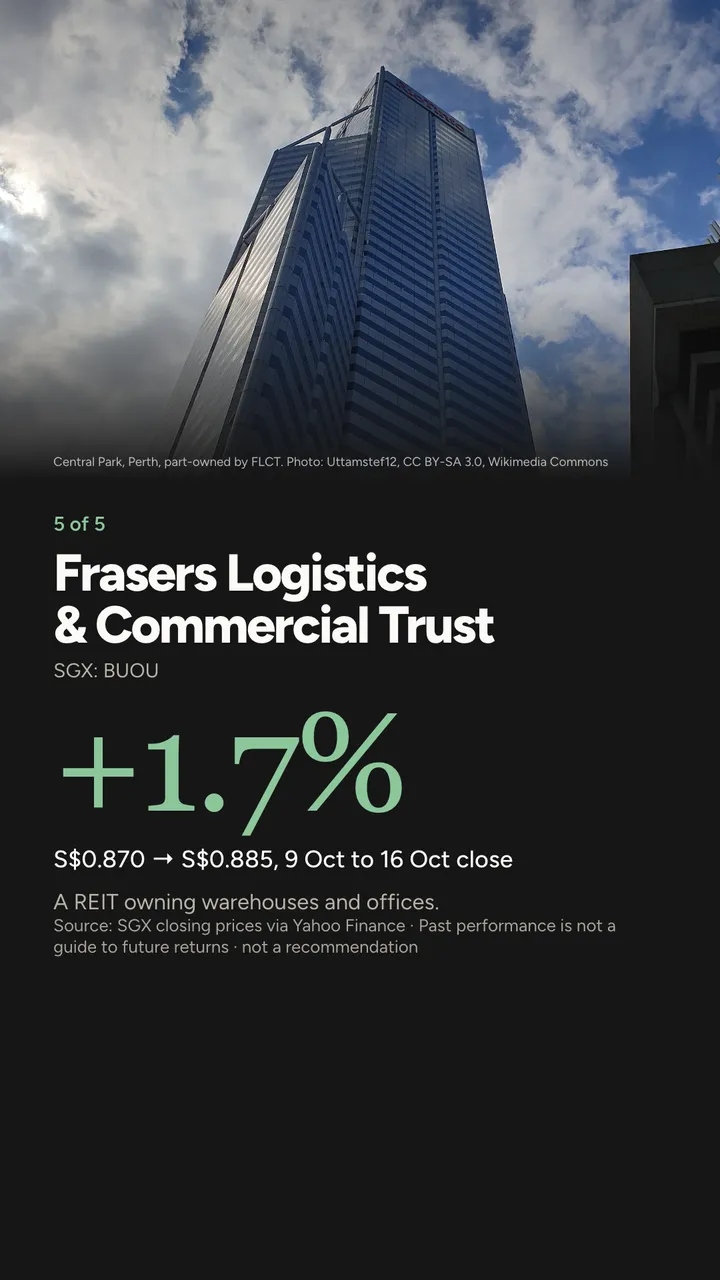
FLCT is a REIT, short for real estate investment trust. Instead of buying a warehouse yourself, you buy units in a trust that owns warehouses and offices, and it pays out most of the rent it collects. The parcel at your HDB door probably spent a night in a warehouse like the ones FLCT owns. Its properties are in Australia, Europe, Singapore and the UK. Its units went from S$0.870 to S$0.885, and no single reason was reported.
The arithmetic
- 1,000 units on 9 October: 1,000 x S$0.870 = S$870.
- 1,000 units on 16 October: 1,000 x S$0.885 = S$885.
- A gain of S$15, or about S$1,017.24 per S$1,000 held.
A low price isn't a cheap price
A common misconception: a unit under S$1 must be "cheap" next to a bank share at S$41. The price of one unit says nothing about value by itself. A 1.7% move is a 1.7% move whether the unit costs 87 cents or 87 dollars.
What this means for you: compare percentages, not price tags. REITs also work quite differently from a bank or a shipbuilder, so I've written them up properly in what is a REIT.
The week in one table
| Stock | Ticker | Close, 9 Oct to 16 Oct | Change | S$1,000 or US$1,000 became |
|---|---|---|---|---|
| UOB | SGX: U11 | S$39.96 to S$41.61 | +4.1% | S$1,041.29 |
| DFI Retail Group | SGX: D01 | US$3.17 to US$3.29 | +3.8% | US$1,037.85 |
| Yangzijiang Shipbuilding | SGX: BS6 | S$5.10 to S$5.21 | +2.2% | S$1,021.57 |
| Hongkong Land | SGX: H78 | US$8.10 to US$8.25 | +1.9% | US$1,018.52 |
| Frasers Logistics & Commercial Trust | SGX: BUOU | S$0.870 to S$0.885 | +1.7% | S$1,017.24 |
| Straits Times Index | STI | 5,401.89 to 5,415.53 | +0.3% | about S$1,002.50 |
All before fees, dividends and currency moves.
The pattern: most of it came without a headline
For three of the five, no reason was reported at all. Only UOB's rise came with a clear story, and even Hongkong Land's news wasn't tied to its price.
That's normal. Over a single week, prices often move without any news, and a week is a very short time in the life of a company. Two of these names, DFI Retail and Yangzijiang, were also in the top five the week before, when the STI fell (I wrote that week up in the STI's top five for 5 to 9 October). That tells you something about the last fortnight, and nothing at all about next month.
If you only remember three things
- The STI is an average of 30 companies. Your own week can look completely different.
- Percentages aren't symmetrical: after a 7.3% fall, a 4.1% rise still leaves you about 3.5% down.
- Some SGX shares, like DFI and Hongkong Land, are quoted in US dollars, so currency moves are part of your return.
How I keep track of this
I'll be honest: I check the STI more often on bad weeks than good ones. What helps is seeing my own holdings next to my savings, CPF and flat, so a red week sits in proportion.
In Sum, your SGX shares held in your CDP account sit inside your net worth, beside your bank accounts, CPF and HDB flat. Stocks and CDP holdings are on the Essential plan; live prices, profit and loss, and dividends are on Pro. If you hold US shares too, the Dow had its own top five that week: the Dow's top five for the same week.
Talk soon, Brandon

Sum is launching in Singapore soon.
Your banks, cards, CPF and HDB flat, added up into one net worth. Statements sorted, card caps tracked, bills remembered.
Brandon · Finance team, Sum
Brandon is on Sum's finance team in Singapore. Brandon reads the CPF Board, IRAS and MAS updates so you don't have to, and turns our carousels into the longer version. Questions, corrections or something to share? Email Brandon at [email protected].
Got something interesting to share?
A money story, a question, something we got wrong, or a tip other Singaporeans should hear. Reach out to me at [email protected], or leave your email and I'll write to you.
Sources: Yahoo Finance, Straits Times Index price history; The Business Times, Singapore shares rise as banks rebound after sell-off, 12 Oct 2026; The Business Times, Singapore shares fall as global chip rout hits regional markets, 15 Oct 2026; The Business Times, Singapore stocks rise 0.2% on Friday as exports surge, 16 Oct 2026; The Straits Times, Hongkong Land in talks to buy Orchard Road stake, 14 Oct 2026; The Business Times, Stocks to watch: HPL, 15 Oct 2026; SGX, board lot changes from 5 Oct 2026 (100 units for prices up to S$10); IRAS, Dividends: what is taxable and what is not.
Any app screens shown use sample data, not a real person's. Sum is free to start; some features need a paid plan.
Information only, not financial advice.