The STI's top 5 stocks, week of 16 to 20 Nov 2026
The STI fell 4.9% and only three of its 30 stocks rose. Hongkong Land, Singtel, Jardine Matheson, Yangzijiang and ThaiBev held up best, with the maths.

On Friday evening, a little after six, my dad posted in the family group chat. He does this when the news has a number in it. "STI drop below 5,000 today." A minute later: "Brandon, which one never drop?"
I was on the North East Line with my phone at eleven percent. I typed "Three of them", then added "out of thirty", because I know my dad. He replied with a thumbs up. Then my mum, who reads the chat but rarely writes in it, sent one line: "Then just buy those three."
It's the most natural reaction in the world, and exactly the one this kind of list invites. So this week I want to do two things: show you which five STI stocks held up best between Friday 13 November and Friday 20 November 2026, with the reasons where any were reported and the arithmetic for S$1,000, and explain why a list like this is a record of one week, not a shopping list. No predictions, no tips.
The STI fell 4.9%, and only three of its 30 stocks rose
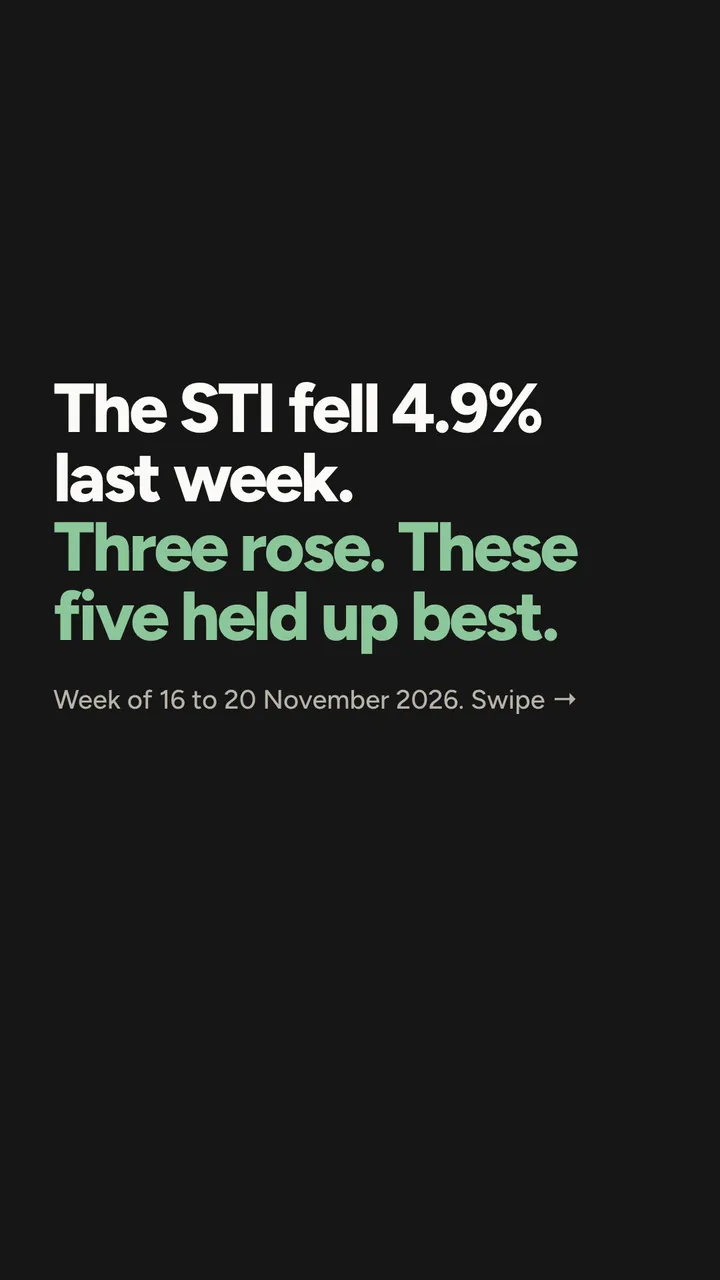
The Straits Times Index tracks 30 of the biggest companies listed on SGX, the Singapore Exchange. This week it went from 5,231.84 to 4,975.17. S$1,000 spread exactly like the index would have become about S$950.94, before fees and dividends.
To find the top five, we compare each stock's closing price (the last traded price when the market shuts) on the two Fridays, using Yahoo Finance, and rank all 30 ourselves. This week only three rose, so two of the "top five" actually fell. They just fell much less than everything else.
How the week went
- Monday, down 0.9%. Wall Street's selling in artificial intelligence and chip stocks spread across Asia. I couldn't find a Singapore report with its own reason for the day.
- Tuesday, down 1.4%. This one fell even though Singapore's non-oil domestic exports for October jumped 79.8% from a year earlier, The Business Times reported. The night before, the Dow had dropped more than 800 points as chip stocks sold off, CNBC reported.
- Wednesday, down 1.1%, and Thursday, up 0.5%, when Singtel led the gainers.
- Friday, down 2.1%. Asian markets sold off together after Anthropic's debut on the Nasdaq failed to revive the artificial intelligence trade, and markets priced in a US interest rate rise in December, The Business Times reported. The STI closed below 5,000.
The three local banks all fell: DBS 5.4%, OCBC 7.0% and UOB 6.2%. No bank-specific reason was reported. Seatrium, the rig and shipbuilder, fell 13.3%, the most on the index, including 8.8% on Friday. An IG analyst told The Business Times that a broker's cut to its target price "did no favours" to the shares on a bad day for markets.
What a margin call is
The Business Times also reported more margin calls and forced selling at brokers and private banks that week. Here's what that means. Some investors borrow money from their broker to buy more shares than their own cash would cover. The shares are the security for the loan. When prices fall far enough, the broker asks for more cash. That request is the margin call. If the investor can't pay, the broker sells shares for them, whatever the price.
Say Daniel has S$10,000 of his own and borrows S$10,000 to buy S$20,000 of shares. This is made up, to show the mechanics. If those shares fall 10%, they're worth S$18,000. He still owes S$10,000, so his own money is now S$8,000. A 10% fall in the shares became a 20% fall in what's his. Borrowing works the same way on the way up.
What this means for you: when prices fall fast, some of the selling isn't anyone's view on a company. It's people who have to sell. That's worth remembering before reading too much into a single bad day.
Hongkong Land rose 2.1%, the week of its third-quarter update
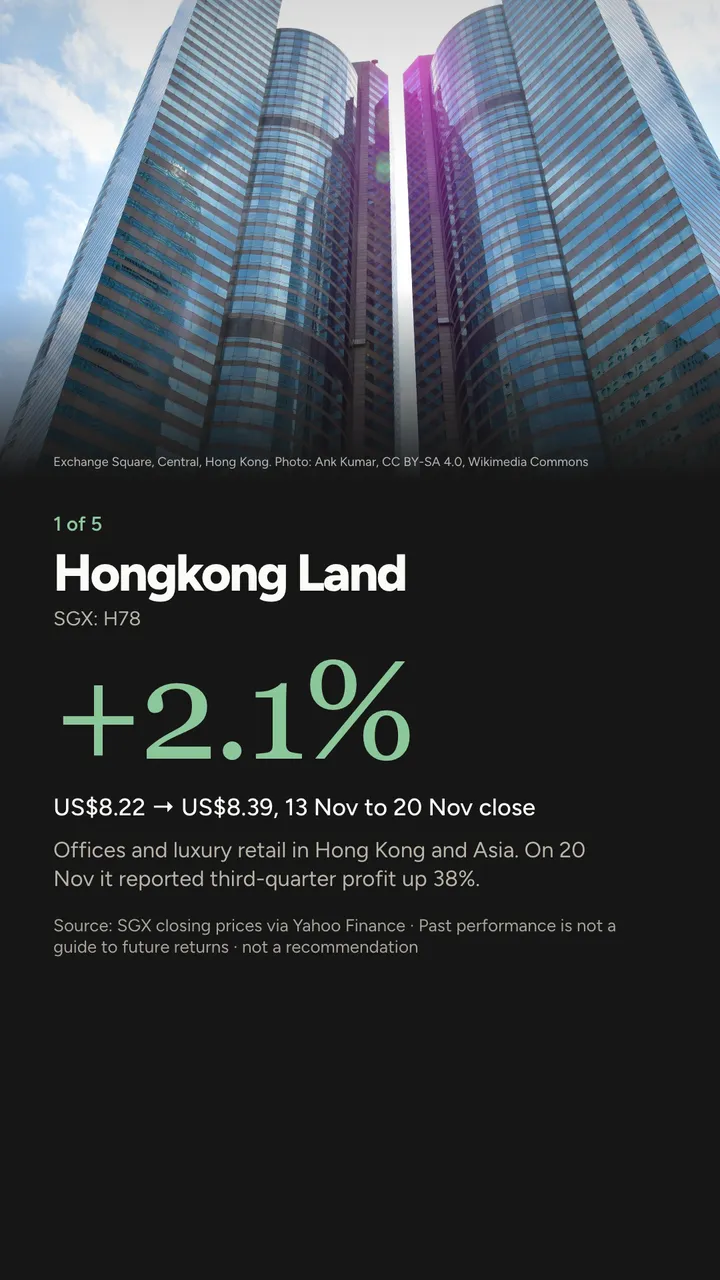
Hongkong Land owns and runs offices and luxury shopping centres, mostly in Central, Hong Kong's business district, with others in Singapore and mainland China. Its SGX shares trade in US dollars.
On Friday it released a trading update, a short report between full results, and said its third-quarter underlying profit was 38% higher than a year earlier, mainly because of higher contributions from Hong Kong Central and mainland China and lower financing costs. It also raised its full-year guidance: it now expects underlying profit to grow in the mid-teens percent, up from the 11% it achieved in the first half.
The timing is worth a look. The shares slipped 0.4% that Friday. Most of the week's rise came on Monday and Wednesday, about 1% each, before the update, and no reason was reported for those days.
What "underlying" profit means
Property companies own buildings whose value is reassessed regularly. A change in that value goes through the accounts, but it's not money the company earned from tenants that year. So many property groups also report an underlying profit, which leaves out changes like these to show how the business itself did. When you read "profit up 38%", it's worth checking which profit they mean.
The arithmetic
- S$1,000 of Hongkong Land shares would have become about S$1,020.68, before fees, if the US dollar stayed level against the Singapore dollar. Because the shares are priced in US dollars, a Singapore investor's result also depends on the exchange rate.
- One board lot (100 shares, the standard trading size on SGX): US$822 became US$839, a gain of US$17 before fees.
What this means for you: if you hold an SGX share priced in US dollars, your result in Singapore dollars has two parts, the share price and the exchange rate. It's worth checking both.
Singtel rose 1.2%, on two good days
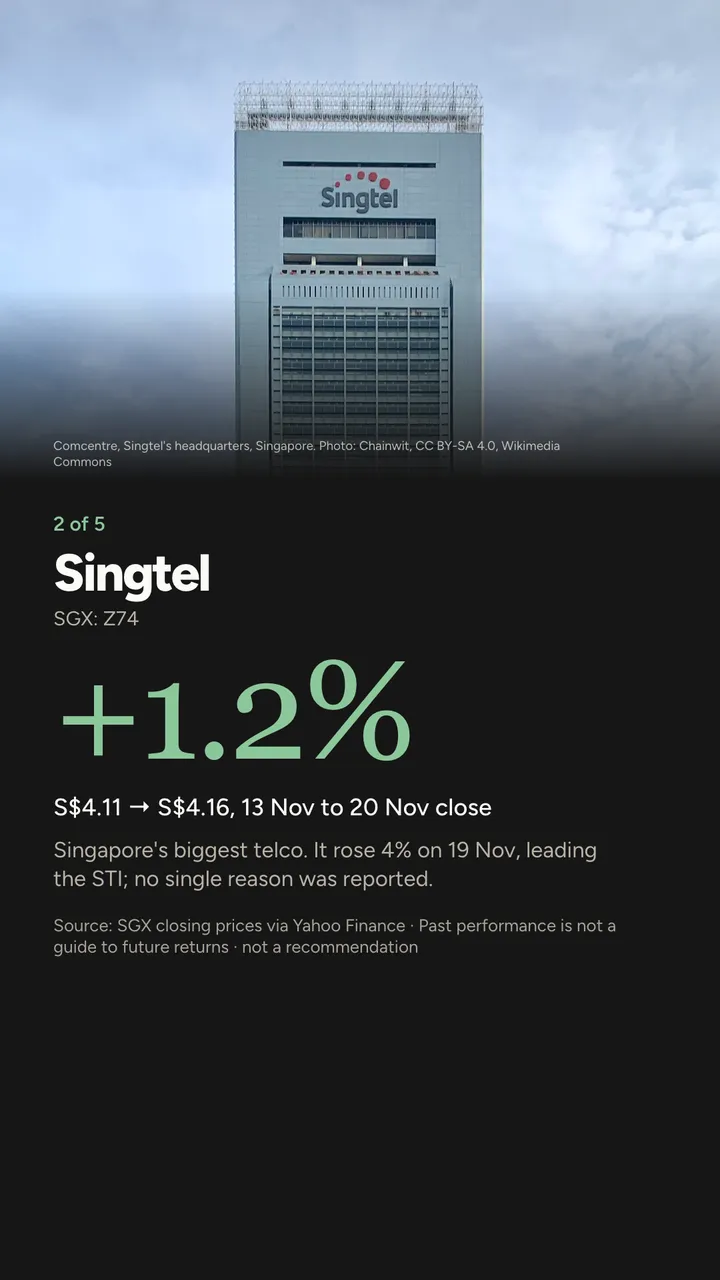
Singtel is Singapore's biggest telco: mobile, broadband and pay TV here, plus stakes in telcos across the region.
It had a choppy week. It fell 2.7% on Monday, then rose 2.5% on Tuesday, when The Business Times said analysts remained positive after its half-year results the week before. On Wednesday SingNet's email service was disrupted, which Singtel said was a configuration issue at a service provider, not a cyberattack, The Straits Times reported. The shares dipped 1.5%. On Thursday they rose 4%, leading the STI, and no single reason was reported for that day.
Why a company reports two profit figures
The Business Times noted that Singtel's underlying earnings improved in the half year even though its reported net profit fell. The reported figure includes one-off items, like a gain from selling part of a business. The underlying figure leaves those out. When a big one-off gain sits in last year's numbers, this year's reported profit can fall even while the business does better. Neither figure is the "real" one. They answer different questions.
The arithmetic
- S$1,000 of Singtel shares would have become about S$1,012.17.
- One board lot: S$411 became S$416, a gain of S$5 before fees.
What this means for you: a piece of bad news, like an outage, doesn't always move a share much, and a good day doesn't always come with a reason. Here, the week's whole rise came from Tuesday and Thursday.
Jardine Matheson rose 0.7%, after a strong quarter
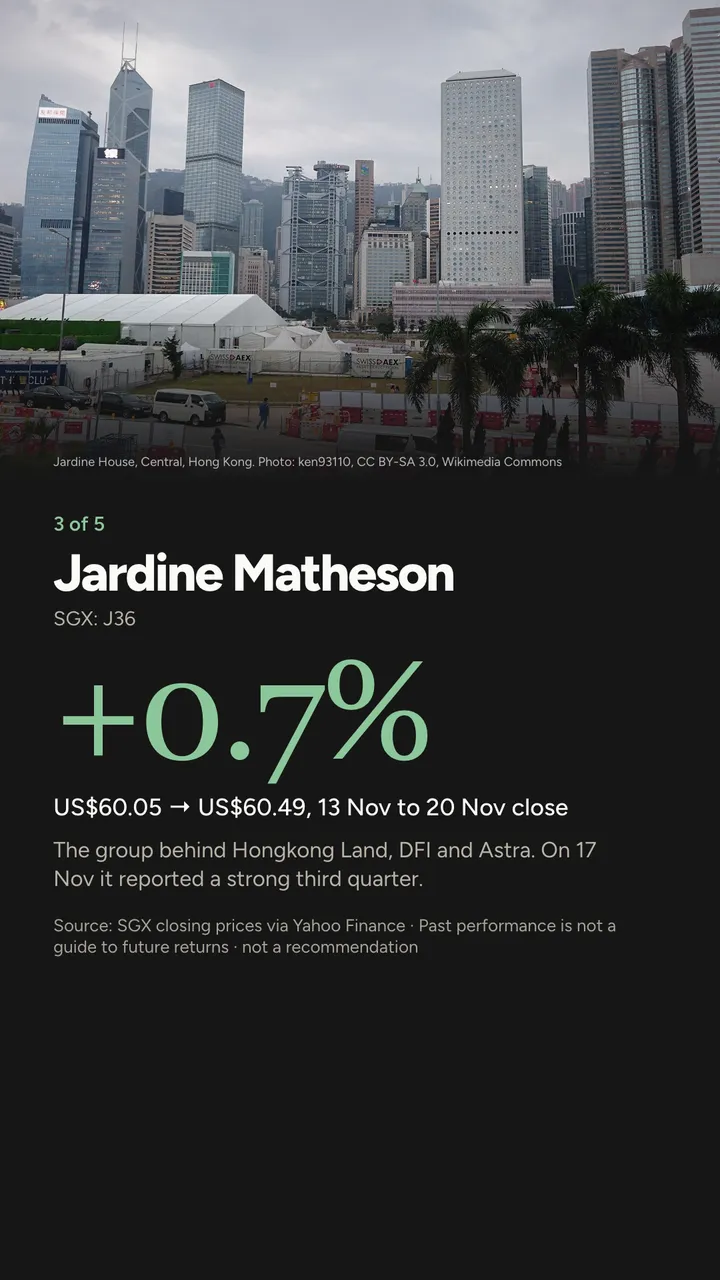
Jardine Matheson is a holding company: its main job is owning large stakes in other companies and running them. Its group includes Hongkong Land, DFI Retail, Mandarin Oriental and Astra in Indonesia. So when Hongkong Land does well, part of that shows up in Jardine's numbers too.
On Tuesday it published its third-quarter statement. It said the portfolio's performance was strong and ahead of what it expected at the half year, and that it expects a full-year dividend of at least US$2.50 a share, 6% more than last year. The shares rose 2.4% on Wednesday, though no report linked the move to the statement.
News that was already known
Jardine's profit guidance, US$5.50 to US$5.65 a share for the year, was raised in October, not in this statement. When a company repeats good news, the share price usually moved when the news was new.
The arithmetic
- S$1,000 of Jardine shares would have become about S$1,007.33, before fees and exchange rate moves.
- One board lot: US$6,005 became US$6,049, a gain of US$44 before fees.
- If the dividend is US$2.50 as expected, 100 shares would receive US$250 for the year.
What this means for you: when you read that a company raised its forecast, check when it did. A raise from last month is not this week's news.
Yangzijiang fell 0.5%, a tenth of the market's fall
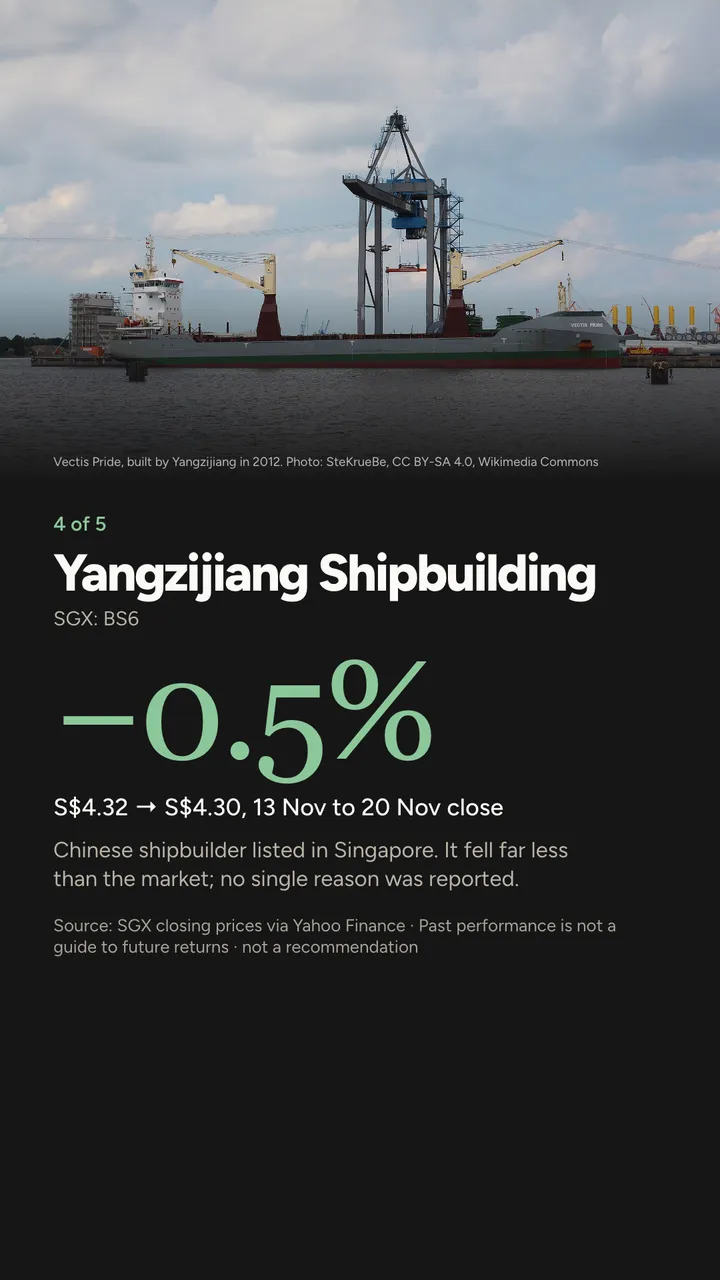
Yangzijiang Shipbuilding builds container ships, bulk carriers and gas carriers at yards in China, and is listed in Singapore. No single reason was reported for its move. It rose 2.5% on Monday, fell 2.5% on Tuesday and ended the week almost where it started.
Doing better than the market, while falling
Fund managers have a word for this: outperform. Yangzijiang fell 0.5% while the index fell 4.9%, so it outperformed the index by about 4.4 percentage points. Relative performance is useful for comparing things, but your account only shows the absolute number.
The arithmetic
- S$1,000 of Yangzijiang shares would have become about S$995.37.
- One board lot: S$432 became S$430, a loss of S$2 before fees.
What this means for you: "beat the market" can still mean "lost money". It's worth knowing which of the two a headline is talking about.
Thai Beverage fell 1.2%, by half a cent
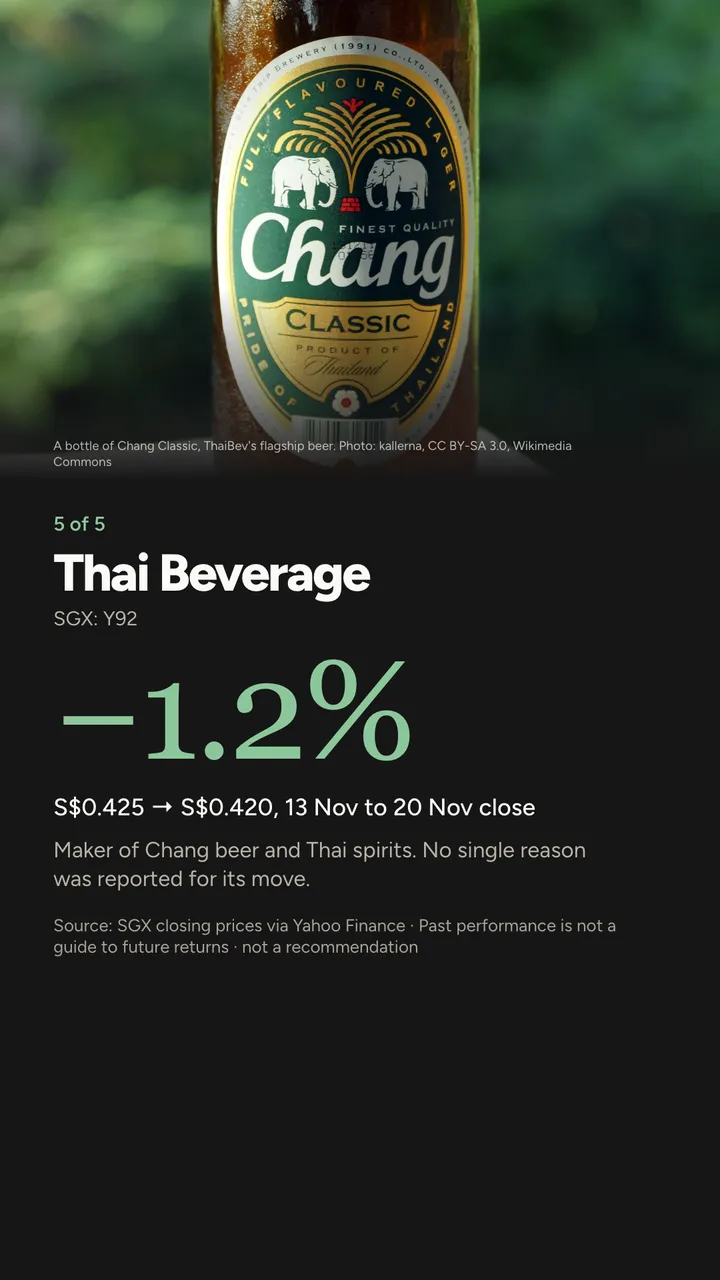
Thai Beverage, or ThaiBev, makes Chang beer and Thai spirits. No single reason was reported for its move this week.
When 1.2% is one step
ThaiBev's shares cost less than half a dollar each. At that price, the smallest step the price can move on SGX is half a cent. So the whole week's move, S$0.425 to S$0.420, was a single step down. On a share this cheap, one step is more than 1%. That's why low-priced shares can show percentage moves that look bigger than what actually happened.
The arithmetic
- S$1,000 of ThaiBev shares would have become about S$988.24.
- One board lot: S$42.50 became S$42.00, a loss of 50 cents before fees.
What this means for you: for very cheap shares, look at the price itself as well as the percentage. A big-looking move can be one tick.
The week in one table
| Stock | Ticker | Close, 13 Nov to 20 Nov | Change | S$1,000 became |
|---|---|---|---|---|
| Hongkong Land | SGX: H78 | US$8.22 to US$8.39 | +2.1% | S$1,020.68 |
| Singtel | SGX: Z74 | S$4.11 to S$4.16 | +1.2% | S$1,012.17 |
| Jardine Matheson | SGX: J36 | US$60.05 to US$60.49 | +0.7% | S$1,007.33 |
| Yangzijiang Shipbuilding | SGX: BS6 | S$4.32 to S$4.30 | minus 0.5% | S$995.37 |
| Thai Beverage | SGX: Y92 | S$0.425 to S$0.420 | minus 1.2% | S$988.24 |
| Straits Times Index | STI | 5,231.84 to 4,975.17 | minus 4.9% | about S$950.94 |
All before fees and dividends, and for the two US dollar shares, before exchange rate moves. One week tells you what happened, and nothing about what comes next.
If you only remember three things
- In a falling week, the "top five" can include shares that fell. Ranking is relative; your account isn't.
- Some selling in a fast fall is forced, from margin calls, not a judgement on the company.
- Check the date and the kind of number behind every "because": underlying or reported, this week's news or last month's.
How I keep track of this
A week like this is when I most want to see my money in proportion. A 4.9% fall in the index sounds dramatic until I see it next to my savings, CPF and the flat, which didn't move at all that week.
In Sum, SGX shares in your CDP account sit inside your net worth beside your bank accounts, CPF and HDB flat. Stocks and CDP holdings are on the Essential plan; live prices, profit and loss, and dividends are on Pro. If you hold US shares too, the Dow's top five for the same week had only one stock that rose. Last week, when results lifted SATS and SIA, is in the STI's top five for 10 to 13 November.
At Sunday dinner my mum asked whether I'd bought "those three". I said the list tells you who fell least last week, and nothing about next week. She thought about it while cutting the oranges. "So it's like asking which student was absent the day of the test." Not quite, I said, but close enough. My dad asked if the STI was back above 5,000 yet. Monday, I said. We'll see on Monday.
Talk soon, Brandon

Sum is launching in Singapore soon.
Your banks, cards, CPF and HDB flat, added up into one net worth. Statements sorted, card caps tracked, bills remembered.
Brandon · Finance team, Sum
Brandon is on Sum's finance team in Singapore. Brandon reads the CPF Board, IRAS and MAS updates so you don't have to, and turns our carousels into the longer version. Questions, corrections or something to share? Email Brandon at [email protected].
Got something interesting to share?
A money story, a question, something we got wrong, or a tip other Singaporeans should hear. Reach out to me at [email protected], or leave your email and I'll write to you.
Sources: Yahoo Finance, Straits Times Index price history; The Business Times (via Longbridge), Singapore stocks fall even as exports surge; STI down 1.4%, 17 Nov 2026; The Business Times (via Longbridge), Singtel takes the lead as Singapore stocks rise; STI up 0.5%, 19 Nov 2026; The Business Times (via Longbridge), Singapore stocks fall in tandem with regional downturn; STI down 2.1%, 20 Nov 2026; The Business Times (via Longbridge), 'We'll wait and see': Investors wary after STI sinks below 5,000 amid global AI selldown, 20 Nov 2026; CNBC, Dow drops more than 800 points, S&P 500 posts lowest close since July, 17 Nov 2026; Hongkong Land, Quarterly Trading Update, 20 Nov 2026; The Straits Times via Yahoo News, SingNet e-mail service disrupted over configuration issues; no cyberattack: Singtel, 18 Nov 2026; Jardine Matheson, Interim Management Statement, 17 Nov 2026.
Any app screens shown use sample data, not a real person's. Sum is free to start; some features need a paid plan.
Information only, not financial advice.