The STI's top 5 stocks, week of 5 to 9 Oct 2026
The STI fell 4.1% as the banks slid, but five stocks still rose: Jardine Matheson, Wilmar, DFI Retail, Yangzijiang and Sembcorp, explained with the maths.

On the Friday this week ended, I was having dinner at a hawker centre near my parents' flat when a relative asked me, quite seriously, whether she should move her savings out of her bank "because the bank shares are falling".
It was a fair question, and a very common mix-up. The three local banks had a bad week on the stock market. That is not the same thing as your deposits being in trouble, and I spent the rest of the meal (and most of a plate of char kway teow) explaining the difference. I'll do the same below.
This post is a look back at the week of 5 to 9 October 2026. I've saved it for now because it explains the week after it. The Straits Times Index fell 4.1% that week, ending Friday 9 October at 5,401.89. And yet five of its 30 stocks still finished higher. For each one I'll explain what the company does and where you meet it in Singapore, the move with the arithmetic, and what it does and doesn't tell you. No forecasts, no tips.
Why the STI fell 4.1%: the banks
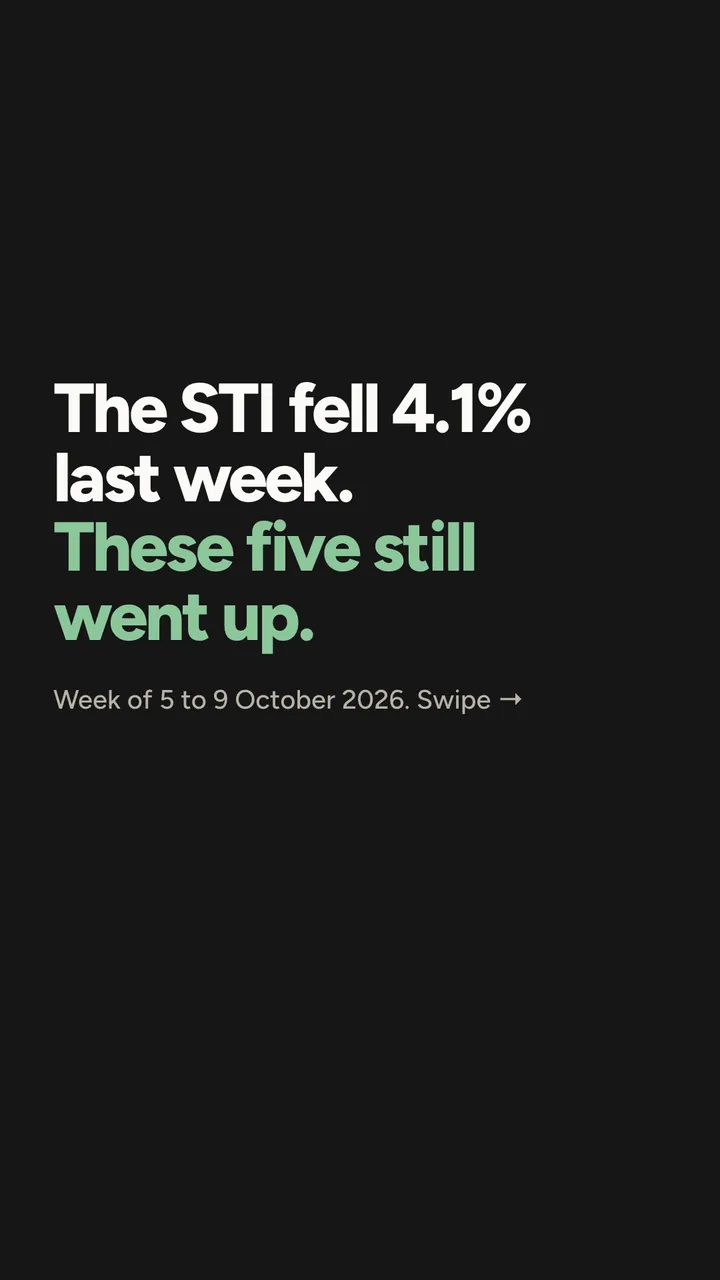
The STI, or Straits Times Index, tracks 30 of the biggest companies listed on SGX, the Singapore Exchange. It's the number people usually mean when they say "Singapore stocks fell today".
We rank all 30 by comparing each stock's closing price (its last traded price of the day) on Friday 2 October with Friday 9 October, using Yahoo Finance. The five that rose the most make the carousel.
The three local banks had a hard week. OCBC fell 8.4%, UOB 7.3% and DBS 5.0%. Because the banks are among the biggest companies in the index, a bad week for them drags the whole STI down. I don't have a dated report I'd trust that pins down one cause for that slide, so I won't guess.
The arithmetic
- S$1,000 spread exactly like the STI on 2 October would have been worth about S$959 a week later.
- S$1,000 in OCBC shares would have been about S$916.
Bank shares versus bank deposits
Back to my relative's question. When you own shares in a bank, you own a small slice of the business, and the share price moves with the market. When you keep savings in a bank, you're a depositor, and your balance doesn't change because the share price did.
Deposits are also protected by SDIC, the Singapore Deposit Insurance Corporation. Your insured deposits with each member bank are added together and insured up to S$100,000. A falling share price doesn't touch that.
What this means for you: a red week for bank shares is news for shareholders. It isn't, on its own, a reason to worry about your savings account.
Jardine Matheson rose 2.5% in a falling market
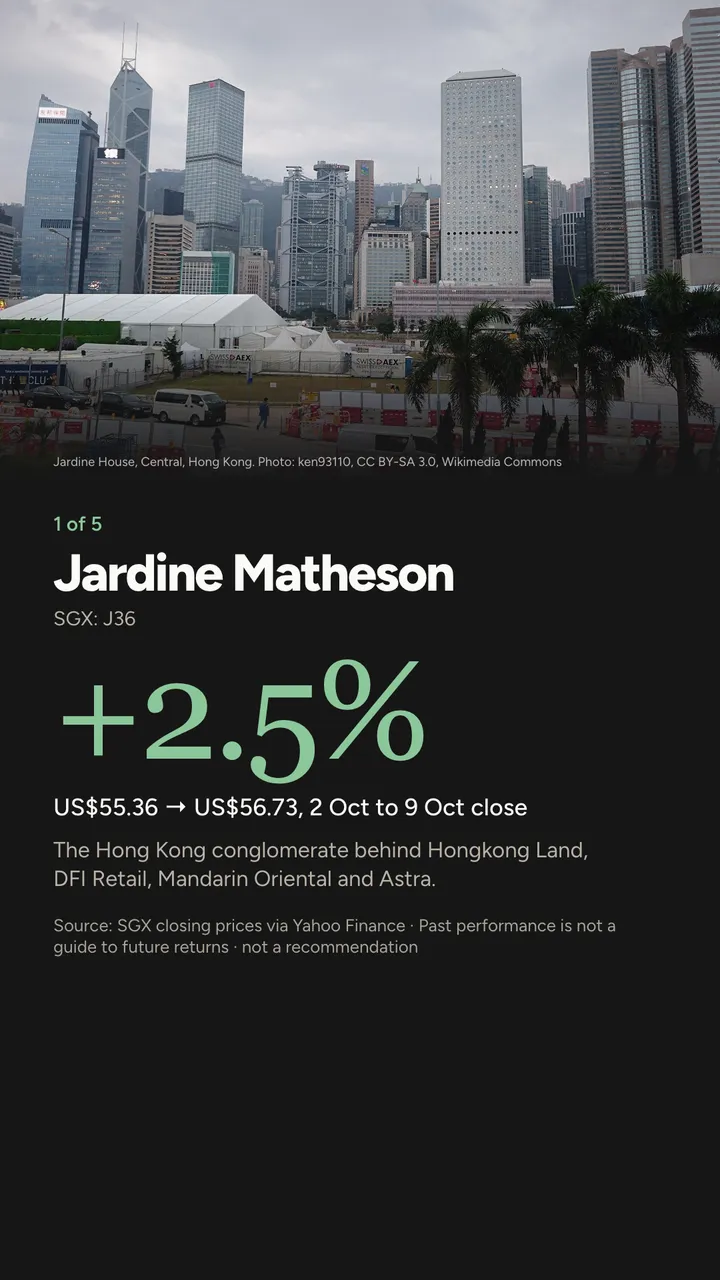
Jardine Matheson is a Hong Kong conglomerate, meaning a group that owns lots of different businesses under one roof. Its family includes Hongkong Land (offices and malls), DFI Retail (shops), Mandarin Oriental (hotels) and Astra (a large Indonesian group). In Singapore, you've most likely met it through DFI, which runs Guardian and 7-Eleven here. Owning a Jardine share is a bit like owning a small piece of all of these at once.
Shares went from US$55.36 to US$56.73. No single reason was reported for the week's rise.
The arithmetic
- US$1,000 of Jardine on 2 October would have become about US$1,024.75 by 9 October.
- Yes, US dollars. A few big SGX-listed companies, including Jardine and its group companies, are quoted in US dollars rather than Singapore dollars, so your Singapore-dollar result also depends on the exchange rate that week.
What this means for you: when a company owns other listed companies, check whether you already hold some of them. Owning Jardine and DFI together means part of your money is in the same business twice.
Wilmar International: palm oil, flour and sugar, up 2.3%
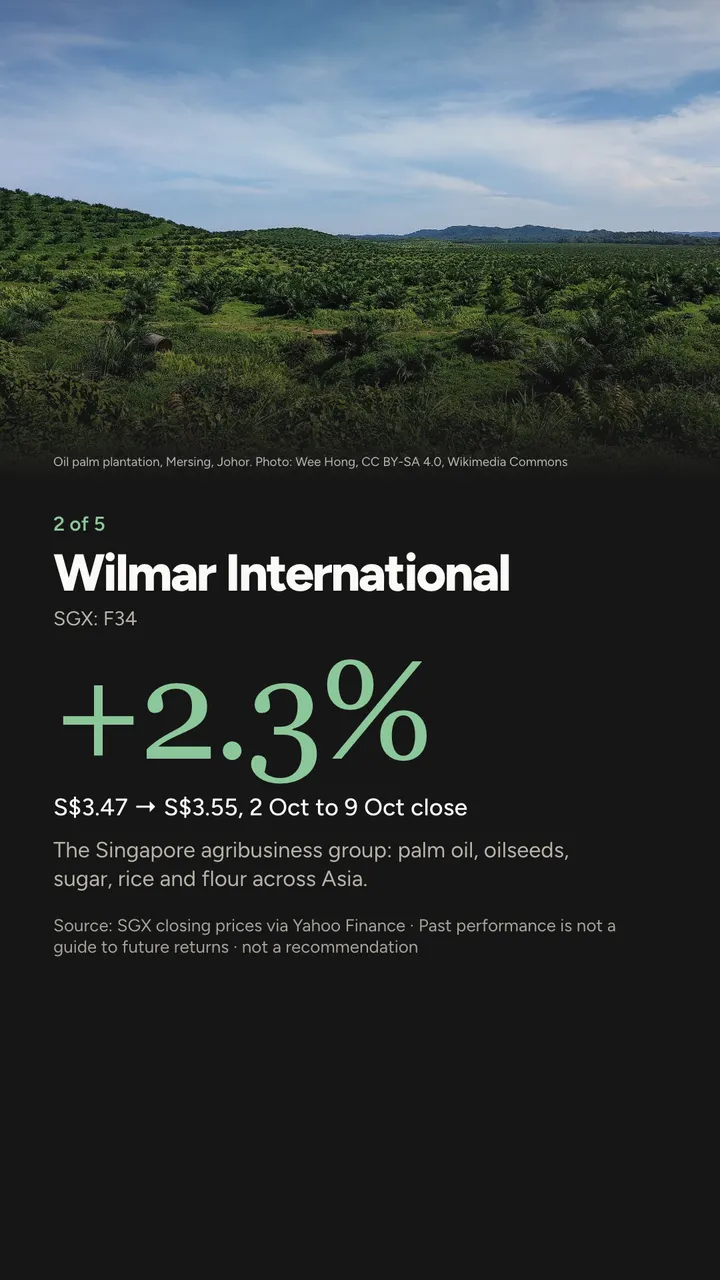
Wilmar is a Singapore agribusiness group, a company that grows, processes and sells farm products. Its basics are palm oil, oilseeds, sugar, rice and flour, across Asia. You meet this kind of business every time you eat something fried, sweetened or baked, even if the brand on the packet isn't Wilmar's. It's a business where the margins depend on the prices of crops, which move with weather, harvests and demand.
Shares went from S$3.47 to S$3.55. No single reason was reported.
The arithmetic, in board lots
A board lot is the standard trading size on SGX. Since 5 October 2026, it's 100 shares for anything priced up to S$10, which covers Wilmar.
- 100 shares on 2 October: 100 x S$3.47 = S$347.
- 100 shares on 9 October: 100 x S$3.55 = S$355.
- A gain of S$8 before fees, or about S$1,023.05 per S$1,000 held.
I remember the first time I bought a board lot of a local company: I triple-checked "Buy" against "Sell", the trade went through in a second, and then the brokerage fee was a surprisingly big slice of such a small order. An S$8 move can be swallowed by fees if you buy and sell quickly.
What this means for you: know your broker's minimum fee before you trade small amounts. It changes the arithmetic more than you'd expect.
DFI Retail Group: Guardian and 7-Eleven, up 2.3%
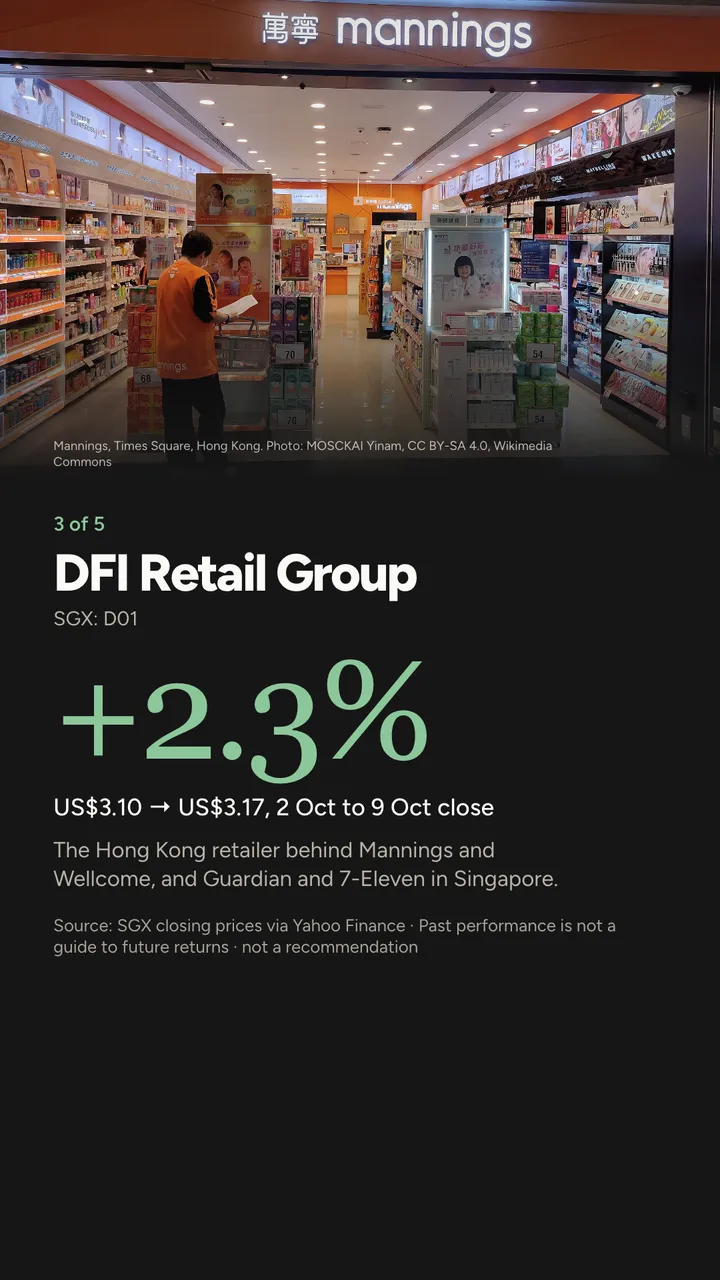
DFI is the retailer behind Guardian and 7-Eleven in Singapore, and Mannings and Wellcome in Hong Kong. The 7-Eleven where you top up your travel card or grab a late-night snack, the Guardian where you buy cough syrup: that's DFI. Retail like this earns small amounts on a very large number of everyday purchases.
It's part of the Jardine group, so that's two Jardine names in the top three. Shares went from US$3.10 to US$3.17, and no single reason was reported.
The arithmetic
- US$1,000 of DFI on 2 October would have become about US$1,022.58.
- DFI rose again the following week, by 3.8%, to US$3.29. Over both weeks, US$1,000 would have become about US$1,061.29.
Reading a dividend notice
DFI pays dividends, and the dates on a dividend notice confuse almost everyone the first time. The ex-dividend date is the cut-off: buy on or after it and you don't get the coming payment. The payment date is when the money actually arrives, often weeks later. For individuals resident in Singapore, IRAS says dividends from Singapore companies under the one-tier system, and foreign dividends received in Singapore, are generally not taxable.
What this means for you: if you're looking at a share around its dividend, check the ex-date, not the payment date. That's the one that decides whether the payment is yours.
Yangzijiang Shipbuilding: container ships from Jiangsu, up 1.6%
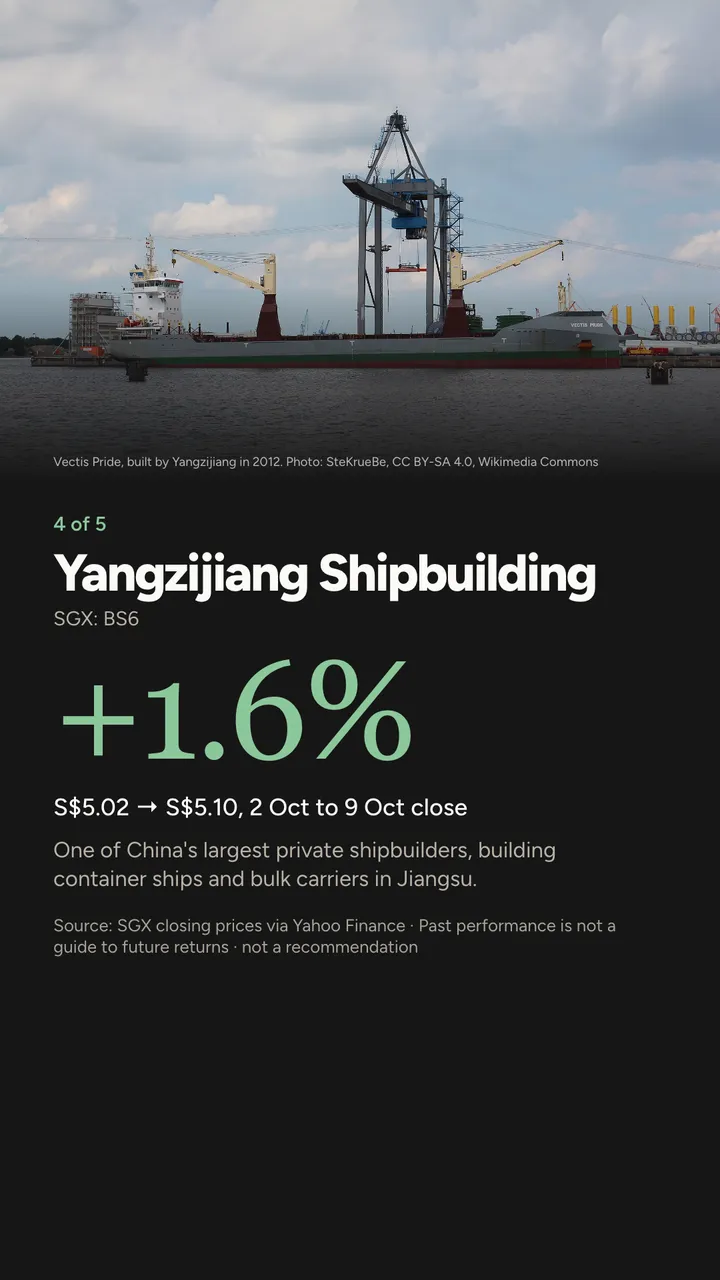
Yangzijiang is one of China's largest private shipbuilders. It builds container ships (the ones carrying the stacks of coloured boxes you see anchored off East Coast Park) and bulk carriers (for loose cargo like grain or coal) in Jiangsu province. It's listed here in Singapore, which is why it's in the STI. A shipbuilder earns money over years: an order today might be delivered several years later.
Shares went from S$5.02 to S$5.10. No single reason was reported.
The arithmetic
- 100 shares on 2 October: S$502. On 9 October: S$510. A gain of S$8 before fees.
- Per S$1,000 held: about S$1,015.94.
- Like DFI, it made the top five again the next week, rising 2.2% to S$5.21. Over the fortnight, S$1,000 would have become about S$1,037.85.
What this means for you: a stock appearing in a top-five list two weeks running is a record of two weeks, nothing more. Keep it in proportion to a business whose orders take years to deliver.
Sembcorp Industries: power, renewables and industrial parks, up 1.0%
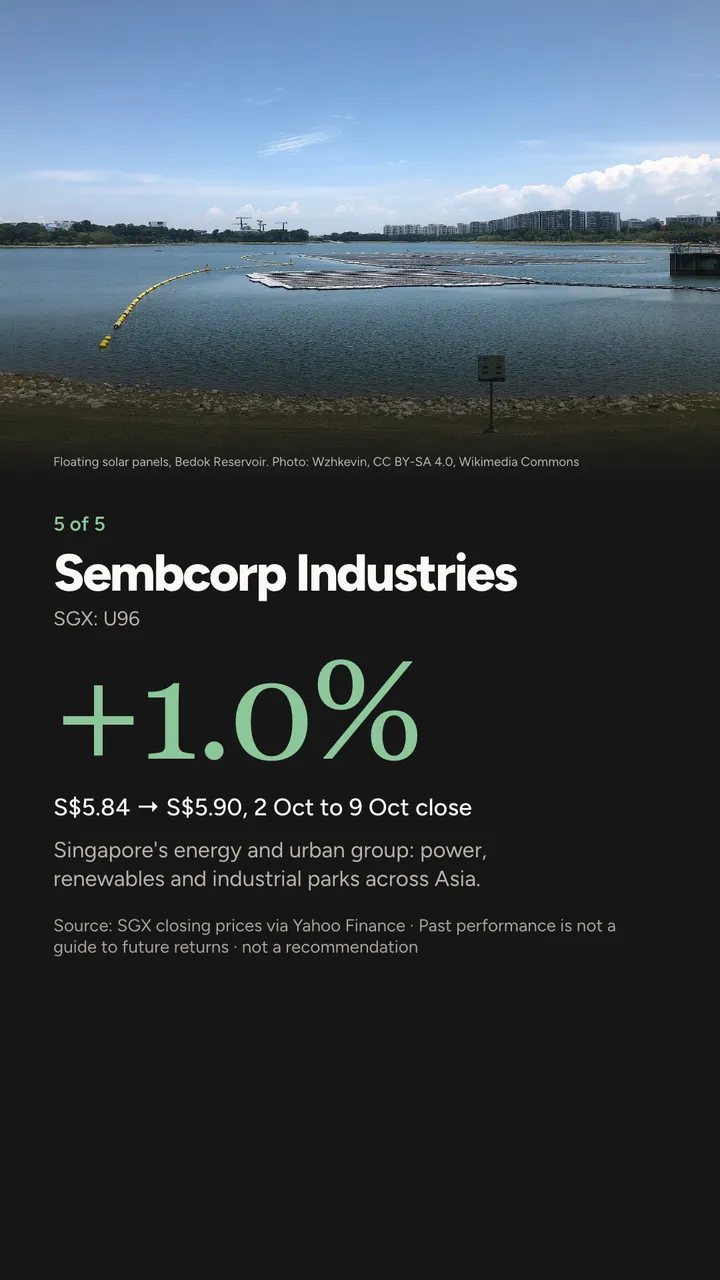
Sembcorp is a Singapore energy and urban development group. It runs power plants, builds renewable energy like solar, and develops industrial parks (large areas where factories and warehouses are built together) across Asia. Its business is the kind you rarely think about until the lights go out.
Shares went from S$5.84 to S$5.90. No single reason was reported.
The arithmetic
- 100 shares on 2 October: S$584. On 9 October: S$590. A gain of S$6 before fees.
- Per S$1,000 held: about S$1,010.27.
What this means for you: a 1.0% rise sounds tiny, and it is. But in a week when the index fell 4.1%, the gap between them was more than 5 percentage points. Comparing a stock with its index tells you more than the stock's number alone.
The week in one table
| Stock | Ticker | Close, 2 Oct to 9 Oct | Change | S$1,000 or US$1,000 became |
|---|---|---|---|---|
| Jardine Matheson | SGX: J36 | US$55.36 to US$56.73 | +2.5% | US$1,024.75 |
| Wilmar International | SGX: F34 | S$3.47 to S$3.55 | +2.3% | S$1,023.05 |
| DFI Retail Group | SGX: D01 | US$3.10 to US$3.17 | +2.3% | US$1,022.58 |
| Yangzijiang Shipbuilding | SGX: BS6 | S$5.02 to S$5.10 | +1.6% | S$1,015.94 |
| Sembcorp Industries | SGX: U96 | S$5.84 to S$5.90 | +1.0% | S$1,010.27 |
| Straits Times Index | STI | closed at 5,401.89 | -4.1% | about S$959 |
All before fees, dividends and currency moves.
One footnote that didn't fit on a slide: First Resources, a palm oil company, rose 6.5% that week, more than any of the five. It isn't on the list because it's on the STI's reserve list, the companies next in line to join the index, rather than in the index itself.
The pattern: not one bank
Look at the five again. Not one bank. Two Jardine group companies, a food and agribusiness group, a shipbuilder and an energy group. In a week when the biggest part of the index struggled, the stocks that held up were doing something quite different from banking.
That's the plain idea behind spreading money across different kinds of businesses: they don't all have the same bad week at the same time. It doesn't stop the bad weeks. It just means they don't all land together.
It's also worth noticing how small these gains are next to the losses. The best performer rose 2.5% in a week when OCBC fell 8.4%. Five green numbers don't change a 4.1% fall. The following week the banks began to recover, and UOB topped the list; I wrote that up in the STI's top five for 12 to 16 October.
If you only remember three things
- The banks are a big part of the STI, so their bad weeks become the index's bad weeks.
- Bank shares falling is not the same as bank deposits being at risk; SDIC insures deposits up to S$100,000 per member bank.
- Some SGX shares, including the Jardine group's, are quoted in US dollars, so the exchange rate is part of your return.
How I keep track of this
Whatever the STI did, the week that matters to you is your own. On weeks like this one, I find it calming to look at my shares as one line in my whole net worth, next to my savings, CPF and flat, instead of staring at a red number on its own.
In Sum, your SGX shares held in your CDP account (the Central Depository, where Singapore shares are registered in your name) sit inside your net worth beside your bank accounts, CPF and HDB flat. Stocks and CDP holdings are on the Essential plan; live prices, profit and loss, and dividends are on Pro. The free plan already shows your net worth across banks, cards, CPF and loans.
Talk soon, Brandon

Sum is launching in Singapore soon.
Your banks, cards, CPF and HDB flat, added up into one net worth. Statements sorted, card caps tracked, bills remembered.
Brandon · Finance team, Sum
Brandon is on Sum's finance team in Singapore. Brandon reads the CPF Board, IRAS and MAS updates so you don't have to, and turns our carousels into the longer version. Questions, corrections or something to share? Email Brandon at [email protected].
Got something interesting to share?
A money story, a question, something we got wrong, or a tip other Singaporeans should hear. Reach out to me at [email protected], or leave your email and I'll write to you.
Sources: Yahoo Finance, Straits Times Index price history; Yahoo Finance, Jardine Matheson (J36.SI) price history; SDIC, deposit insurance coverage (S$100,000 per depositor per Scheme member); SGX, board lot changes from 5 Oct 2026 (100 units for prices up to S$10); IRAS, Dividends: what is taxable and what is not.
Any app screens shown use sample data, not a real person's. Sum is free to start; some features need a paid plan.
Information only, not financial advice.