The Dow's top 5 stocks, week of 5 to 9 Oct 2026
The Dow rose 0.9%. Visa, Walmart, Disney, Cisco and Procter & Gamble led the 30. What each company does, the maths of each move, and what it can't tell you.

The cover of this carousel said "Let's see why." I'll be honest with you up front: for these five stocks, I couldn't find a dated report from a source I trust that explains any of the moves. I looked. I had three browser tabs of market wraps open on the bus home and none of them said anything I'd put my name to.
So this post is mostly about the what: what these five companies do, where you meet them in Singapore, the arithmetic of each move, and what a single week can and can't tell you. It's a look back at the week of 5 to 9 October 2026, when the Dow Jones Industrial Average rose 0.9%, from 51,176.96 to 51,654.95.
I like this week for a different reason too. Every one of these five is a company you've touched this month, probably without noticing. That makes it a good week to learn how to read a stock move, because you already know the businesses. No forecasts, no tips.
What the Dow is, and how it moved
The Dow tracks 30 large American companies, many of them names you deal with every week without thinking about it. That's what makes it a good starting point if you're new to US stocks: you already know most of what's in it.
We rank all 30 by comparing each stock's closing price (its last traded price of the day) on Friday 2 October with Friday 9 October, using Yahoo Finance.
The arithmetic for the index
US$1,000 spread exactly like the Dow on 2 October would have been worth about US$1,009.34 a week later. A 0.9% rise is a small move on the surface. Underneath, five of its stocks did a lot of the lifting, and not every big name joined in: Nvidia fell 2.0% and Caterpillar 5.3% over the same five days.
What this means for you: an index rising doesn't mean everything in it rose. Even in a green week, some of the biggest names can be red.
Visa rose 6.9%: the network behind your card
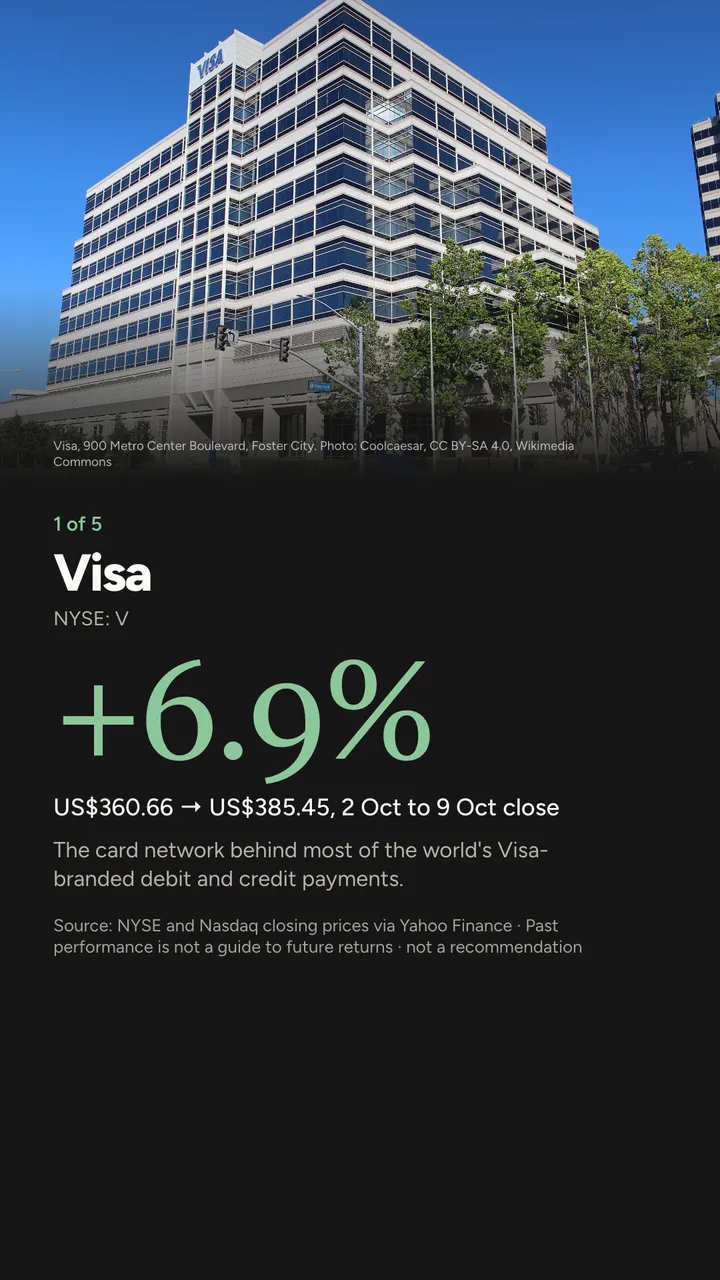
Look in your wallet. If one of your cards has the Visa logo on it, this company is involved every time you tap it at the MRT gantry or the supermarket.
Here's the thing people often get wrong, and I got wrong myself. When I got my first credit card, I thought Visa had approved me and was lending me the money. It wasn't. Your bank issues the card, sets your credit limit and charges you interest if you don't pay in full. Visa runs the network that carries the payment from the shop to your bank and back, and earns a small fee on the transactions it processes. That's why Visa makes money whether you pay your bill on time or not.
Shares went from US$360.66 to US$385.45. No single reason was reported.
The arithmetic
- US$1,000 of Visa on 2 October would have become about US$1,068.74.
- At US$360.66 a share, US$1,000 buys 2 whole shares (US$721.32), with US$278.68 left in cash. Those 2 shares were worth US$770.90 a week later.
- Some brokers let you buy a fraction of a share instead, so the whole US$1,000 is invested.
What this means for you: a high share price doesn't make a company "expensive" by itself. It mostly changes how neatly your money divides into whole shares.
Walmart rose 6.8%: the world's largest retailer
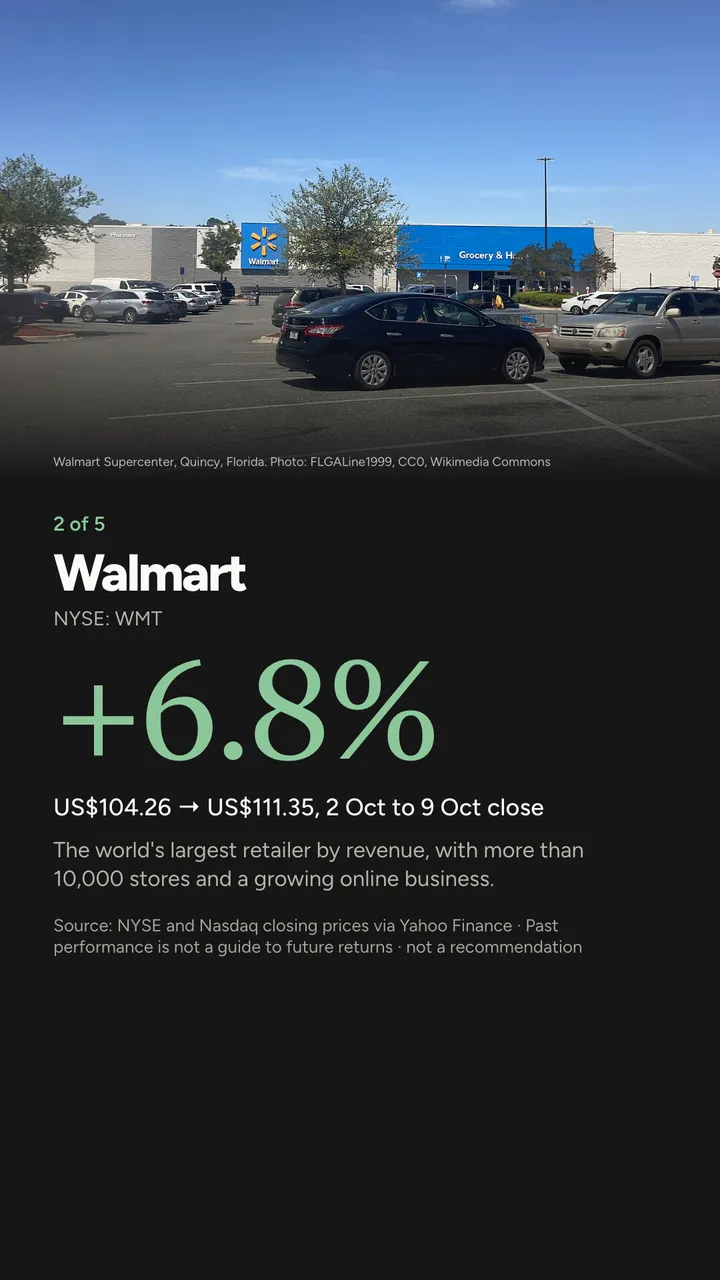
Walmart is the world's largest retailer by revenue, with more than 10,000 stores and a growing online business. There's no Walmart in Singapore, so picture your nearest NTUC FairPrice Xtra and multiply it by a few thousand. Its business is low prices on huge volumes: earning a little on each item, from an enormous number of shoppers.
Shares went from US$104.26 to US$111.35. No single reason was reported for this week's rise.
The arithmetic, and the week after
- US$1,000 of Walmart on 2 October would have become about US$1,068.00.
- It made the top five again the following week, rising 6.7% to US$118.81. Over both weeks, US$1,000 would have become about US$1,139.55.
That second week did come with a named reason in the news: investors moving out of technology stocks.
What this means for you: two good weeks in a row are two data points. They describe a fortnight, not a direction.
Disney rose 5.7%: parks, films and Disney+
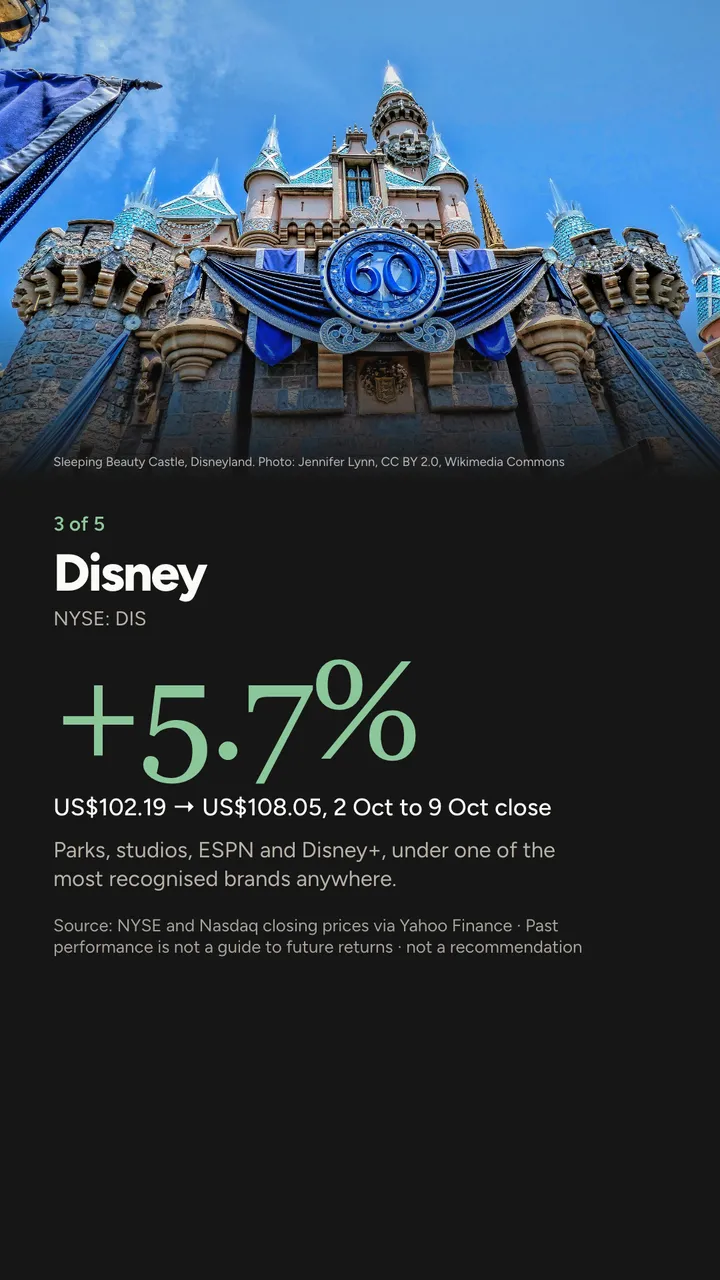
Theme parks, film studios, the ESPN sports channels and the Disney+ streaming service, all under one of the most recognised brands anywhere. In Singapore you most likely meet Disney through a Disney+ subscription, or the Marvel or Pixar film you watched at the cinema last school holidays.
It's a good example of a company with several very different businesses inside it. A theme park earns from tickets and the food stalls inside; a streaming service earns from monthly subscriptions; a film studio earns in lumps when a big film is released. One share gives you a slice of all of them.
Shares went from US$102.19 to US$108.05. No single reason was reported.
The arithmetic
- US$1,000 of Disney on 2 October would have become about US$1,057.34.
- That's US$5.86 a share.
Where my subscription goes
I'll admit I once tried to work out whether my own streaming subscriptions "added up" to anything for these companies. They don't, obviously. But it's a useful way to remember that a share is a claim on a real business, and that business earns from millions of small payments like yours.
What this means for you: when you read about a company with many divisions, ask which part is doing the work. A headline about one division doesn't describe the whole company.
Cisco rose 5.5%, then had the worst week of all 30
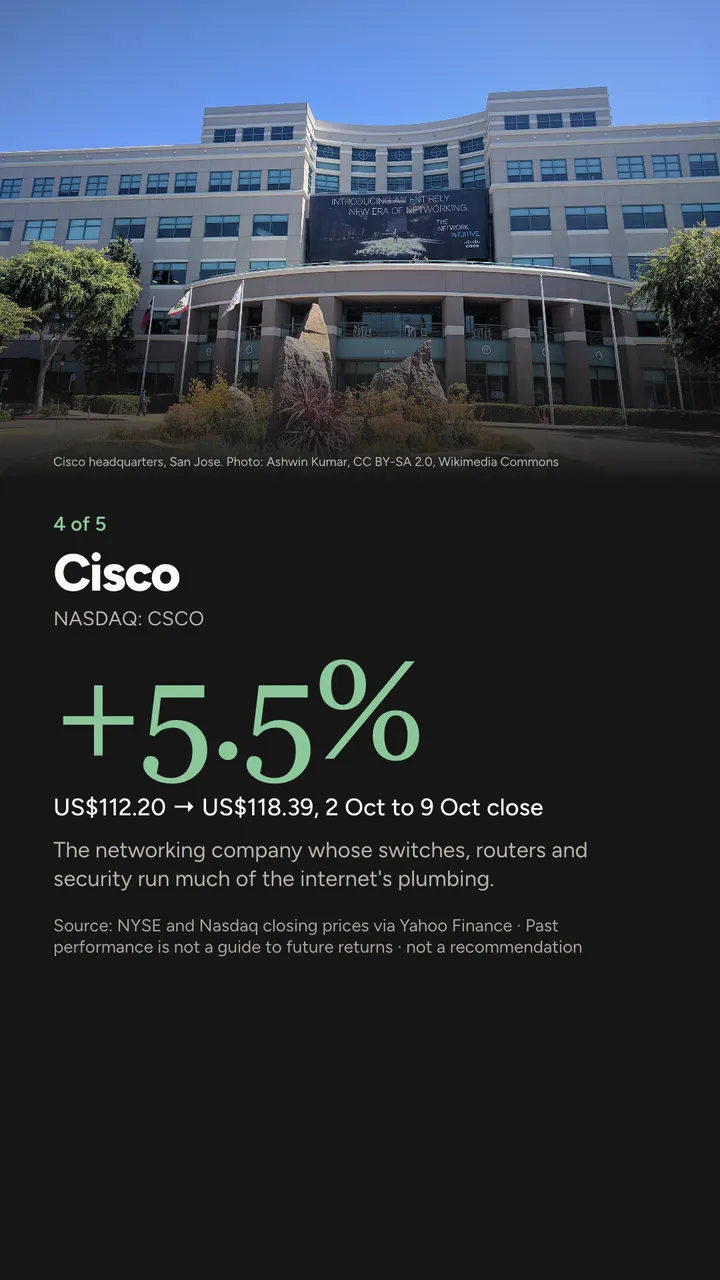
You've never bought anything from Cisco, but you've almost certainly used it. Its switches, routers and security equipment run much of the internet's plumbing: the boxes in offices and data centres that move data from one place to another. When the office wifi works, there's a fair chance a box like that is involved.
Notice the ticker says NASDAQ, not NYSE. Being in the Dow has nothing to do with which exchange a company is listed on; Cisco trades on the Nasdaq and is still one of the Dow's 30. Shares went from US$112.20 to US$118.39, and no single reason was reported.
The arithmetic, over two weeks
Here's the lesson I'd take from Cisco. The following week, it fell 9.3%, the worst of all 30 Dow stocks. Follow US$1,000 through both weeks:
- 2 October: US$1,000.
- 9 October, up 5.5%: about US$1,055.
- 16 October, down 9.3%: about US$957.
Top five one week, bottom of the list the next, and about 4% below where it started.
What this means for you: a top-five list tells you who did well over five days. It doesn't tell you who will do well over the next five.
Procter & Gamble rose 4.4%: the toiletries aisle
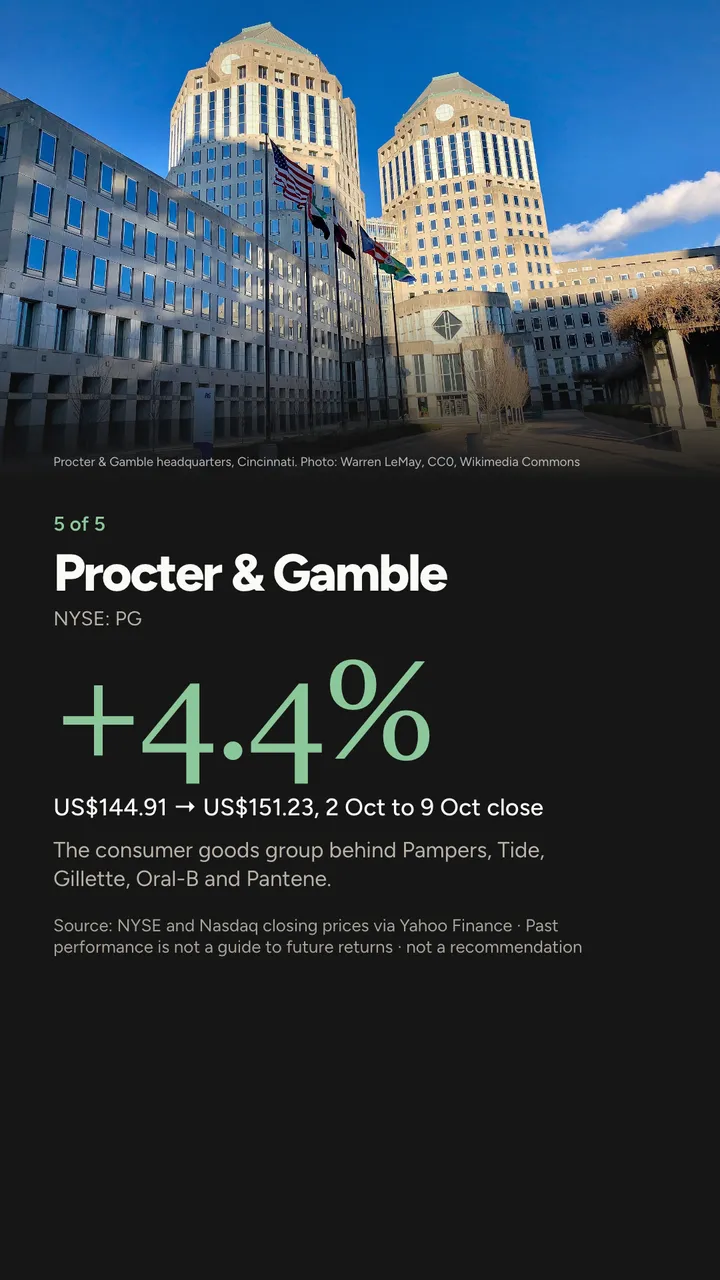
If you've stood in the toiletries aisle at a supermarket, you've seen P&G's products: Pampers, Tide, Gillette, Oral-B and Pantene, among many others. This is a consumer goods company: it makes the everyday things people buy again and again, whatever the economy is doing. Nobody postpones buying toothpaste.
Shares went from US$144.91 to US$151.23. No single reason was reported.
The arithmetic
- US$1,000 of P&G on 2 October would have become about US$1,043.61.
- That's US$6.32 a share.
Reading a US dividend notice
Companies like P&G pay regular dividends, and the first US dividend I received looked smaller than I expected. That's because the US generally withholds tax at 30% on dividends paid to people who aren't US residents, unless a tax treaty sets a lower rate, according to the IRS.
A made-up example: a US$20 dividend with 30% withheld means US$6 goes to the US tax authority and US$14 reaches your account. Your broker's statement should show both.
What this means for you: when you compare dividends from US and Singapore shares, compare what actually lands in your account.
The week in one table
| Stock | Ticker | Close, 2 Oct to 9 Oct | Change | US$1,000 became |
|---|---|---|---|---|
| Visa | NYSE: V | US$360.66 to US$385.45 | +6.9% | US$1,068.74 |
| Walmart | NYSE: WMT | US$104.26 to US$111.35 | +6.8% | US$1,068.00 |
| Disney | NYSE: DIS | US$102.19 to US$108.05 | +5.7% | US$1,057.34 |
| Cisco | NASDAQ: CSCO | US$112.20 to US$118.39 | +5.5% | US$1,055.17 |
| Procter & Gamble | NYSE: PG | US$144.91 to US$151.23 | +4.4% | US$1,043.61 |
| Dow Jones Industrial Average | DJIA | 51,176.96 to 51,654.95 | +0.9% | US$1,009.34 |
All in US dollars, before fees, dividends, tax and currency moves.
The pattern: everyday businesses
Payments, shopping, entertainment, networking and household goods. Four of the five sell straight to ordinary consumers. That week, the familiar names led.
But I'd be careful about reading too much into it. Put this week next to the following one and you get Walmart up twice in a row and Cisco going from the top five to the very bottom. A single week is a snapshot, not a trend. If you'd like to see what Singapore's market did over the same five days (it was a much rougher week), I wrote up the STI's top five for 5 to 9 October.
If you only remember three things
- Visa runs the card network; your bank issues the card and lends the money.
- A stock can go from the top five to the bottom of the list in a week, as Cisco did.
- These prices are in US dollars, so your Singapore-dollar return also depends on the exchange rate, and dividends are generally taxed at source.
How I keep track of this
US shares usually sit with your broker rather than in your CDP account, so they're easy to forget when you add up what you own. For years mine were the line I always left out of my Chinese New Year net worth spreadsheet, because they lived in a different app, in a different currency.
In Sum, your US stocks sit inside your net worth next to your bank accounts, CPF and flat, so the full picture is in one place. Stocks are on the Essential plan; live prices, profit and loss, and dividends are on Pro.
Talk soon, Brandon

Sum is launching in Singapore soon.
Your banks, cards, CPF and HDB flat, added up into one net worth. Statements sorted, card caps tracked, bills remembered.
Brandon · Finance team, Sum
Brandon is on Sum's finance team in Singapore. Brandon reads the CPF Board, IRAS and MAS updates so you don't have to, and turns our carousels into the longer version. Questions, corrections or something to share? Email Brandon at [email protected].
Got something interesting to share?
A money story, a question, something we got wrong, or a tip other Singaporeans should hear. Reach out to me at [email protected], or leave your email and I'll write to you.
Sources: Yahoo Finance, Dow Jones Industrial Average price history; Yahoo Finance, Visa (V) price history; IRS, Withholding on US-source income paid to nonresident aliens (30% or a lower treaty rate).
Any app screens shown use sample data, not a real person's. Sum is free to start; some features need a paid plan.
Information only, not financial advice.