Managing money as a couple: what to split, and how
50/50, by salary or by ownership share, plus the three BTO payments and whose CPF went in. Brandon from Sum's finance team explains it with worked examples.

A few weeks after our wedding, Rachel and I sat at the dining table on a Sunday night with the spreadsheet. You know the one. It had started life as a list of banquet tables and ang bao estimates, and somewhere along the way it had grown a tab called "after". The "after" tab was supposed to be the easy part.
Rachel scrolled down, stopped, and asked a very reasonable question: "So who pays for the aircon servicing?"
I work in finance. I read CPF circulars for fun. And I realised I had no idea. Not because we'd disagreed about it, but because we'd never talked about it. We'd planned a wedding down to the last table, and we'd bought a flat together with a joint HDB loan that both our Ordinary Accounts pay into every month, but the small, boring, every-month question of who pays for what had simply never come up.
That conversation took about an hour and was a lot less awkward than I'd feared. How we split things is ours, and I'll keep it that way. But it made me read up properly on how couples in Singapore usually do this, and that's what our latest carousel is about.
So here it is, slide by slide: why the talk comes first, three common ways to split shared costs, how a BTO is paid for, why you'll want to know whose CPF went into the flat, and how a shared account fits in.
Managing money as a couple starts in the open

There's no single right way for a couple to manage money. Some pool everything, some keep it all separate, and most end up in between: their own accounts, plus a shared pot for the flat and the bills.
What the slide is getting at is the last part: it works better in the open. Whichever way you choose, it only works if both of you can see it. A split that one person quietly resents, or one that only one person understands, tends to come apart at the worst moment, usually a big bill.
What this means for you
Before you pick a method, it's worth writing down what actually counts as "shared". The flat, utilities and groceries, almost certainly. The car, the holidays, your parents' allowances, the cat? That's where couples differ, and it's easier to agree on a list than on a feeling.
Talk about it early, and honestly

The slide lists three things to talk about: what you earn, what you owe and what you want. They're in that order for a reason.
- What you earn is the easiest to say and the one people dodge most. You can't pick a fair split without it.
- What you owe is the one that causes surprises later: a car loan, a study loan, a card balance that rolls over every month. None of these is a scandal. Finding out about one after you've signed for a flat together can feel like one.
- What you want is the fun part: a flat by a certain year, a trip, kids, helping your parents.
"No ego, no hiding" is the line I'd underline. The person who earns more isn't the "better" one, and the person with a loan isn't the problem. You're both just putting your numbers on the table so you can plan with real ones.
What this means for you
If it feels awkward, start with "what you want". It's much easier to talk about earning and owing once you've agreed what the money is for.
Option 1: split it 50/50

This is the one most of us start with, often without deciding to. Each of you pays half of every shared cost. It's simple: no maths, no percentages, and it feels even.
It really is the fairest option when you earn about the same. Where it starts to pinch is when you don't.
A worked example
Let me borrow an example couple. Say Wei Ling and Jun Hao are both 30 and share costs of $3,000 a month: the flat, utilities, groceries, the internet and the odd dinner out. This is made up, but it's a fairly ordinary picture. Jun Hao earns $6,000 a month and Wei Ling earns $4,000.
Split 50/50, each pays $1,500.
- For Jun Hao, $1,500 is $1,500 ÷ $6,000, which is 25% of his pay.
- For Wei Ling, $1,500 is $1,500 ÷ $4,000, which is 37.5% of hers.
Same split, very different month. Wei Ling has $2,500 left; Jun Hao has $4,500. Over a few years, that gap shows up in who can save and who quietly feels stretched.
What this means for you
If you earn about the same, 50/50 is hard to beat for simplicity. If you don't, it's worth working out what share of each person's pay the split takes, like above, before deciding it's fair.
Option 2: split by salary
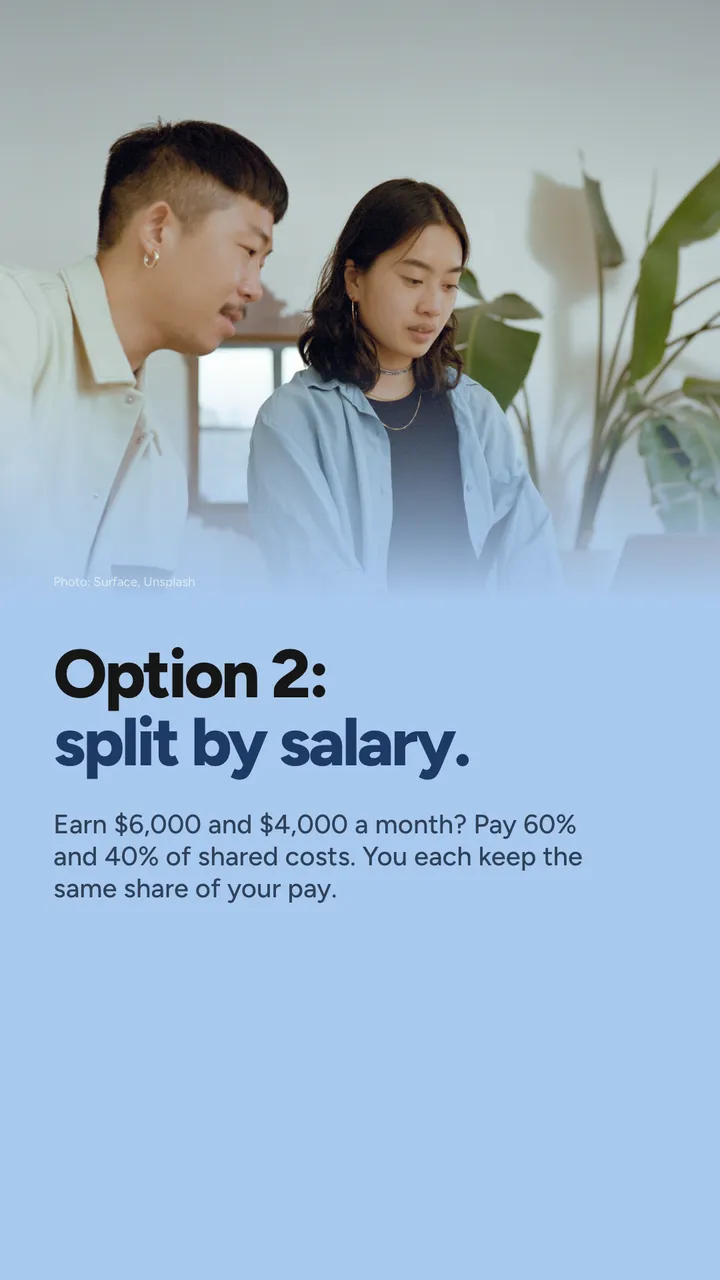
The second option fixes exactly that gap. Instead of half each, each of you pays the same share as your share of what you earn together.
Here's the arithmetic, with the slide's numbers. Together Jun Hao and Wei Ling earn $6,000 + $4,000 = $10,000 a month. Jun Hao earns $6,000 of that $10,000, which is 60%. Wei Ling earns $4,000, which is 40%. So they pay 60% and 40% of shared costs.
On their $3,000 a month:
| Pays | Share of own pay | Left over | |
|---|---|---|---|
| Jun Hao (60%) | $1,800 | 30% | $4,200 |
| Wei Ling (40%) | $1,200 | 30% | $2,800 |
Both of them now spend 30% of their pay on the shared costs. That's what the slide means by "you each keep the same share of your pay".
Two things to agree on before you start. First, which number you use: take-home pay after CPF is usually the one that matches what each of you can actually spend. Second, when you'll update it: a promotion, a new job or a bonus month changes the ratio. Once a year, or whenever either salary changes, is a reasonable rhythm.
What this means for you
If one of you earns noticeably more, this is worth trying with your own numbers. It keeps the share of pay equal, which for many couples feels fairer than the dollar amount being equal.
Option 3: split by ownership share

The third option is only about the flat, and it starts with a term most of us skim past when buying one: the manner of holding. It's how the owners hold the flat between them, and HDB has two.
- Joint tenancy. You own the flat together, as a whole, with no set shares. If one owner passes away, their interest goes to the surviving owner. This is called the right of survivorship.
- Tenancy-in-common. Each of you owns a set share, like 50/50 or 60/40. There's no right of survivorship: if one owner passes away, their share goes according to their will, or the law on intestate succession if there isn't one.
HDB lets owners change from one to the other, or change the shares, with an application that every current and proposed owner has to agree to.
Some couples who hold their flat as tenants-in-common pay for it in the same ratio as they own it. If Jun Hao and Wei Ling own their flat 60/40, he pays 60% of the flat costs and she pays 40%. What each puts in matches what each owns, which makes the record very clean if things ever change.
What this means for you
Worth checking: how your flat is held today. It's on your HDB documents. If you don't know, you're in good company, and it's a five-minute look. Whether to change it is a bigger question, and one where talking to a lawyer is worth it.
Your BTO, in three payments
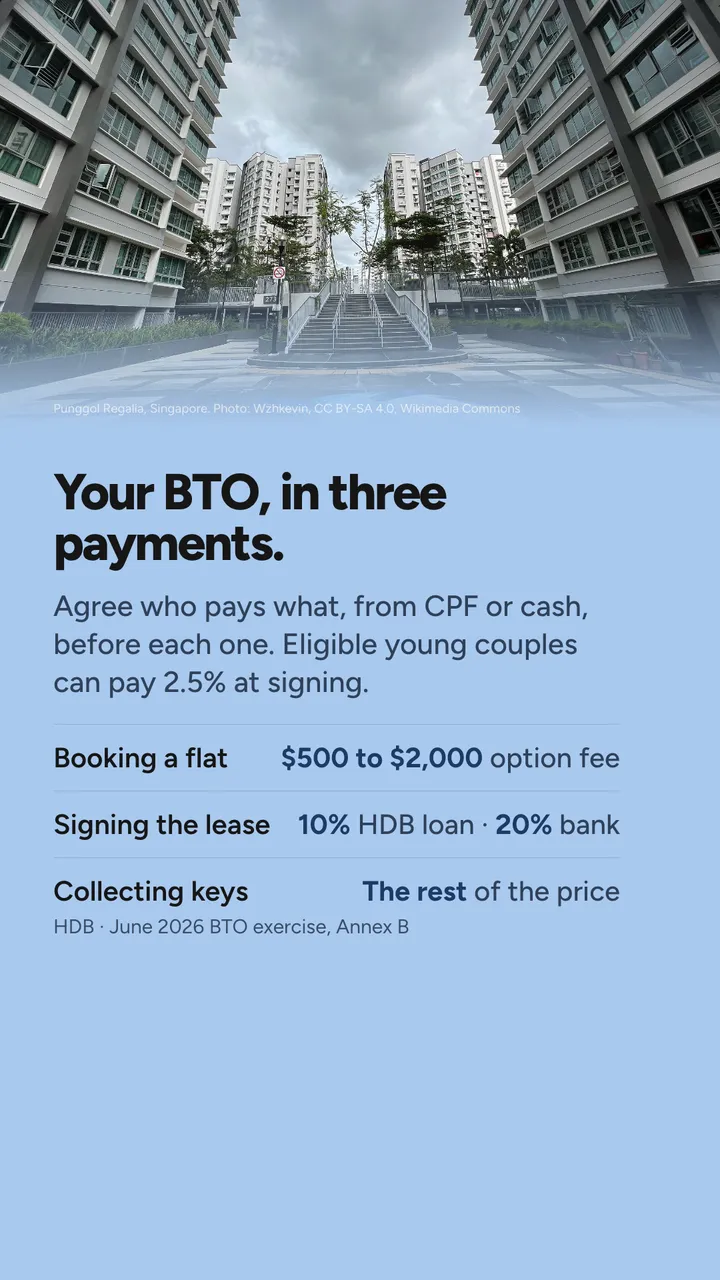
A BTO isn't paid for in one go. It comes in three steps, often years apart, and each one is a moment where a couple has to agree who pays what, and from where: CPF or cash.
- Booking a flat. You pay an option fee. It depends on the flat type, from $500 to $2,000; it's $2,000 for a 4-room flat. It forms part of the downpayment.
- Signing the Agreement for Lease. The downpayment: usually 10% of the price with an HDB loan, or 20% with a bank loan, minus the option fee you've already paid. It can come from CPF, cash or both. Under HDB's Staggered Downpayment Scheme, eligible young couples can pay 2.5% at signing instead, and pay the rest of the downpayment when they collect the keys. HDB tells you at the booking appointment if you qualify.
- Collecting the keys. The rest of the price, which for most couples is mostly the loan.
A worked example
Say Jun Hao and Wei Ling book a 4-room BTO at $400,000 (a made-up price) and take an HDB loan.
- At booking: the option fee, $2,000.
- At signing: 10% of $400,000 is $40,000. Minus the $2,000 option fee, that's $38,000.
- If they're eligible for the staggered scheme: 2.5% of $400,000 is $10,000. Minus the $2,000, that's $8,000 at signing, with the other $30,000 of the downpayment at key collection.
If they split by salary, 60/40, the $38,000 at signing is $22,800 and $15,200. If they split 50/50, it's $19,000 each. Either is fine. What matters is that they decide before the payment is due, not at the counter.
What this means for you
The years between booking and keys are long, and salaries change in between. It's worth agreeing the split for each of the three payments separately, and writing it down, so nobody has to remember a conversation from four years ago.
Track whose CPF went into the flat
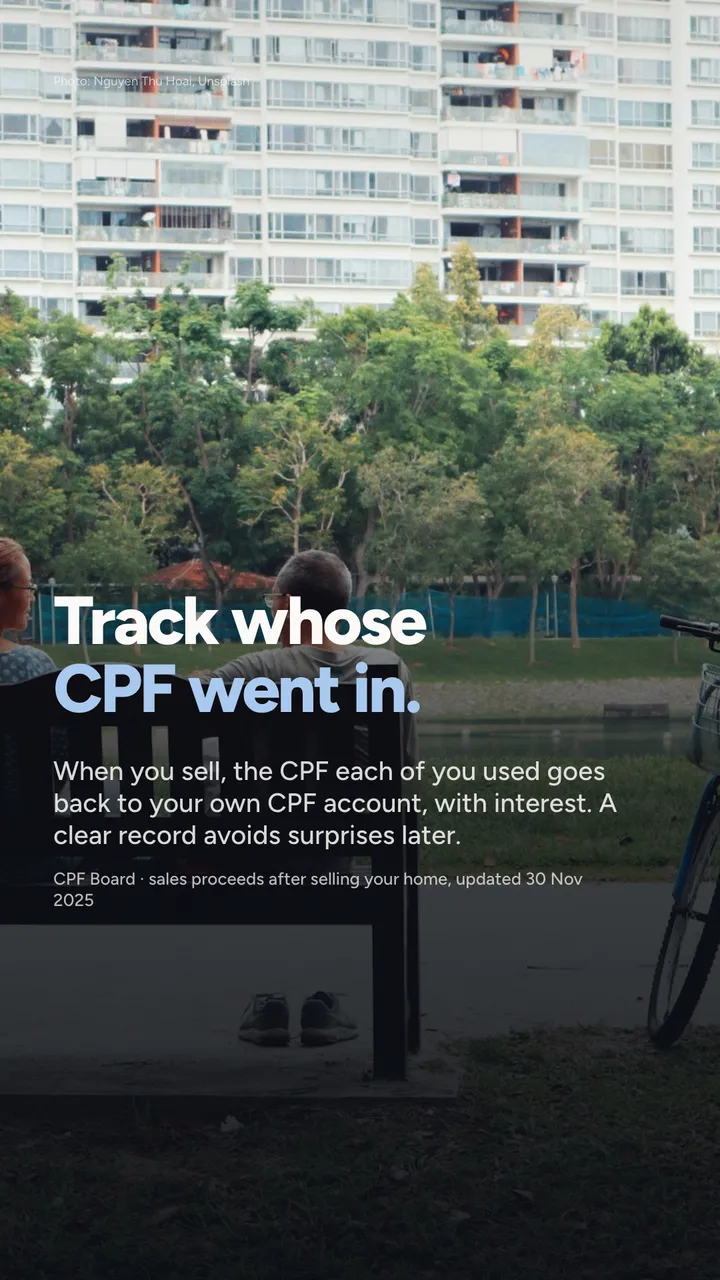
This is the slide I'd most like every couple to read twice.
When you use CPF to pay for a flat, it isn't gone. If you sell, CPF Board requires you to refund the CPF you used, plus the accrued interest: the interest that money would have earned if it had stayed in your CPF account. And it goes back to your own CPF account, not to a shared pot.
So if Jun Hao used more of his Ordinary Account for the flat than Wei Ling did, more of the sale proceeds goes back to his CPF. That's fair, since it was his CPF. But it can be a surprise if the couple thought of the flat as "ours, half each" and never kept track of who paid in what.
One more thing worth knowing from the same CPF page: if you sell the flat at market value and the proceeds aren't enough to refund everything, you don't have to top up the shortfall in cash.
What this means for you
Your CPF statement shows how much you've used for housing, and the accrued interest. It's worth each of you looking once a year, so the numbers never come as a surprise, whether or not you ever sell.
One account for shared bills

Once you've agreed a split, the easiest way to run it is one place where the shared money lives.
- A joint account. Each of you transfers your share in every month, and the shared bills come out of it. Jun Hao and Wei Ling, at 60/40, would each move $1,800 and $1,200 in on payday.
- One card with a supplementary card. One of you holds the main card and the other gets a supplementary card on the same account. All the shared spending lands on one bill. Worth knowing: the main cardholder is usually responsible for the whole bill, supplementary spending included, so check the card's terms.
Either way, the shared spending ends up in one statement you can both see.
What this means for you
If you set up a joint account, a standing transfer on payday for each of you does most of the work. The account only works if both of you can see what's going in and out.
Both of you, one clear view
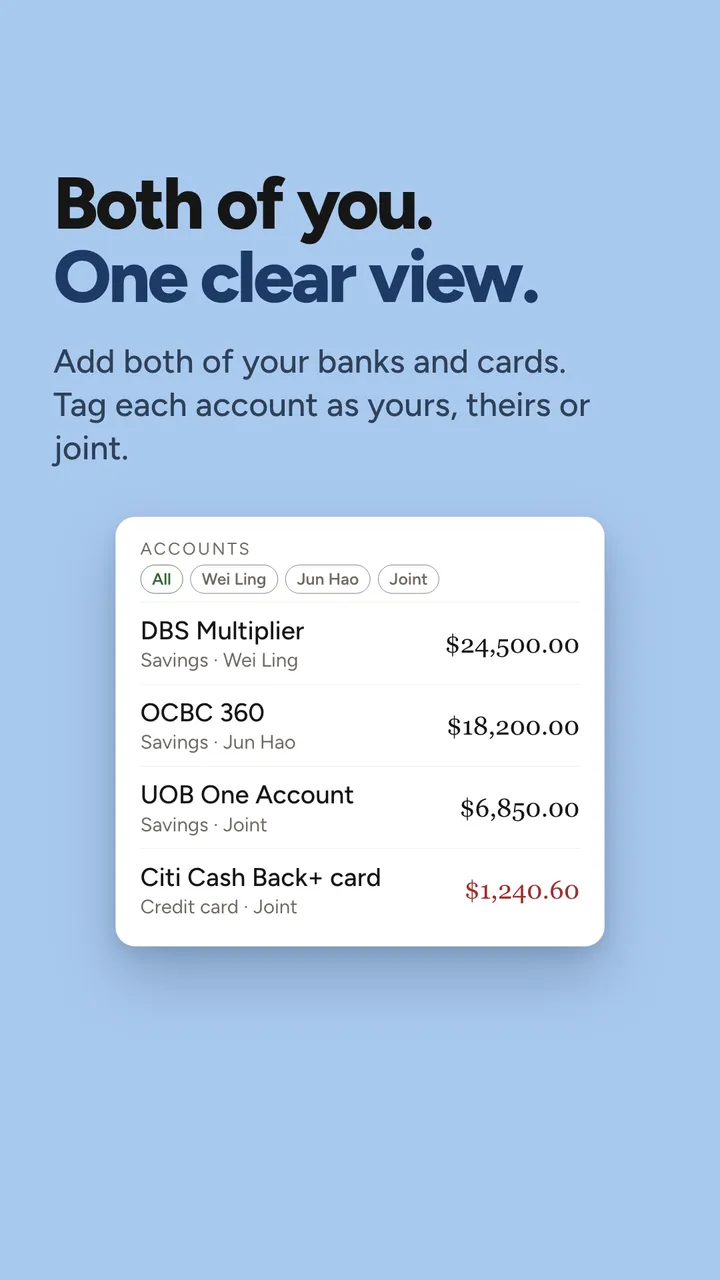
This is where Sum comes in. You can add both of your banks and cards in one Sum: link a bank, or import a statement. Then tag each account by owner, as yours, your partner's or joint, and filter the list by person.
On the slide, Wei Ling's savings, Jun Hao's savings, the joint account and the joint card all sit in one list, each labelled. One person's Sum shows the whole household, and you can still look at just your own accounts when you want to.
To be clear about what it is: it's one Sum with both of your accounts in it, tagged by owner. It isn't two logins linked together. Only add your partner's accounts if they're happy for you to.
Plan the big things together
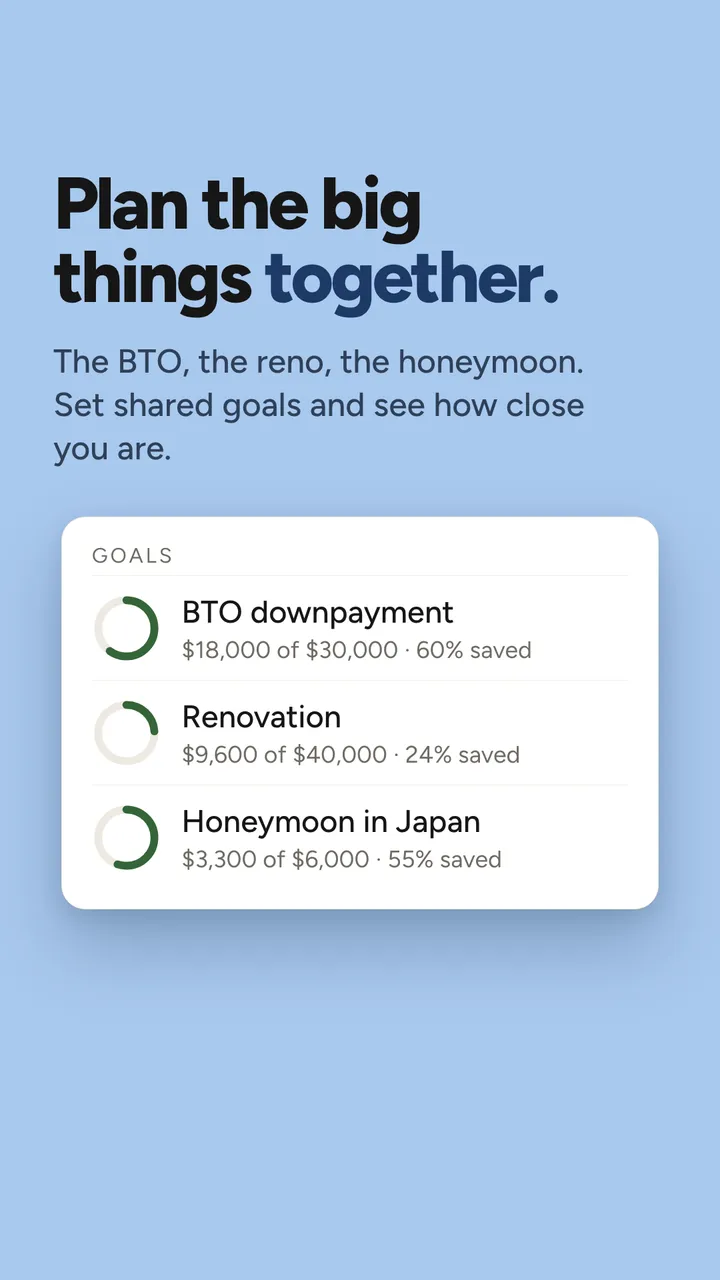
The last piece is the part that makes the money talk worth having: the things you're saving for. On the slide, the example couple has three goals: a BTO downpayment ($18,000 of $30,000, 60% saved), the renovation ($9,600 of $40,000, 24%) and a honeymoon in Japan ($3,300 of $6,000, 55%).
A goal you can both see turns "we should save more" into "we're 60% of the way to the downpayment".
If you only remember three things
- Talk first: what you earn, what you owe, what you want. The method matters less than both of you seeing it.
- 50/50 is simplest when you earn about the same. Splitting by salary keeps the same share of each person's pay. Splitting by ownership share matches what each of you owns.
- For a flat, agree each of the three payments ahead of time, and know whose CPF went in, because it goes back to each owner's own CPF account, with interest, when you sell.
How I keep track of this
In my own Sum, my accounts are tagged as mine and the joint account and joint card as joint. On the first of the month, with my kopi, I import last month's statements as usual, and I now look at the joint account too: what went in, what came out, and whether the shared bills matched what we'd expected.
We also have a couple of shared goals. I'll keep those to ourselves, but seeing them fill up together is the part I didn't expect to enjoy this much.
And the aircon servicing? It's in the shared bills now, with a reminder before it's due. It took us an hour on a Sunday night to sort out, and it was one of the better hours of the year.
If you've found a way of splitting that works for you, or a question this post didn't answer, email me at [email protected]. I read every one.
Talk soon, Brandon
Try the numbers yourself

Sum is launching in Singapore soon.
Your banks, cards, CPF and HDB flat, added up into one net worth. Statements sorted, card caps tracked, bills remembered.
Brandon · Finance team, Sum
Brandon is on Sum's finance team in Singapore. Brandon reads the CPF Board, IRAS and MAS updates so you don't have to, and turns our carousels into the longer version. Questions, corrections or something to share? Email Brandon at [email protected].
Got something interesting to share?
A money story, a question, something we got wrong, or a tip other Singaporeans should hear. Reach out to me at [email protected], or leave your email and I'll write to you.
Sources: HDB, Change in manner of holding or ownership proportion; HDB, Sign Agreement for Lease (BTO downpayment and Staggered Downpayment Scheme); June 2026 BTO exercise, Annex B; CPF Board, Sales proceeds after selling your home (updated 30 Nov 2025).
Any app screens shown use sample data, not a real person's. Sum is free to start; some features need a paid plan.
Information only, not financial advice.