Why is managing money so hard in Singapore? It isn't you.
Travel, family, a flat of your own, and a life that keeps asking for more. Brandon from Sum on keeping track of your money when you can't watch it all.

A few Sundays ago I was at my parents' flat for dinner. My mum asked, for maybe the fourth time this year, when I was finally going to take that Japan trip I keep talking about. My dad had the evening news on, something about oil prices and the markets. And I was half-listening to both, because my phone had just reminded me a card bill was due that week and I was trying to remember whether I'd set up the payment.
That one evening had most of my financial life in it. Something I want (the trip). People I want to look after (the two of them, arguing gently about the TV volume). Admin that never stops (the bill). And a world that moves my money whether I'm paying attention or not (the news).
Nobody dreams of a budget. What we want is the life the money pays for. This post goes with our carousel about exactly that: what young Singaporeans want their money for, what gets in the way, and how to keep track without watching everything. One section per slide, with the arithmetic where there is some.

Saving for travel: how to plan a trip fund

For years my travel planning went like this: book the trip, pay for it on a card, and spend the next few months paying it off. The holiday kept showing up in my statements long after the tan had faded.
What changed it was a sinking fund: money you set aside regularly for a cost you know is coming, so the cash is there when it arrives.
A worked trip fund
Here's how I'd plan a spring trip to Tokyo, starting a year out. These are example figures for illustration, not quotes; your own will depend on when you go and how you travel.
| Item | Example budget |
|---|---|
| Flights | $700 |
| Accommodation (my share) | $1,200 |
| Food and local transport | $1,000 |
| Shopping and a buffer | $1,100 |
| Total | $4,000 |
- Months until the trip: 12
- Monthly amount: $4,000 divided by 12 = about $333 a month
If I only start six months out, it's $4,000 divided by 6, or about $667 a month. Same trip, twice the monthly pain. Starting early is most of the trick.
What this means for you
- Price the trip before you book it, line by line, and include a buffer. The buffer is what stops the trip spilling into the next three statements.
- Give the trip its own goal, separate from your emergency money, so you never have to choose between them.
- If you pay on a card for the rewards, have the cash ready to clear the bill in full. A trip paid off over months with card interest costs a lot more than the price on the booking page.
Looking after your parents, and yourself

I grew up in an HDB flat with parents who never once made me feel money was tight, which I now understand took a lot of quiet effort on their part. These days I give them something every month. It doesn't feel like a bill. It feels like the least I can do.
But the slide's second half matters just as much: "with something left over for themselves". If you give so much that you can't save, you may need help yourself later, which is the last thing most parents want.
A worked example
Say Mei Ling (an example, not a real person) takes home $4,000 a month. She plans her month like this:
- Allowance to her parents: $400 a month, which is 10% of her take-home pay
- A separate "For Mum and Dad" fund for the bigger things, like a new fridge or a dental bill: $125 a month
- Her own savings and goals: decided after those two, not instead of them
The sample goal on the slides further down shows "For Mum and Dad" at $1,500 of $3,000. At $125 a month, the remaining $1,500 takes $1,500 divided by $125 = 12 months.
A CPF option worth knowing about
If you top up a parent's CPF in cash, you may be able to claim tax relief on it. According to IRAS, CPF Cash Top-up Relief for top-ups to family members is capped at $8,000 per Year of Assessment, separate from the $8,000 for your own account, and the family member's income in the preceding year must not exceed $8,000. There are other conditions too, so check the IRAS page (linked under Sources below) before you rely on it.
What this means for you
- Decide the family amount first, then your own savings, so neither gets whatever's left at the end of the month.
- Talk to your parents about their plans, not just their needs. Knowing what they already have makes your help go further.
Saving for a flat and the things you love

A flat of your own is the biggest goal on this list for most of us, and it's also the longest. The sample goal later in the deck is a $30,000 BTO downpayment fund with $9,000 saved. That figure is sample data; what you'll actually need depends on the flat, the price and the loan, so check HDB's own pages for your situation.
Still to save: $30,000 minus $9,000 = $21,000. At $600 a month, that's $21,000 divided by $600 = 35 months, just under three years. At $800 a month, it's about 26 months.
Then there's the other half of the slide: hobbies and passions. People feel guilty about this one, and I think that's a mistake. I keep a small monthly amount for my own hobbies as a real budget line, not a leak. Planned, I enjoy it more and I don't raid the flat fund for it.
What this means for you
- Long goals need visible progress. Check the flat fund monthly, not daily, and watch the percentage rather than the gap.
- Budget for joy on purpose. A small, planned hobby amount protects your big goals from impulse raids.
Why money admin wears you down

The first thing that gets in the way of all those wants is simply life. You work long days. You come home tired. And then there's the admin.
Let me count mine. Two credit card bills with different due dates. An income tax instalment by GIRO. Town council charges. A phone bill. A yearly insurance premium I always forget. A CPF statement I mean to look at. Six or seven things, each in a different app or envelope, each easy on its own.
It's the pile that wears you down. Every item is a small decision: did I pay it, is the amount right? When you're tired, the easiest thing is not to look, and money you don't look at tends to drift.
What this means for you
- Write down every recurring bill once: what it is, how much, how often, and when it's due. Most people find one they'd forgotten.
- Put whatever you can on automatic payment, then check the amounts once a month rather than remembering each one.
- I wrote more about the pile in too many bills and cards.
How world news ends up in your accounts

The second thing is the world. The slide names three ways it reaches your money:
- Geopolitical tension. A conflict or a trade dispute far away can change what companies expect to earn, and share prices move on those expectations.
- Oil prices. Oil goes into shipping, flights, electricity and plastics, so a jump in its price raises costs for many companies. It can help others, like energy producers.
- Interest rates. When rates rise, borrowing costs more and safer places to keep money pay more, so investors may pay less for shares. When rates fall, the reverse can happen.
My dad's evening news is full of these. The headlines feel far away, and they are. But if you own shares or a fund, events thousands of kilometres away can show up in your accounts within hours, without you doing anything.
I'm not going to tell you what any of this means for markets next month. Nobody knows, and I'd be wary of anyone who says they do.
What this means for you: know what you own and why. If you understand what's in your portfolio, a headline is easier to put in context, and a move in your numbers is part of investing, not a sign your plan has gone wrong.
What to do when your investments drop
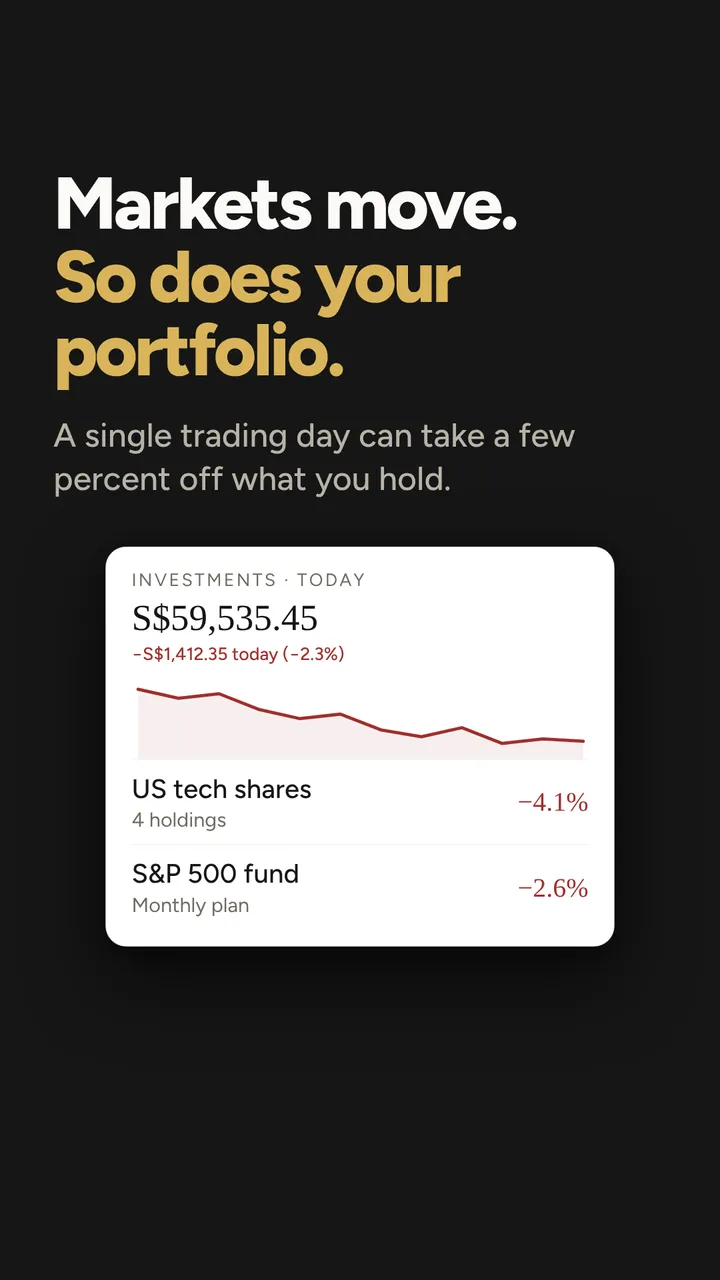
If you invest, you'll have days like the one on this slide. The sample portfolio is at S$59,535.45, down S$1,412.35 on the day, or 2.3%. Underneath: US tech shares down 4.1%, and an S&P 500 fund on a monthly plan down 2.6%.
The two lines fell by different amounts. Different holdings react to the same news differently, so the whole portfolio moves less than its worst line.
Putting the number in context
A drop of $1,412.35 looks alarming on its own. Here's how I'd read it:
- Yesterday's value: $59,535.45 + $1,412.35 = $60,947.80
- The fall as a share of the portfolio: $1,412.35 divided by $60,947.80 = about 2.3%
- The fall as a share of the sample net worth on the next slide ($448,611.85): $1,412.35 divided by $448,611.85 = about 0.3%
Same dollar figure, very different feeling. A red number at the top of an investments screen is one part of your money, on one day.
The "monthly plan" next to the S&P 500 fund means a fixed amount invested every month. On a down day, that same amount simply buys more units at the lower price. That's how the arithmetic works, not a prediction: prices can keep falling, and past performance is not a guide to future returns.
What this means for you
- You didn't make a mistake because the market moved. Prices go up and down; that's what investing involves.
- A single day tells you very little about a plan meant to run for years. Decisions made at 2am after a headline are rarely the ones you'd make with a clear head.
You can't watch everything, and you don't need to

Last year I went through a stretch of checking my investments several times a day. I told myself it was responsible. My returns were the same as if I'd looked once a week, and my sleep was worse.
The arithmetic of constant checking
Say you check five money apps three times a day, at about two minutes each:
- Per day: 5 apps times 3 checks times 2 minutes = 30 minutes
- Per year: 30 minutes times 365 = 10,950 minutes, which is about 182 hours, or more than seven full days
Now compare one proper look a week, say 15 minutes on a Sunday. That's 15 times 52 = 780 minutes, or 13 hours a year. You'd get back almost 170 hours, and you'd probably know your numbers better, because a weekly look is a real review and not a nervous glance.
What this means for you: pick a rhythm (weekly for spending and bills, monthly for goals, yearly for the big picture) and let reminders hold the due dates instead of your head.
Seeing your whole net worth through the ups and downs
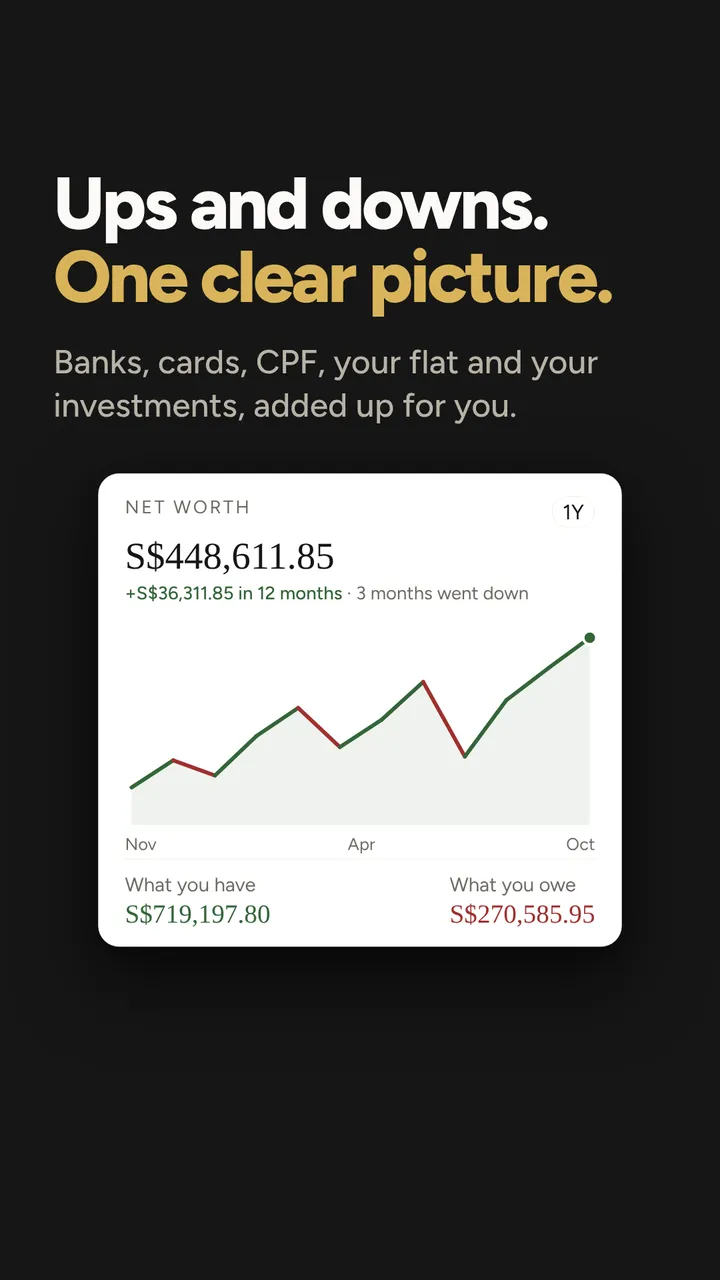
Your net worth is everything you have minus everything you owe. In the sample, what you have is S$719,197.80 and what you owe is S$270,585.95, so the net worth is S$448,611.85.
The chart is the more interesting part. Over the last 12 months it's up S$36,311.85, which means it started at $448,611.85 minus $36,311.85 = $412,300. Three of those twelve months went down. That's what a normal year looks like. A bad headline becomes a dip in a line, not a crisis.
Remember the S$1,412.35 drop from the investments slide? Against this whole picture, it's about 0.3%. That's why I find the full view calming rather than stressful: it puts every individual number in proportion.
What this means for you: judge your money by the 12-month direction, not one month or one day, and include everything. A net worth that leaves out CPF or your home loan can look much better or much worse than reality.
Keeping your goals where you can see them
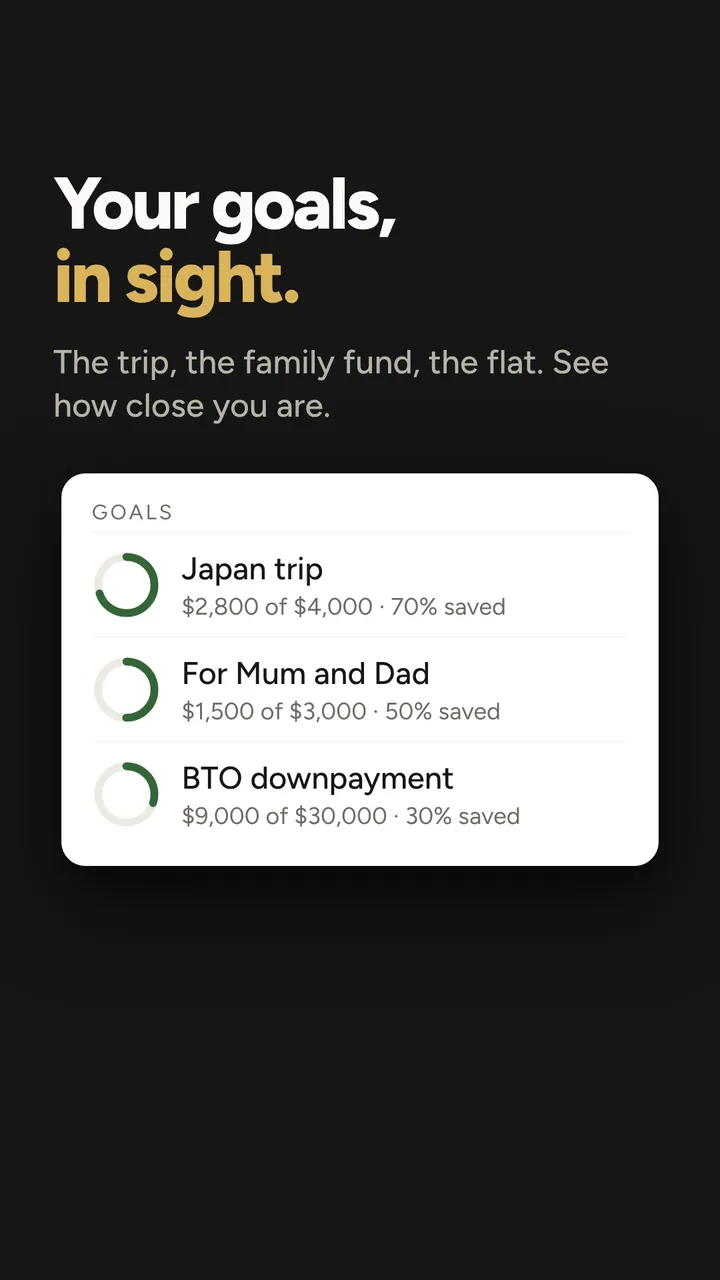
Remember the three things we started with? Here they are as goals:
- Japan trip: $2,800 of $4,000, 70% saved
- For Mum and Dad: $1,500 of $3,000, 50% saved
- BTO downpayment: $9,000 of $30,000, 30% saved
Across all three, that's $2,800 + $1,500 + $9,000 = $13,300 saved out of $4,000 + $3,000 + $30,000 = $37,000, or about 36%.
Seeing these together makes trade-offs visible. When I was saving for my own trip, seeing "70%" made it much easier to say no to things I didn't really want. A sale page is easier to resist when the alternative has a progress ring.
What this means for you
- Order your goals. If money is tight one month, decide in advance which goal gets topped up first.
- Celebrate when one finishes. Then give that monthly amount a new job straight away, before it quietly turns into spending.
Never missing a bill
I once paid a card bill four days late, in a week when everything at work was due at once. It was a small amount, and the late fee still annoyed me more than almost anything I've ever bought, because I got nothing for it.
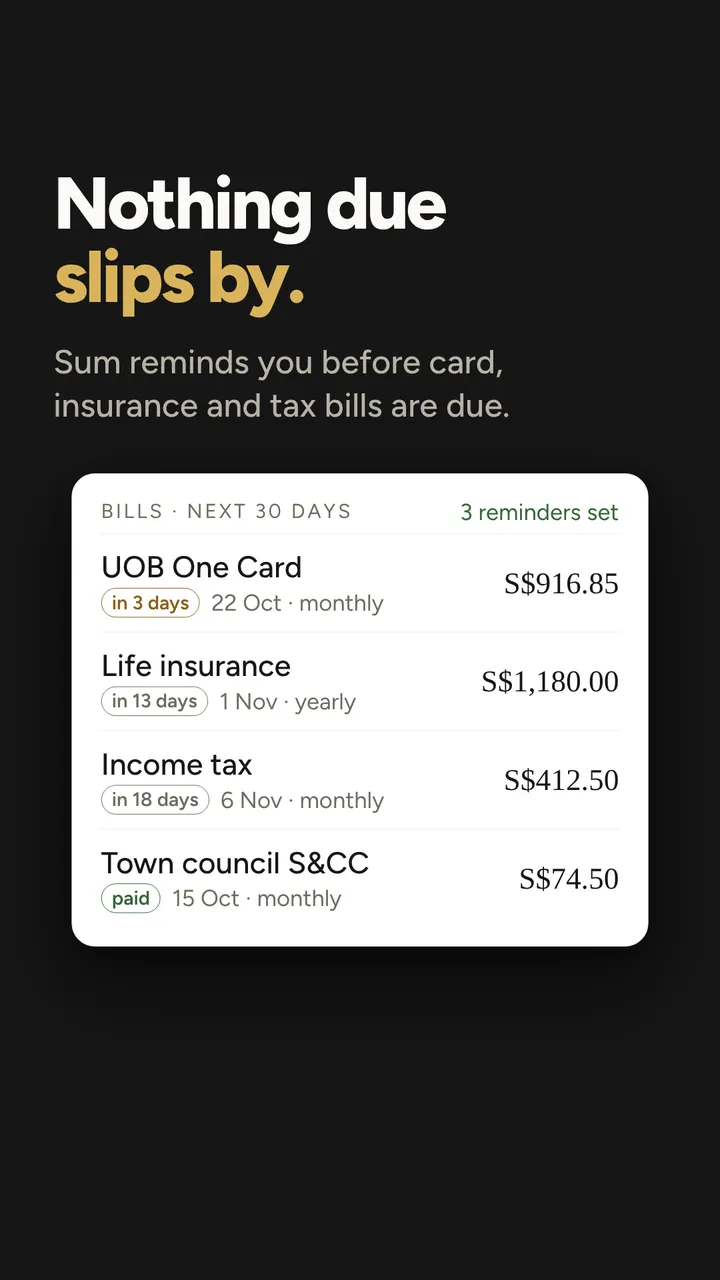
The sample shows the next 30 days:
- UOB One Card: S$916.85, due 22 Oct, in 3 days
- Life insurance: S$1,180.00, due 1 Nov, yearly
- Income tax: S$412.50, due 6 Nov, monthly
- Town council service and conservancy charges: S$74.50, already paid on 15 Oct
The arithmetic worth doing
What's still due: $916.85 + $1,180.00 + $412.50 = $2,509.35. That's the amount your account needs to cover over the next few weeks, on top of everything else.
The yearly insurance premium is the sneaky one. $1,180 once a year is a jolt. $1,180 divided by 12 is about $98.33 a month. If you set that aside monthly, the premium month feels like any other month.
What this means for you
- Know your total due for the next 30 days, not just the next bill, and spread yearly bills into monthly set-asides.
- Pay card bills in full and on time. Late fees and card interest are money spent on nothing.
If you only remember three things
- Give each want a goal with a number and a date. A trip fund started a year out costs half as much per month as one started six months out.
- Put news-driven drops in proportion. One day's fall is one part of your money on one day.
- Don't try to watch everything. Pick a weekly rhythm and let reminders carry the rest.
How I keep track of this

I wanted one place that keeps track, so I only have to look when it matters. My bank accounts, cards, CPF and loans are added up into one net worth with a 12-month chart, which is the view I check on Sunday mornings. I have goals for the trip and for my parents, with progress rings. And bill reminders cover my cards, insurance and tax, so a due date in a busy week doesn't catch me out again. All of that is on the free plan, and Sum is free to start.
Investments in your net worth, and pulling in your flat's details automatically, are on the paid plans.
To be clear about what Sum is: it keeps track. It doesn't invest your money, grow it or move it. It's read-only and can't make a payment. What it does is take the need-to-dos off your mind, so there's more room for the want-to-dos.
I did finally book the Japan trip, by the way. My mum has moved on to asking other questions.
If you try Sum, I'd love to hear what your first goal is. Email me at [email protected], I read every one.
Talk soon, Brandon
Try the numbers yourself

Sum is launching in Singapore soon.
Your banks, cards, CPF and HDB flat, added up into one net worth. Statements sorted, card caps tracked, bills remembered.
Brandon · Finance team, Sum
Brandon is on Sum's finance team in Singapore. Brandon reads the CPF Board, IRAS and MAS updates so you don't have to, and turns our carousels into the longer version. Questions, corrections or something to share? Email Brandon at [email protected].
Got something interesting to share?
A money story, a question, something we got wrong, or a tip other Singaporeans should hear. Reach out to me at [email protected], or leave your email and I'll write to you.
Sources: IRAS, CPF Cash Top-up Relief.
Any app screens shown use sample data, not a real person's. Sum is free to start; some features need a paid plan.
Information only, not financial advice.