Why is it so hard to save money? Four things working against you
Other people's best days online, buying to be seen, ads that look like tips, and deals that end at midnight. Brandon from Sum on why saving feels so hard.

It was 11:52pm on a Wednesday. I'd picked up my phone to set an alarm, and somehow I was looking at a smartwatch at more than half off. There was a countdown in red. There was a little bar saying most of the stock was gone. I had eight minutes to decide whether I needed a smartwatch, a question I had never once asked myself before 11:44pm.
I bought it, obviously. I wore it every day for about three weeks. Then the novelty wore off, the strap irritated my wrist, and it went into a drawer, where it still lives with its charger, like a small monument to that night.
I'm not telling you this because it was a financial disaster. It wasn't. I'm telling you because I work in finance, I know exactly how that sale was designed, and it still worked on me. If saving money feels harder than it should, I don't think it's because you're bad with money. A lot of very clever people spend their working days making spending feel easy, natural and urgent. Saving has nobody cheering it on.
Our carousel names four things working against you. Here's the longer version of each one, with the arithmetic, and what I've found actually helps.
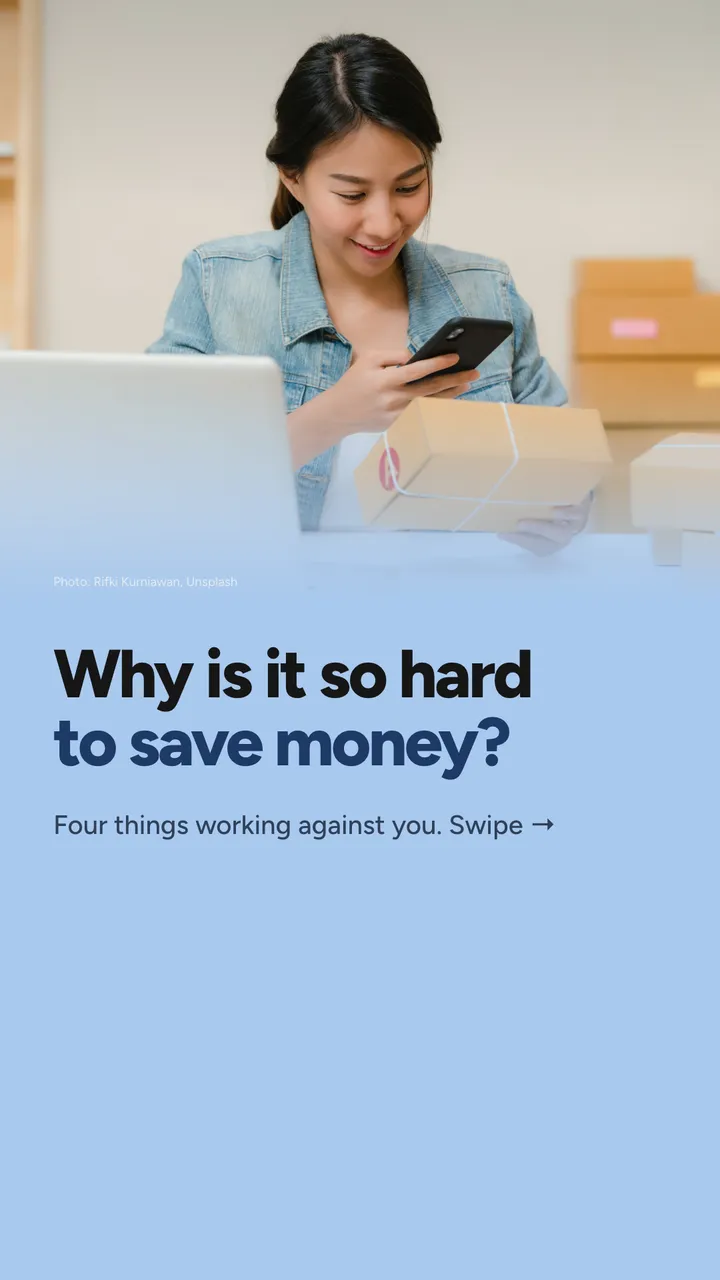
Why everyone's life looks better online
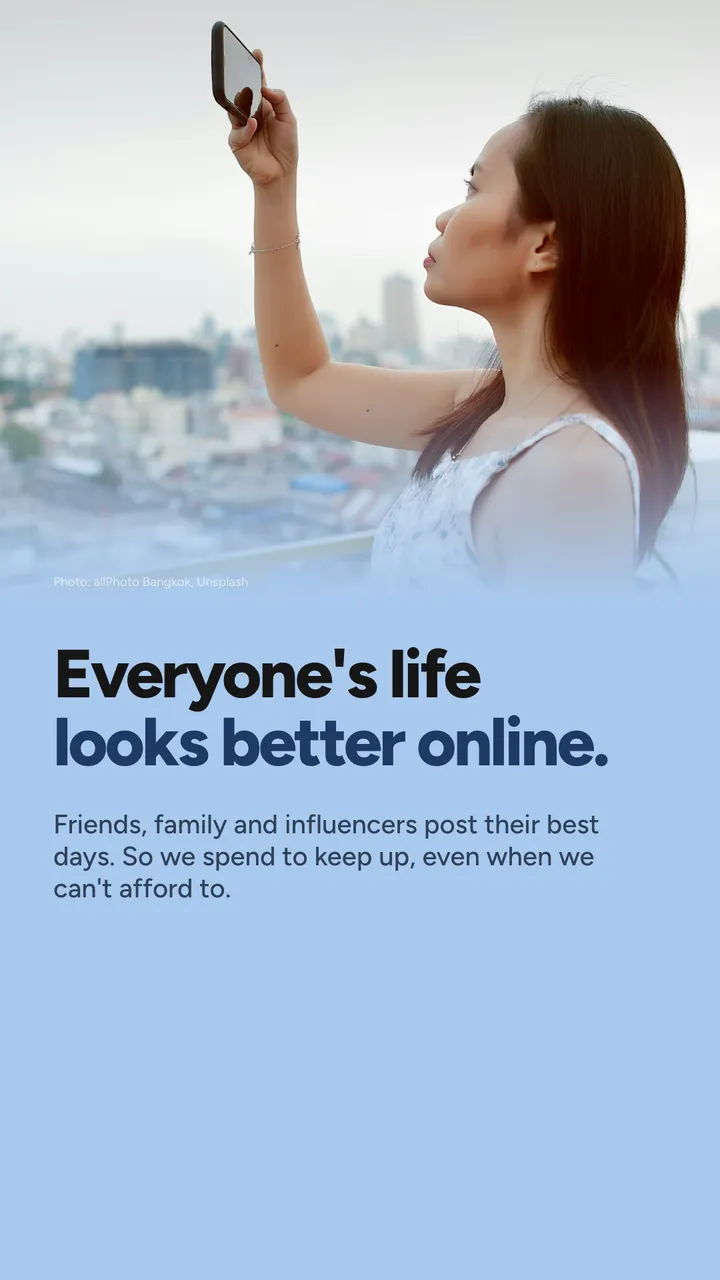
Nobody posts the night they ate instant noodles to stay under budget. They post the rooftop bar, the omakase, the hotel view. So when you scroll, you're comparing your ordinary Tuesday with everyone else's best day.
Psychologists call this social comparison: we judge how we're doing by looking at the people around us. That instinct made sense when "the people around us" meant a kampung or an office. Online, it means hundreds of people's highlights, all arriving at once.
Why it feels like everyone is always on holiday
Here's some simple arithmetic, with made-up but ordinary numbers. Say you follow 150 friends and acquaintances, and each of them takes two trips a year and posts about them.
- Trips in your feed per year: 150 people times 2 trips = 300
- That's 300 trips spread over 365 days, so close to one a day
Nobody you know is on holiday all the time. But your feed is, because it's adding up 150 people's best weeks. It quietly resets what "normal" looks like, and normal starts to cost more. A few years ago, after a week of other people's Japan photos, I booked a weekend away I hadn't planned for. It was a lovely weekend. It also wasn't in the budget, and I knew that when I booked it.
What this means for you
- Remember that a feed is an edit, not a bank statement. You can see what someone bought. You can't see how they paid for it.
- Compare yourself with yourself. Are you in a better spot than a year ago? That's the only comparison with all the facts.
- Notice your triggers. If a certain kind of post reliably makes you want to spend, it's fine to mute it for a while.
Do you love it, or love being seen with it?

This is a question I genuinely ask myself before a big purchase now. Some things we buy because they make our days better: a good mattress, decent running shoes, the kopi that gets us through the morning. Some things we buy because of what they say about us to other people.
There's nothing wrong with enjoying nice things. But buying for status is a treadmill. There's always a newer model, a nicer brand, someone with more. And we get used to new things surprisingly fast. Psychologists call it hedonic adaptation: the thrill of a new purchase fades, and we drift back to how we felt before. That's why the second bag rarely feels as good as the first.
A worked example
Say Jun Hao (an example, not a real person) is choosing between two watches: one at $180 and one at $1,200. Both tell the time. The difference is $1,020.
- If he's saving $300 a month for a trip, $1,020 is $1,020 divided by $300, or 3.4 months of trip savings.
- If he'll wear the watch most days for three years, call it 900 wears. The cheaper one costs $180 divided by 900, or 20 cents a wear. The pricier one costs $1,200 divided by 900, or about $1.33 a wear.
Neither number tells Jun Hao what to do. Maybe the $1,200 watch is something he'll treasure for a decade, and $1.33 a wear is a fine price for that. The point is to see the trade-off clearly instead of letting a feed decide for him.
What this means for you
- Try the "nobody would know" test. Would you still want it if nobody else would ever see you with it? If yes, it might be worth saving for. If the honest answer is no, that's useful to know too.
- Translate prices into your goals. "$1,020" is abstract. "Three and a half months of my holiday fund" is not.
- Wait a week on anything big. If you still want it after seven days, you probably actually want it.
When an ad doesn't look like an ad
A lot of advertising today doesn't look like advertising. It looks like a real person, in their real kitchen, giving a glowing review, with a link below. It feels like a tip from a friend. That's the point.
When something feels like a recommendation instead of a sales pitch, we lower our guard. We stop asking "do I need this?" and start thinking "everyone seems to love this, maybe I need it". Nothing about the product has changed. Only the packaging of the message has.
My own weak spot is kitchen gadgets. I once bought a "life-changing" vegetable chopper after watching a very convincing video. It has changed my life by taking up a drawer.
The discount code trap
Discount codes are a big part of this. Say a video offers 15% off a $60 skincare set with a code.
- The discount: 15% of $60 = $9
- What you pay: $60 minus $9 = $51
It feels like you saved $9. But if you weren't going to buy the set before you watched the video, you didn't save $9. You spent $51.
What this means for you
- Look for the signs a post is paid: a disclosure, a discount code, an affiliate link.
- Use the cart as a waiting room. Add the item, close the app, and look again in a few days. Often you won't remember why you wanted it.
- Ask whether you'd have searched for this. If you didn't know the product existed an hour ago, the need probably came from the video.
Why flash sales make you buy before you need
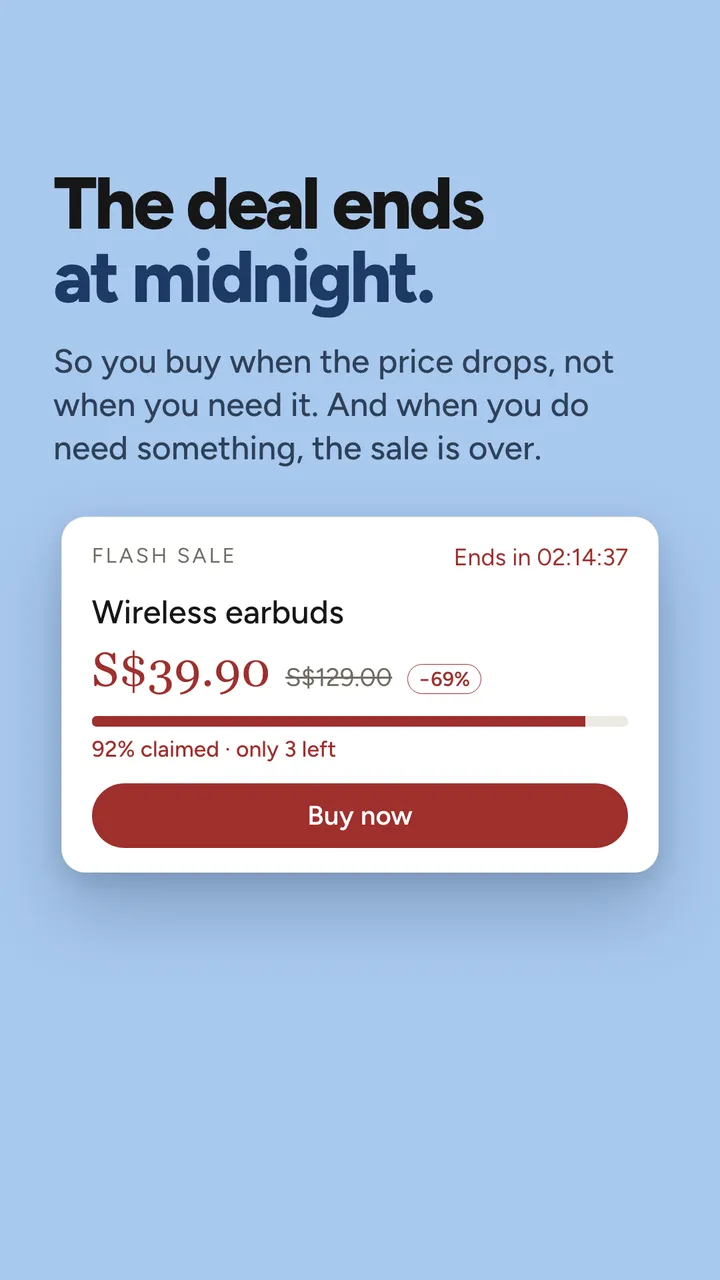
The flash sale on the slide is made up, but you'll recognise every part of it. Wireless earbuds at S$39.90, down from S$129.00. A red "-69%" badge. A bar saying 92% claimed, only 3 left. A countdown: 2 hours, 14 minutes, 37 seconds. Each piece has a job:
- The countdown creates urgency. Deciding quickly is rarely how we make good money decisions.
- "Only 3 left" creates scarcity. Things feel more valuable when they might run out.
- "92% claimed" is social proof. If everyone else is buying, it must be good.
- The crossed-out price is an anchor. Once you've seen $129, $39.90 feels like a bargain, whatever the earbuds are actually worth to you.
The arithmetic of a "saving"
On the slide, $129.00 minus $39.90 is $89.10 off, which is the 69%. That's what the page wants you to focus on. But if your current earbuds work fine, the honest version is simpler: you spent $39.90 you didn't need to spend.
Now say that happens three times a month, at about $40 each. That's $120 a month, or $1,440 a year, on things that were on sale rather than things you needed. That's roughly what my smartwatch drawer represents, give or take.
And here's the sneaky part, which is what the slide is really about. Flash sales get us to buy when the price drops, not when we need the thing. So we end up with things we didn't need yet, and when we do need something, there's usually no sale on.
What this means for you
- Keep a short "actually need" list on your phone. When a sale comes along, check it against the list. If it's not on there, the countdown is somebody else's problem.
- Turn off sale notifications from shopping apps. You'll still find the things you go looking for.
- Count what you spent, not what you "saved". A discount on something you didn't need isn't a saving. It's spending.
An app that's on the side of saving
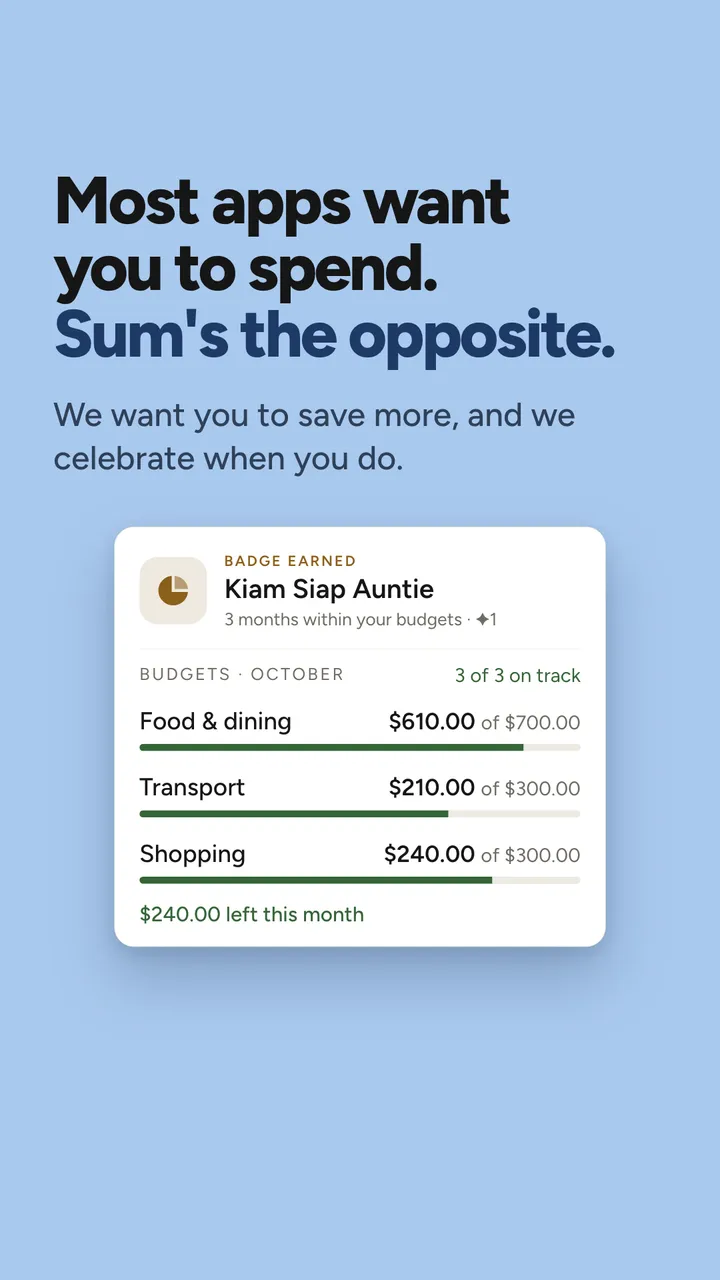
Think about how many apps on your phone make money when you spend. Shopping, delivery, payments, rewards. They're very good at what they do, and what they do is get you to buy.
Sum works the other way. It isn't a shop, and it's read-only, so it can't move a cent of your money. What it does is show you where your money goes, help you set budgets, and celebrate when you stick to them.
Reading the sample
The slide shows October with three budgets, all on track:
- Food and dining: $610 of $700
- Transport: $210 of $300
- Shopping: $240 of $300
The limits add up to $1,300. The spending adds up to $610 + $210 + $240 = $1,060. So $1,300 minus $1,060 leaves $240 for the month.
Stay within your budgets for three months and you earn a badge called Kiam Siap Auntie, Hokkien slang for someone very careful with money, said with love. When I earned mine I was more pleased than a grown man should be about a small brown icon. That's the point. Habits are built on small rewards, and saving rarely gets any. A badge is a tiny pat on the back for a thing that usually goes unnoticed.
What this means for you
- Celebrate staying on track, not just big milestones. Three steady months is an achievement.
- Notice which apps profit when you spend, and give them a little less of your attention.
Saving for something specific: delayed gratification
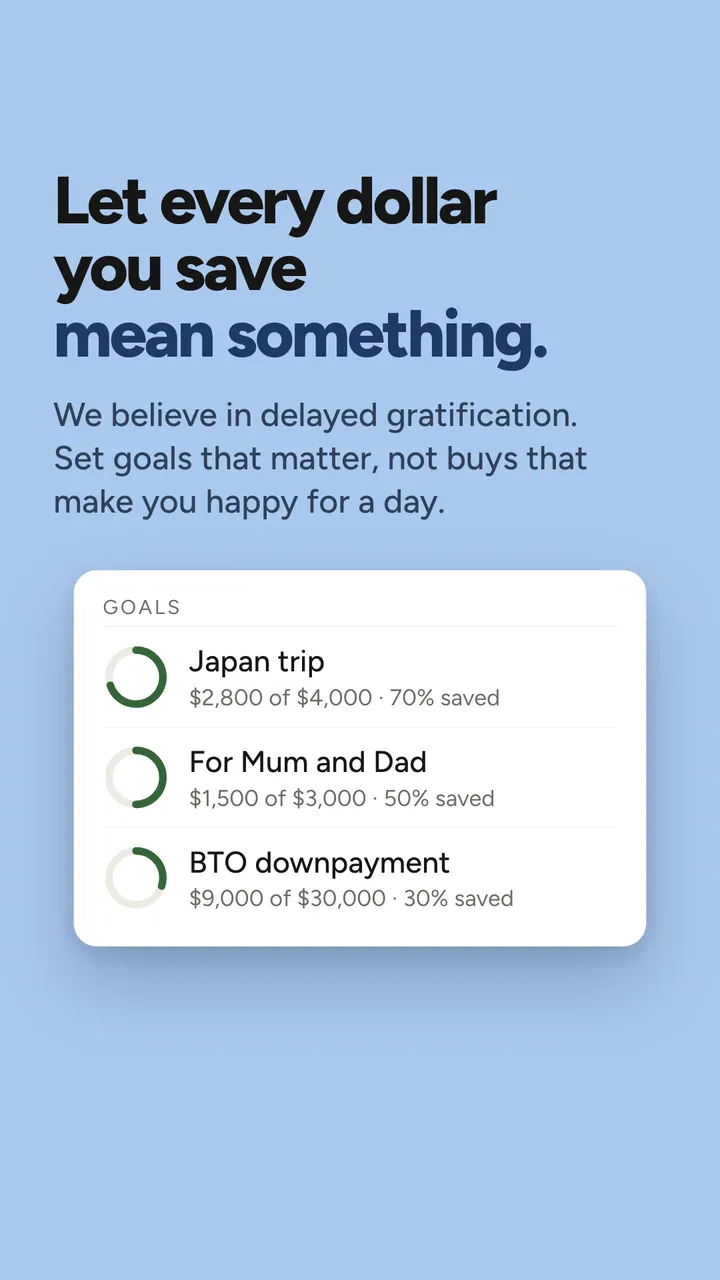
Delayed gratification means choosing a bigger reward later over a smaller one now. It sounds like a test of willpower. In my experience, it's mostly a test of whether "later" has a name.
Saving "in general" is abstract, and abstract money is easy to raid. Saving for a Japan trip with friends, for your parents, or for a BTO downpayment is something you can picture. When I was saving for a trip last year, I found it surprisingly easy to close a sale page. Not because I'd become more disciplined, but because I could see exactly what the money was for.
Turning goals into months
The sample goals on the slide:
- Japan trip: $2,800 of $4,000, so 70% saved and $1,200 to go
- For Mum and Dad: $1,500 of $3,000, so 50% saved and $1,500 to go
- BTO downpayment: $9,000 of $30,000, so 30% saved and $21,000 to go
Say Jun Hao is putting $300 a month into the Japan trip. $1,200 divided by $300 is 4 months.
Now say he skips those three $40 impulse buys a month from the flash-sale section and adds the $120 to the trip instead. That's $420 a month, and $1,200 divided by $420 is about 2.9 months. He's in Japan a month earlier, and he doesn't own any extra earbuds.
That's the real answer to the four things above. You don't beat a countdown timer with willpower alone. You beat it by caring more about something else.
What this means for you
- Name your goals. "For Mum and Dad" is harder to raid than "savings".
- Keep the number of goals small enough that each one moves visibly.
- When you skip an impulse buy, move that money to a goal straight away, so the saving is real and not just a feeling.
If you only remember three things
- A discount on something you didn't need isn't a saving. It's spending.
- Your feed shows hundreds of people's best days at once. Compare yourself with your past self instead.
- Give your savings a name. A goal you can picture beats a countdown timer.
How I keep track of this

For me, the most useful part is simply seeing spending by category. When I import a month's statement, Sum reads it and sorts every line, and the shopping category is where the flash-sale purchases show up, all together, in a way they never do when you buy them one at a time at midnight. I have budgets for food, transport and shopping, and goals for the things I actually care about.
Spending by category, budgets and goals are all on Sum's free plan, and Sum is free to start. If you want the next step, I wrote about the psychology of budgeting and how to start tracking your expenses. We also post a new carousel most days on TikTok and Instagram, and the longer version lands here.
Which of the four gets you most? For me it's still the midnight deal. I have never needed anything at 11:58pm, and yet there's a smartwatch in my drawer that says otherwise.
Talk soon, Brandon

Sum is launching in Singapore soon.
Your banks, cards, CPF and HDB flat, added up into one net worth. Statements sorted, card caps tracked, bills remembered.
Brandon · Finance team, Sum
Brandon is on Sum's finance team in Singapore. Brandon reads the CPF Board, IRAS and MAS updates so you don't have to, and turns our carousels into the longer version. Questions, corrections or something to share? Email Brandon at [email protected].
Got something interesting to share?
A money story, a question, something we got wrong, or a tip other Singaporeans should hear. Reach out to me at [email protected], or leave your email and I'll write to you.
Any app screens shown use sample data, not a real person's. Sum is free to start; some features need a paid plan.