The Dow's top 5 stocks, week of 19 to 23 Oct 2026
In results week the Dow rose 0.4%. IBM, 3M, Honeywell, UnitedHealth and Chevron led the 30, explained simply, with the maths, for investors in Singapore.

Sunday dinner at my parents' place has a fixed order. Rice, soup, my mum asking whether I'm eating enough, and then the evening news on in the background while my dad reads out the parts he has opinions on. Last night it was oil. "Above a hundred US dollars already," he said, and then, to me, "Your American shares all drop, right?"
Not all, I said. The Dow actually ended the week up. He gave me the look he reserves for things that sound too convenient, so I promised to write it down properly. Here it is.
This is the long version of our Monday carousel: the five Dow stocks that rose the most between Friday 16 and Friday 23 October 2026, what each company does, why it moved where a reason was reported, and what US$1,000 held for the week would have become. No predictions, no tips.
The Dow rose 0.4% in a busy results week
The Dow Jones Industrial Average tracks 30 large American companies, from Apple and Walmart to Coca-Cola and Chevron. This week it went from 52,002.41 to 52,215.16, up 0.4%. As an example, US$1,000 spread like the index would have become about US$1,004.09.
The other two big US indexes fell: the S&P 500 by 0.5% and the Nasdaq by 0.7%. CNBC reported the Dow jumped more than 500 points on Tuesday on optimism about company results, then fell 653 points on Friday as oil rose above US$100 a barrel on tensions in the Middle East. So my dad was right about Friday. It just wasn't the whole week.
The biggest falls were Caterpillar and Alphabet, both down 6.0%. I couldn't find a company reason for Caterpillar. For Alphabet, CNBC said it was the weakest of the big cloud companies that week.
Why the Dow can go up when the others go down
The Dow is price-weighted. That means a stock with a higher share price counts for more, whatever the size of the company. A US$1 move in a US$400 share moves the Dow exactly as much as a US$1 move in a US$40 share. The S&P 500 works differently: it weights companies by their total market value, so the largest companies, many of them in tech, count for the most.
This week that difference mattered. Several of the Dow's higher-priced names, like UnitedHealth at about US$400 a share and IBM at about US$250, rose, while several of the big tech names that weigh most in the S&P 500 and the Nasdaq fell: Alphabet 6.0%, Nvidia 1.5% and Microsoft 0.9%.
What this means for you: "the US market" can mean three different numbers. If you hold an S&P 500 fund, your week looked more like the S&P 500's than the Dow's.
IBM rose 9.2%, mostly before its results
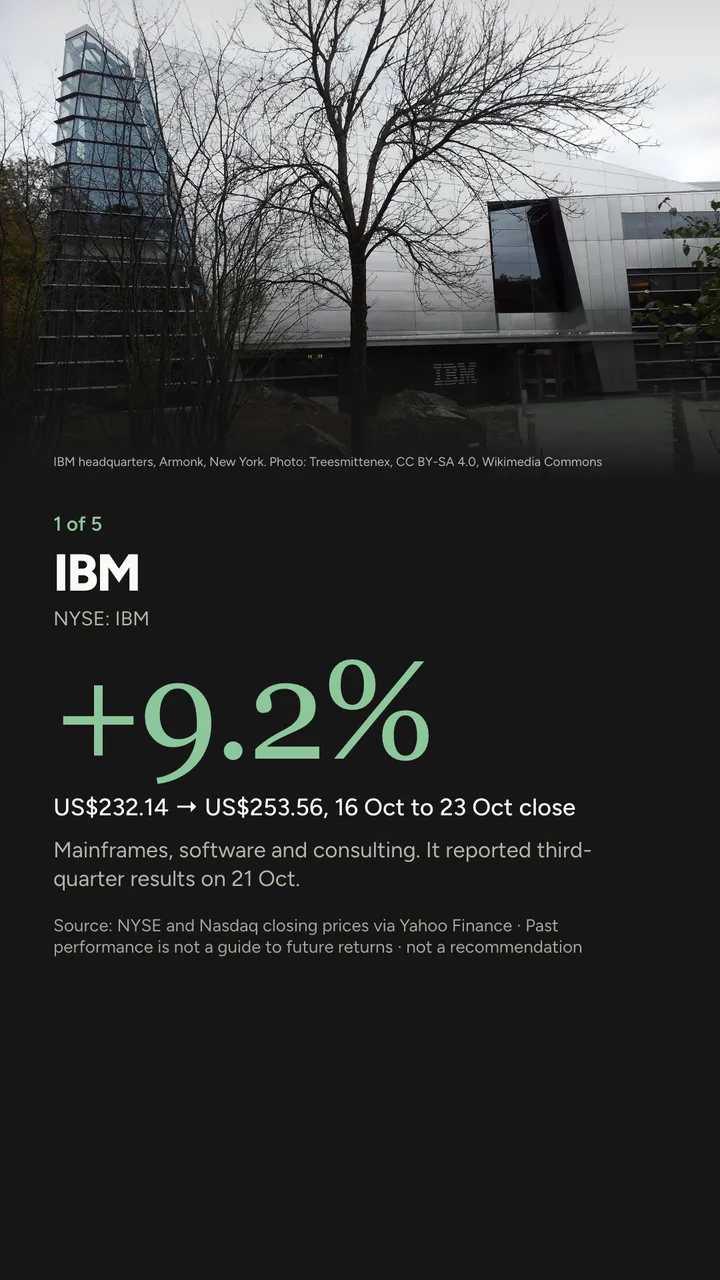
IBM is the computing company behind mainframes (the large machines many banks and airlines still run on), business software and consulting. You probably don't buy anything from IBM directly, but there's a fair chance your bank does.
The timing here is the interesting part. IBM rose about 2.3% on Tuesday and 3.9% on Wednesday, before its results came out, and I couldn't find a reported reason for those two days. Then after the market closed on 21 October, IBM reported third-quarter revenue of US$17.1 billion, up 5% on a year earlier, and raised its outlook for free cash flow (the cash a business has left after running and investing in itself).
The arithmetic
- US$1,000 of IBM on 16 October would have become about US$1,092.27 on 23 October.
- That's US$21.42 a share. Ten shares, US$2,321.40, became US$2,535.60.
Why a move can come before the news
Prices reflect what buyers and sellers expect, and expectations build before a results date. So a stock can move before the numbers, and move again, either way, when they land. If you only look at the results headline, you can get the story backwards.
What this means for you: when a stock "rose on results", check which days it actually rose. Sometimes most of the move came first.
3M rose 5.3% after raising its forecast
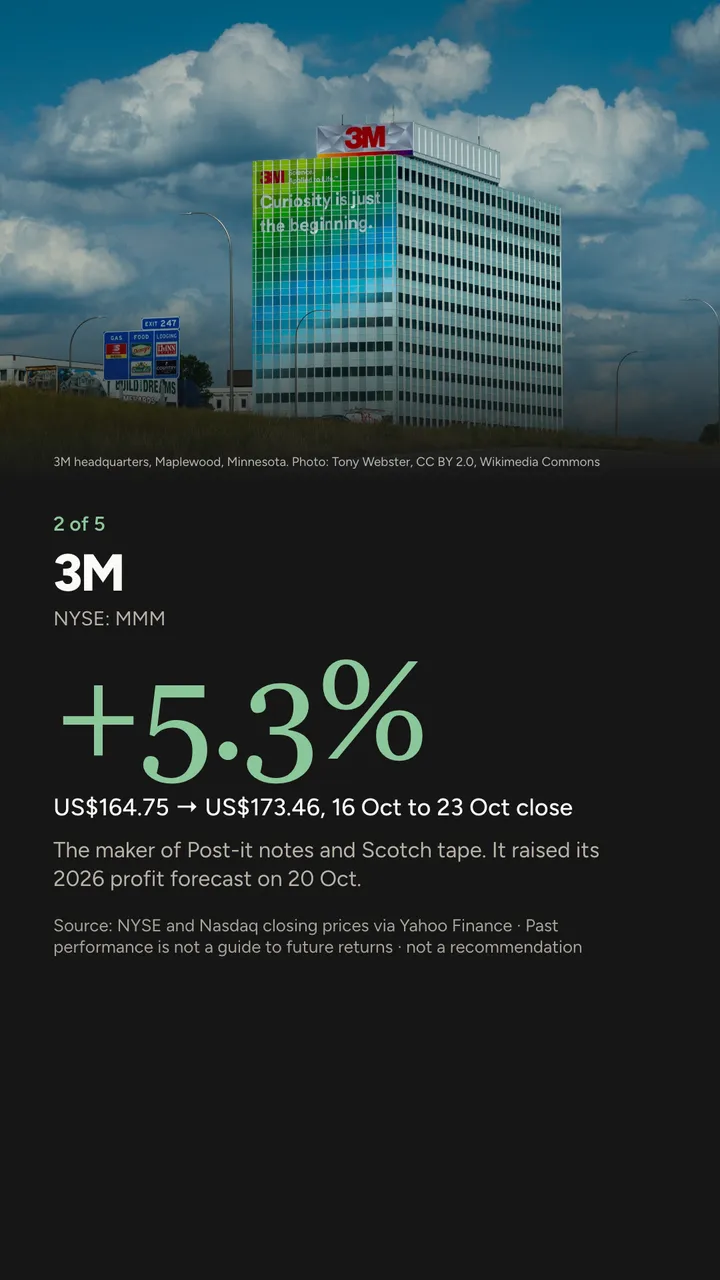
3M makes Post-it notes and Scotch tape, along with a long list of industrial materials you'll never see: films, adhesives and filters inside other companies' products. CNBC reported its shares jumped more than 5% on 20 October after quarterly profit beat what analysts had forecast and 3M raised its profit forecast for the full year.
Two words from results season
- Beat (or miss) estimates: analysts publish forecasts of a company's profit per share. A "beat" means the actual number came in above the average forecast. It says nothing about whether the business is good, only that it did better than expected.
- Guidance: the company's own forecast for the rest of the year. Raising it means management now expects more than it did before. It's still a forecast.
The arithmetic
- US$1,000 of 3M would have become about US$1,052.87.
- That's US$8.71 a share.
What this means for you: "beat estimates" is about expectations, not quality. A company can beat estimates and still be smaller than last year, or miss and still be growing.
Honeywell rose 4.6% in the week it raised its outlook
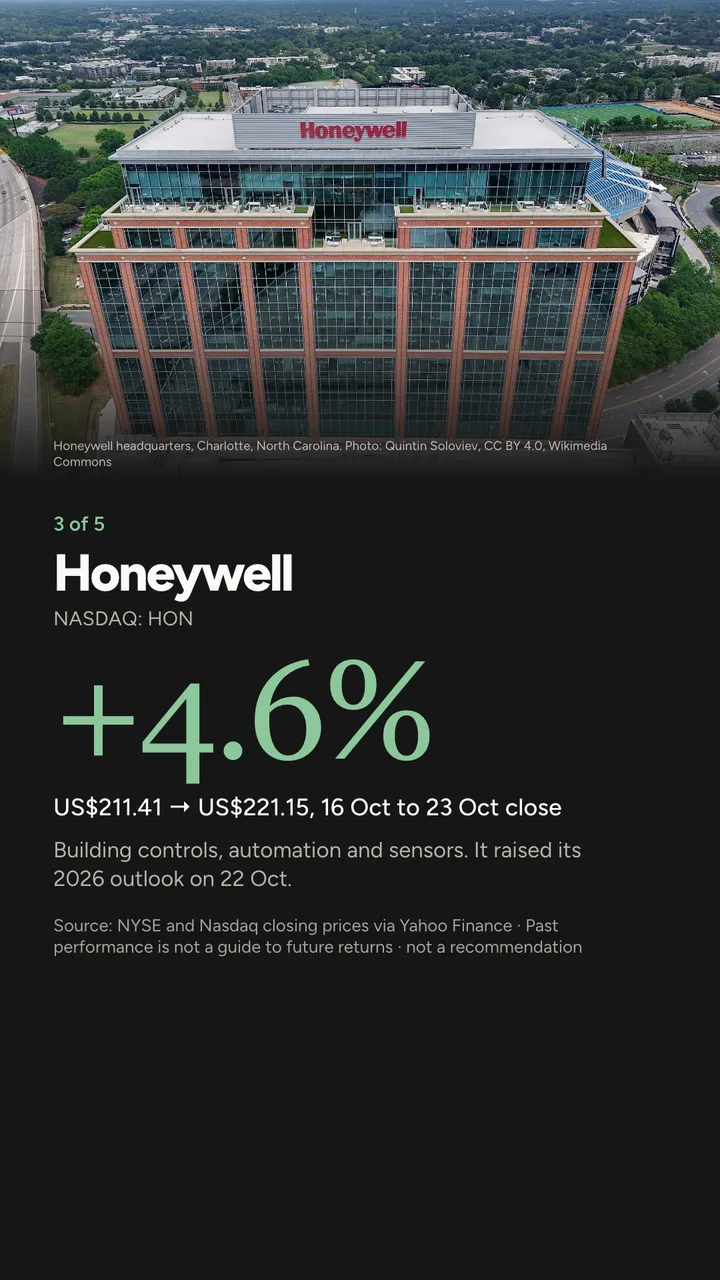
Honeywell is an industrial group: the controls that run a building's air conditioning and lifts, factory automation, sensors. Its shares trade on the Nasdaq exchange.
On 22 October it reported third-quarter sales of US$5.0 billion, with organic sales up 7%. Organic means growth from the existing business, leaving out companies it bought or sold, so you can compare like with like. It also raised its full-year adjusted profit outlook to US$8.40 to US$8.45 a share, from US$8.05 to US$8.35. I couldn't find a report on how the shares reacted that day, so I'll just say that was the week's company news.
The arithmetic
- US$1,000 of Honeywell would have become about US$1,046.07.
- That's US$9.74 a share.
Narrowing a range
Look at the outlook again. The old range was 30 cents wide (US$8.05 to US$8.35); the new one is 5 cents wide and sits above the old top. Late in the year, companies know more, so their ranges get narrower. Moving the whole range up, rather than just narrowing it, is the bit people pay attention to.
What this means for you: when a company "raises guidance", compare the new range with the old one, not just the headline word.
UnitedHealth rose 4.2%, with no single reason reported
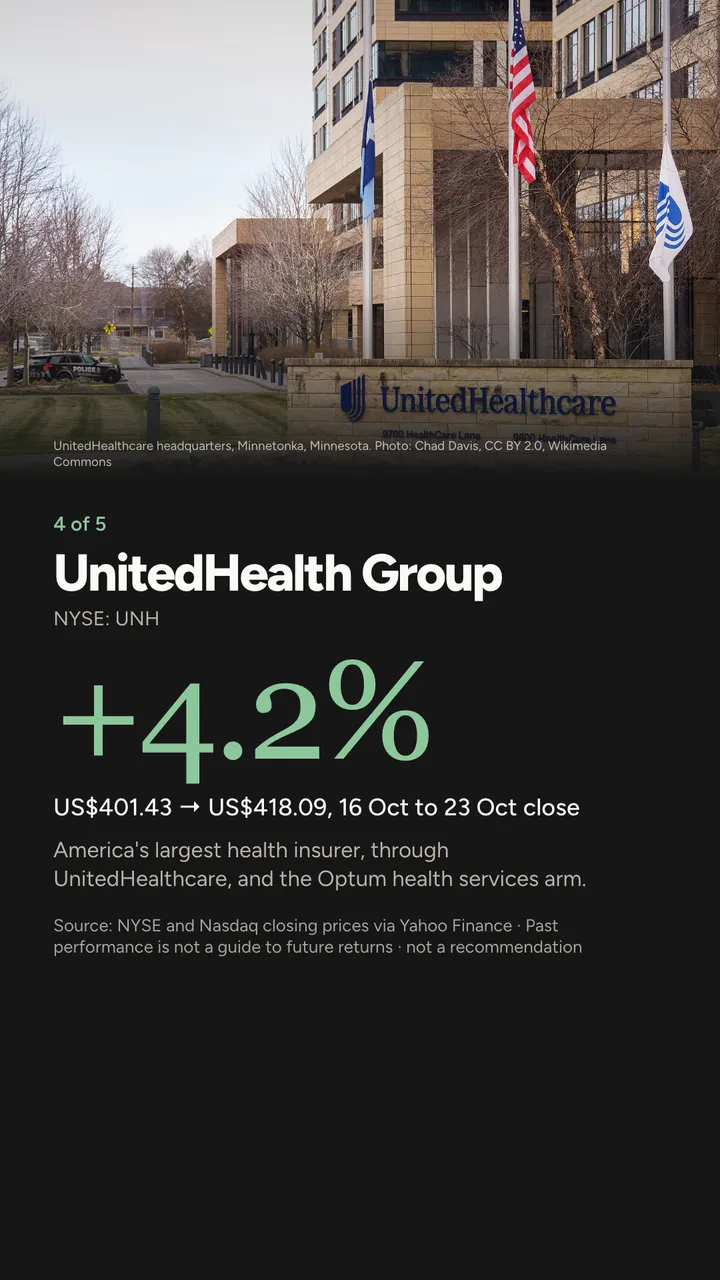
UnitedHealth Group is America's largest health insurer, through UnitedHealthcare, and also runs Optum, which provides health services, pharmacy benefits and data. Its shares went from US$401.43 to US$418.09, most of that on Tuesday. No single reason was reported. Its results came the week before, on 13 October.
The arithmetic, with a pricier share
- US$1,000 of UnitedHealth would have become about US$1,041.50.
- One share moved US$16.66. That's the price-weighting point from earlier: a US$16.66 move in a single share counts for far more in the Dow than a similar percentage move in a US$50 stock.
What this means for you: a high share price doesn't make a company bigger or better. It does make it count for more in the Dow.
Chevron rose 3.7% as oil passed US$100
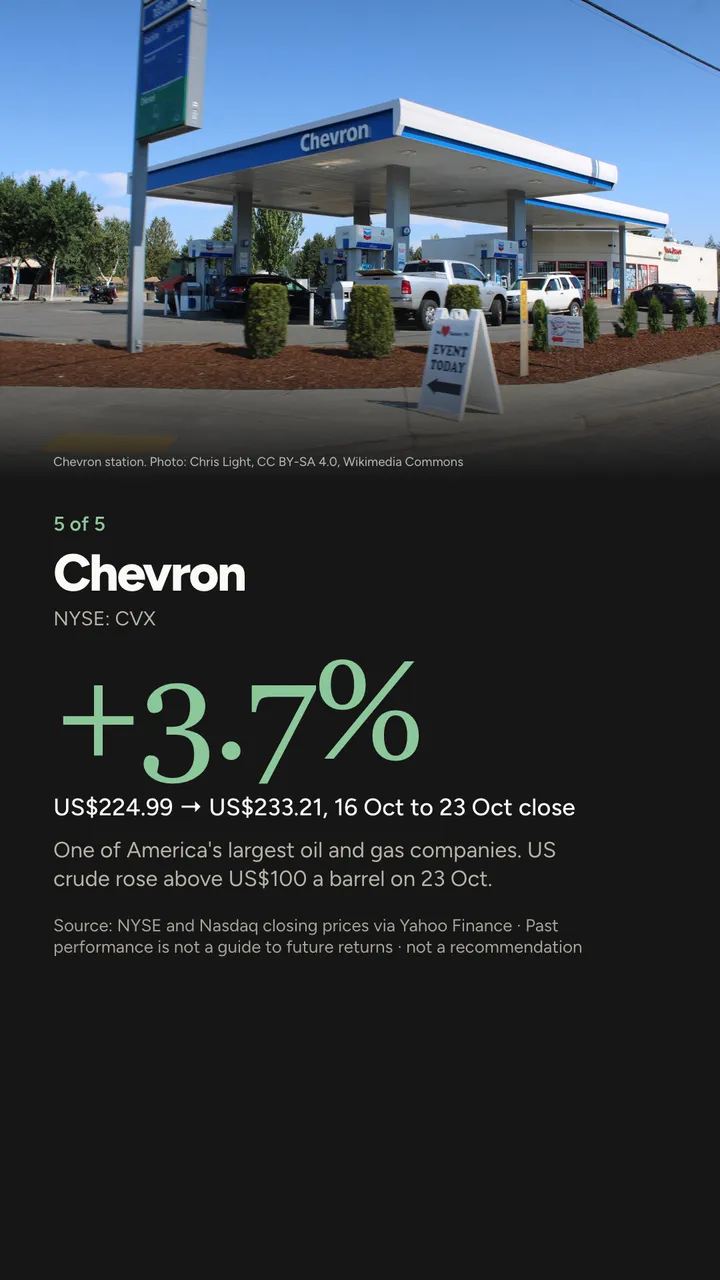
Chevron is one of America's largest oil and gas companies. It finds and produces oil and gas, refines it, and sells fuel. Its shares went from US$224.99 to US$233.21. CNBC reported energy stocks rallied on Friday as US crude rose above US$100 a barrel on tensions in the Middle East.
The arithmetic
- US$1,000 of Chevron would have become about US$1,036.53.
- That's US$8.22 a share.
The same news, two sides
The same Friday headline that lifted Chevron pulled the Dow down 653 points. Higher oil means more revenue for a producer, and higher costs for airlines, delivery firms and, eventually, the rest of us at the pump. My dad's question was the right one, just aimed at the wrong stock.
What this means for you: one piece of news rarely moves everything the same way. It's worth knowing which of your holdings are on which side of a headline like this one.
The week in one table
| Stock | Ticker | Close, 16 Oct to 23 Oct | Change | US$1,000 became |
|---|---|---|---|---|
| IBM | NYSE: IBM | US$232.14 to US$253.56 | +9.2% | US$1,092.27 |
| 3M | NYSE: MMM | US$164.75 to US$173.46 | +5.3% | US$1,052.87 |
| Honeywell | NASDAQ: HON | US$211.41 to US$221.15 | +4.6% | US$1,046.07 |
| UnitedHealth Group | NYSE: UNH | US$401.43 to US$418.09 | +4.2% | US$1,041.50 |
| Chevron | NYSE: CVX | US$224.99 to US$233.21 | +3.7% | US$1,036.53 |
| Dow Jones Industrial Average | DJI | 52,002.41 to 52,215.16 | +0.4% | about US$1,004.09 |
All before fees, dividends and currency moves. In Singapore dollars, your result also depends on how the US dollar moved against the Singapore dollar that week. And if any of these pay you a dividend, US tax is usually withheld before it reaches you: 30% for non-US investors, or a lower treaty rate, according to the IRS.
The pattern: results week, and news that didn't line up
Three of the five reported results or a new forecast that week. Even so, news and prices didn't always line up: IBM made most of its gain before its numbers came out, and UnitedHealth's rise came with no news at all. One week is a short time to judge anything by, which is why we only describe it. (Singapore had a property week instead: the STI's top five for the same week.)
If you only remember three things
- The Dow is price-weighted, so it can rise while the S&P 500 and Nasdaq fall.
- "Beat estimates" and "raised guidance" are about expectations and forecasts, not guarantees.
- Check when a stock moved, not just what it reported. The move can come before the news.
How I keep track of this
I'll admit my first US dividend looked wrong to me, until I learnt about withholding tax. What helps now is seeing US shares next to everything else, so a week like this sits in proportion with our savings, CPF and flat.
In Sum, stocks sit inside your net worth beside your bank accounts, CPF and property. Stocks are on the Essential plan; live prices, profit and loss, and dividends are on Pro.
I'll show my dad this post next Sunday. I expect him to read the Chevron section out loud.
Talk soon, Brandon

Sum is launching in Singapore soon.
Your banks, cards, CPF and HDB flat, added up into one net worth. Statements sorted, card caps tracked, bills remembered.
Brandon · Finance team, Sum
Brandon is on Sum's finance team in Singapore. Brandon reads the CPF Board, IRAS and MAS updates so you don't have to, and turns our carousels into the longer version. Questions, corrections or something to share? Email Brandon at [email protected].
Got something interesting to share?
A money story, a question, something we got wrong, or a tip other Singaporeans should hear. Reach out to me at [email protected], or leave your email and I'll write to you.
Sources: Yahoo Finance, Dow Jones Industrial Average price history; CNBC, Dow jumps 500 points as earnings optimism steadies market (live updates), 20 Oct 2026; CNBC, Stock market news for Oct. 23, 2026 (live updates); IBM, IBM releases third-quarter results (SEC filing), 21 Oct 2026; Honeywell, Third quarter results, raises full-year 2026 outlook (SEC filing), 22 Oct 2026; CNBC, Stocks making the biggest moves midday: Chevron and more, 23 Oct 2026; CNBC, Next week brings major risks for the stock market, just as the AI trade keeps faltering, 23 Oct 2026; S&P Dow Jones Indices, Dow Jones Industrial Average methodology (price-weighted); IRS, Withholding on US-source income paid to nonresident aliens (30% or a lower treaty rate).
Any app screens shown use sample data, not a real person's. Sum is free to start; some features need a paid plan.
Information only, not financial advice.