The STI's top 5 stocks, week of 19 to 23 Oct 2026
The STI edged up 0.1% as REITs led. Frasers Centrepoint Trust, Jardine Matheson, UOL, CICT and Keppel DC REIT topped the 30, explained with the maths.

Last Wednesday, after futsal, I was standing outside the court with my phone out, doing my usual job of chasing five people for their share of the booking on PayNow. One of them, a friend from NS who lives in Woodlands, paid up and then sent a second message: "Eh, Causeway Point is a stock ah? My colleague says she owns part of it."
Sort of, I told him. She probably owns units in a trust that owns the mall. He replied with a thumbs up, which in my experience means "explain later". So this is me explaining later, with a week that turned out to be a good example: the mall's owner topped the STI.
Here's the long version of our Monday carousel: the five STI stocks that rose the most between Friday 16 and Friday 23 October 2026, what each company does, why it moved where a reason was reported, and what S$1,000 (or US$1,000) held for the week would have become. No predictions, no tips.
The STI barely moved, but property did
The Straits Times Index tracks 30 of the biggest companies listed on SGX, the Singapore Exchange. It's one number for roughly how the local market did, and it hides a lot.
This week it went from 5,415.53 to 5,422.16, a rise of 0.1%. As an example, S$1,000 spread exactly like the index would have become about S$1,001.22, before fees. That's not even the kopi.
To find the top five, we compare each of the 30 stocks' closing price (the last traded price when the market shuts) on Friday 16 October with Friday 23 October, using Yahoo Finance, and rank all 30 ourselves. There were no SGX holidays that week.
Why the banks matter, and why they didn't this week
The three local banks are a large slice of the STI, so they usually decide its week. This time they sat still: DBS rose 0.4%, and OCBC and UOB ended flat. With the banks quiet, the rest of the index could show through, and three of the top five were REITs, short for real estate investment trusts.
The Edge Singapore reported REITs rebounding that week as 10-year bond yields fell. The idea behind that link is worth knowing. A REIT pays out most of its rental income, so investors often compare its payout with what a safe government bond pays. When bond yields fall, a REIT's payout looks relatively more attractive, and REITs also borrow to own their buildings, so lower rates can mean lower interest costs. That's the general mechanism, not a promise about any one week.
At the bottom, Yangzijiang Shipbuilding fell 6.3%, Venture 3.0% and Wilmar 2.9%, and I couldn't find a reported reason for any of them.
What this means for you: if your holdings are mostly bank shares, your week was flat. If they're mostly REITs, it probably wasn't. The headline number rarely matches your own.
Frasers Centrepoint Trust rose 5.8% after a record payout
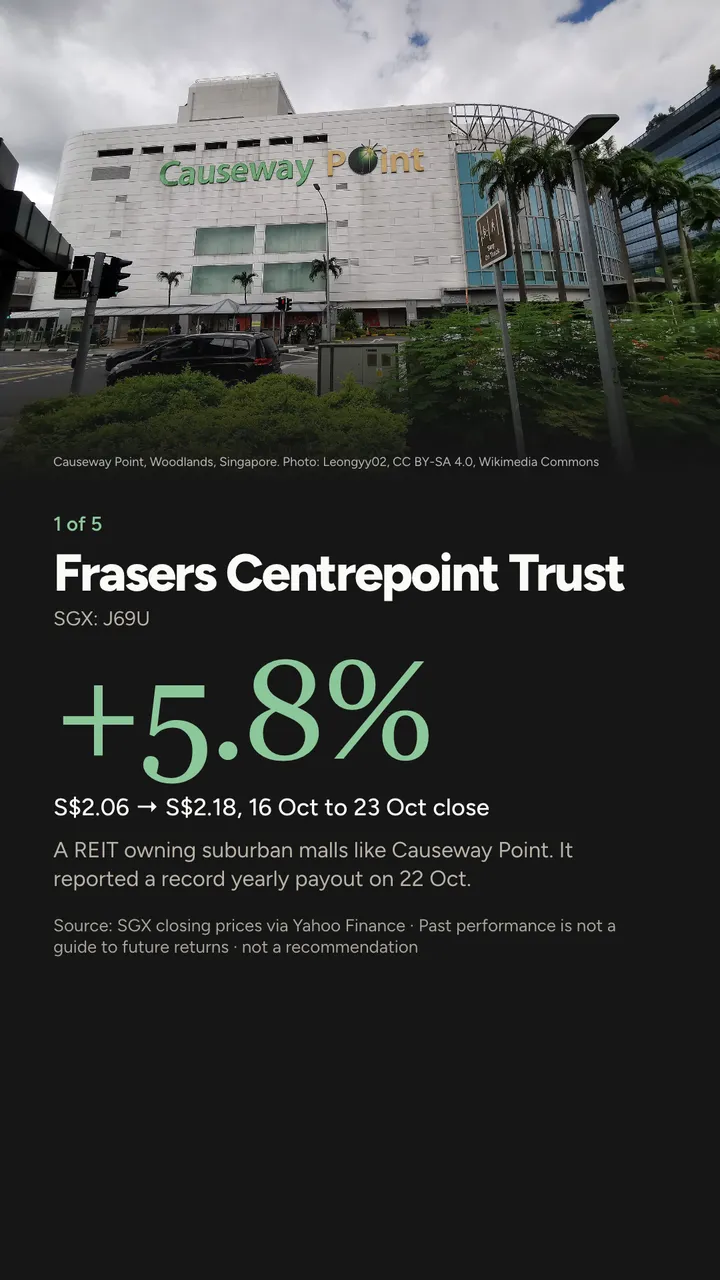
Here's my futsal friend's mall. Frasers Centrepoint Trust (FCT) is a REIT that owns suburban malls, the ones next to an MRT station and a bus interchange where you go for groceries, a haircut and a clinic visit: Causeway Point in Woodlands and Northpoint City in Yishun among them. When you buy a unit, you own a small share of the trust, and the trust pays out most of the rent the tenants pay.
Before the market opened on 22 October, FCT reported its full-year results. Its distribution per unit, or DPU, which is the cash paid out for each unit you hold, was 12.35 cents for the year, which the trust said was its highest since listing on SGX in July 2006. Its units went from S$2.06 to S$2.18 over the week. The trust reported the payout; no report I could open tied the price move to it directly, so I'm putting the two side by side rather than calling one the cause.
The arithmetic
- S$1,000 of FCT units on 16 October would have been worth about S$1,058.25 on 23 October.
- One board lot (100 units, the standard trading size on SGX for prices up to S$10 since 5 October): S$206 became S$218, a gain of S$12 before fees.
What a distribution yield is
A distribution yield is the past year's payout divided by the unit price. Using the figures above:
- 12.35 cents divided by S$2.06 is about 6.0% at the 16 October price.
- 12.35 cents divided by S$2.18 is about 5.7% at the 23 October price.
Same payout, lower yield. When the price goes up, each dollar you put in buys a smaller share of the same payout. It's a backward-looking number too: it tells you what was paid, not what will be.
What this means for you: a REIT's yield moves every time its price does, so check which price and which year's payout a quoted yield uses.
Jardine Matheson rose 5.5%, with no single reason reported
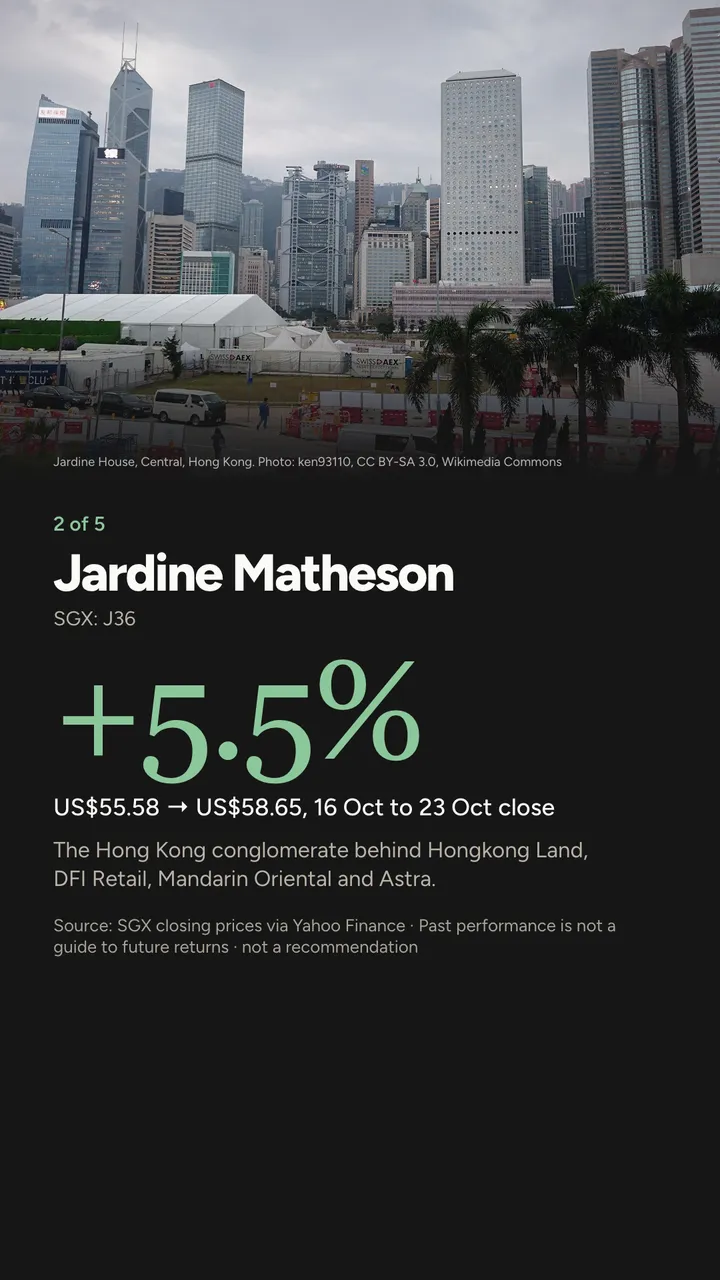
Jardine Matheson is a conglomerate: one company that owns big stakes in several others. Two of them have been on this list before, Hongkong Land (offices and malls) and DFI Retail (Guardian and 7-Eleven in Singapore). It also owns stakes in the Mandarin Oriental hotel group and Astra in Indonesia. Like those two, it's listed on SGX but quoted in US dollars.
Its shares went from US$55.58 to US$58.65. No single reason was reported for the week. Its last company news, a higher earnings forecast for 2026, came on 13 October, the week before.
The arithmetic
- US$1,000 of Jardine shares would have become about US$1,055.24.
- At these prices one board lot of 100 shares is about US$5,558, so the gain was about US$307 before fees. That's a lot more money changing hands than a lot of FCT, for a similar percentage.
- Back in Singapore dollars, your result also depends on how the US dollar moved that week.
Owning the parent, not the shop
When you own Jardine, you own a slice of a slice. Part of its value comes from the stakes it holds in companies that are themselves listed. A good week for Jardine can line up with good weeks for those companies, or not. This week Hongkong Land fell 0.6% and DFI rose 1.2%, while Jardine rose 5.5%.
What this means for you: if you hold a parent company and its listed children, you may own more of the same business than you think. Add up your exposure, not just the number of tickers.
UOL Group rose 4.1%, with no single reason reported
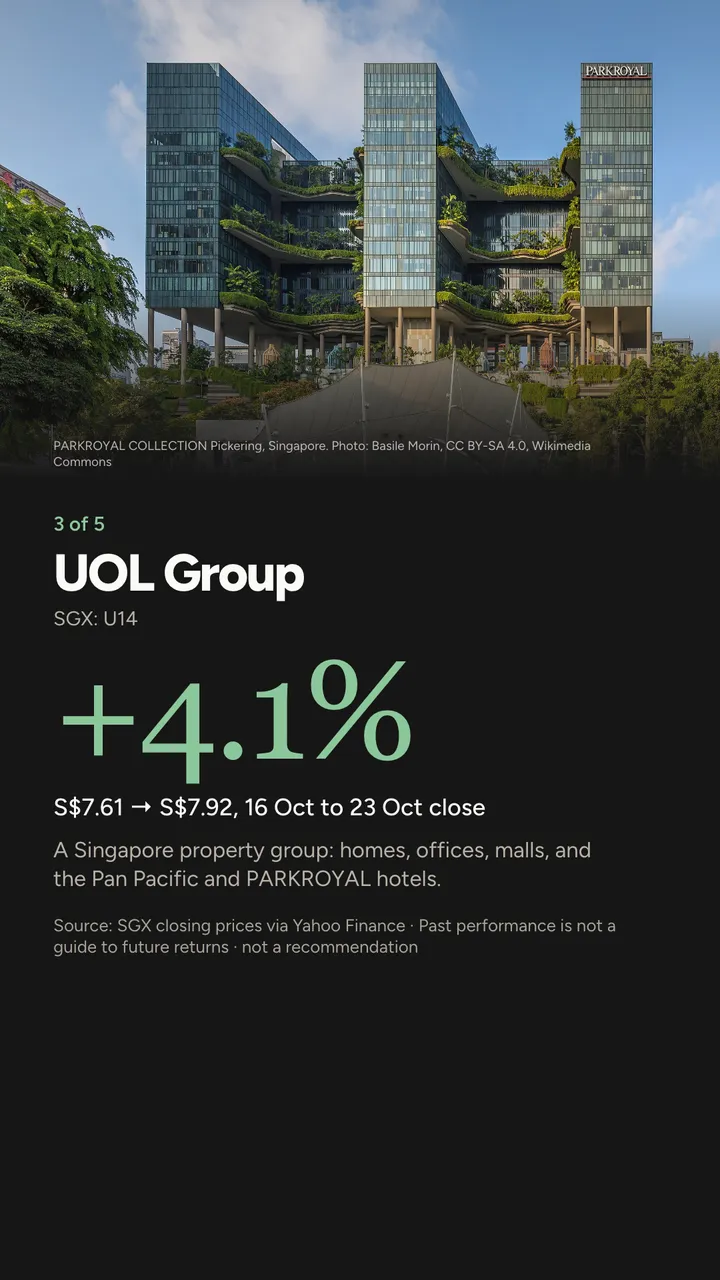
UOL is a Singapore property group. It builds and sells homes, owns offices and malls, and runs hotels under the Pan Pacific and PARKROYAL names (the PARKROYAL on Pickering, with the plants spilling down its terraces, is one of theirs). Its shares went from S$7.61 to S$7.92. No single reason was reported.
The arithmetic
- S$1,000 of UOL would have become about S$1,040.74.
- One board lot: S$761 became S$792, a gain of S$31 before fees.
A property company is not a REIT
UOL and FCT both own buildings, so it's easy to file them together. They work differently:
| REIT (like FCT) | Property company (like UOL) | |
|---|---|---|
| Main income | Rent from buildings it owns | Rent, plus selling homes it builds, plus hotels |
| Payouts | Rules push it to pay out most of its income | The board decides how much to pay as dividends |
| Borrowing | MAS sets a limit on how much it can borrow | Set by the company and its lenders |
A developer's profit can jump in a year when a big project's homes are sold and dip in a year between projects. A REIT's rent tends to be steadier, which is part of why people treat the two differently.
What this means for you: "property stock" covers very different businesses. It's worth checking whether a company mainly collects rent or mainly builds and sells.
CICT rose 3.1%, along with other REITs
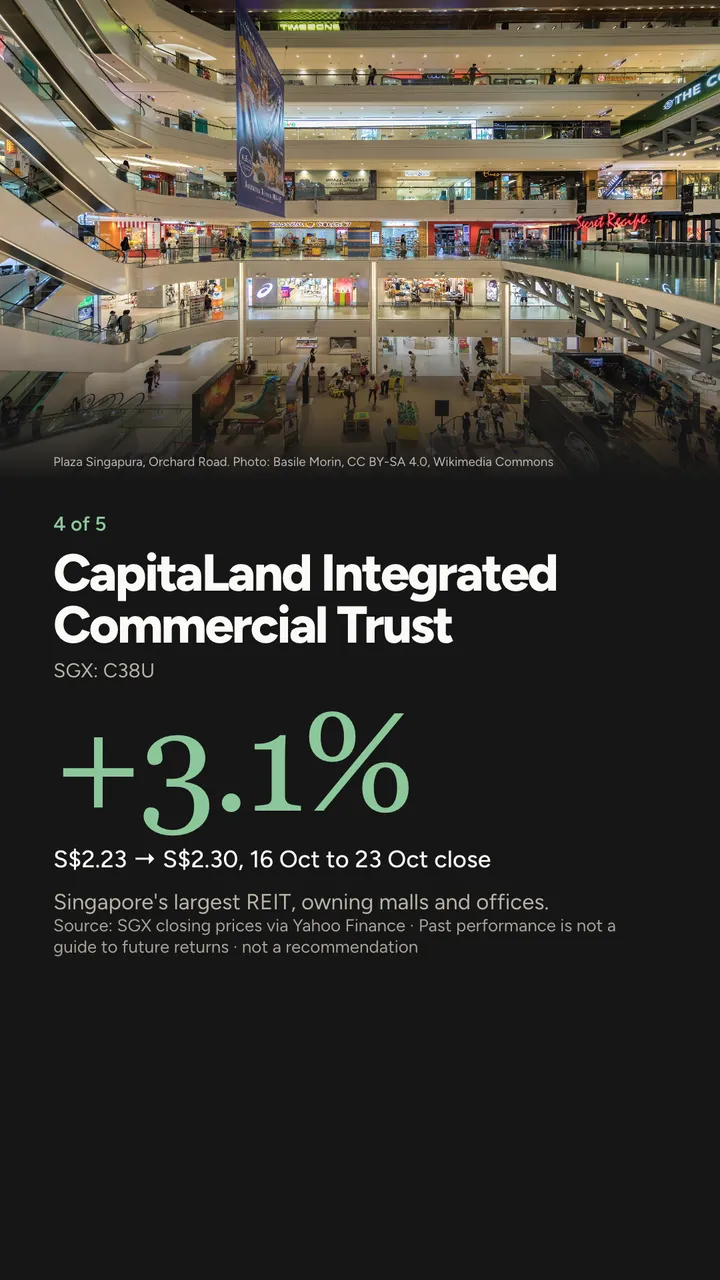
CapitaLand Integrated Commercial Trust, or CICT, is Singapore's largest REIT. It owns malls and offices, including Plaza Singapura at the top of Orchard Road and Raffles City. Its units went from S$2.23 to S$2.30.
There was no company news. It rose with other REITs on Thursday and Friday: FCT, Keppel DC, CapitaLand Ascendas and Mapletree Pan Asia all rose on those days too. When a whole group moves together like that, the reason is usually about the group (rates, in this case, if The Edge's report is right) rather than about one trust.
The arithmetic
- S$1,000 of CICT units would have become about S$1,031.39.
- Per unit, that's 7 cents. On 1,000 units, S$2,230 became S$2,300, a gain of S$70.
What this means for you: if you own several REITs, they often have the same good and bad weeks. Holding five REITs is less spread out than it looks.
Keppel DC REIT rose 2.9% after its third-quarter update
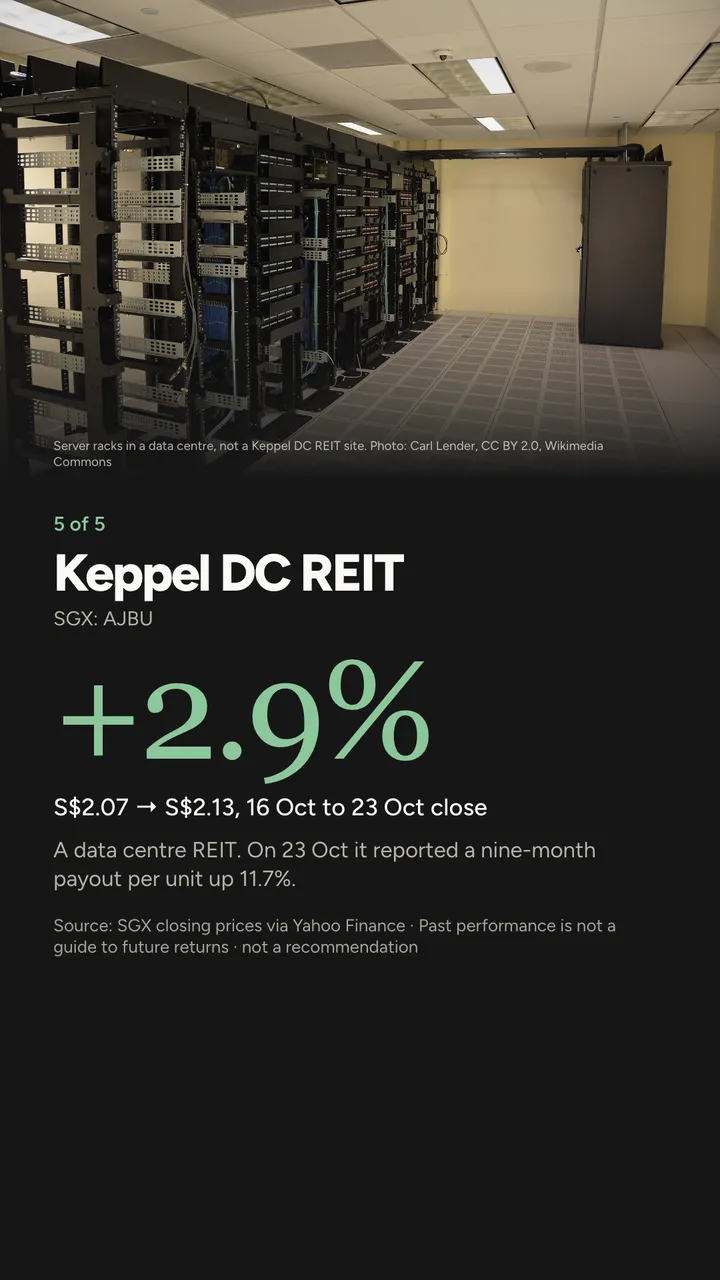
Keppel DC REIT owns data centres in Asia, Europe and Australia: the buildings full of servers that keep your banking app, your streaming and your office email running. Its tenants are the companies renting space and power for those servers.
On 23 October it gave an update for the first nine months of 2026. Its distributable income was S$228.0 million, up 16.7% on a year earlier, and its DPU was 8.571 cents, up from 7.670 cents, which is 11.7% more. Its units went from S$2.07 to S$2.13 over the week.
Reading "up 11.7%"
Two things to check whenever a company says something is "up":
- Up on what? Here it's the first nine months of 2026 against the first nine months of 2025. 8.571 divided by 7.670 is about 1.117, so 11.7% more.
- Why is income up more than the payout? Income rose 16.7% but DPU rose 11.7%. A common reason is that a REIT has issued new units, so the income is shared among more of them. Check the REIT's own report for its reasons before assuming.
The arithmetic
- S$1,000 of Keppel DC units would have become about S$1,028.99.
- One board lot: S$207 became S$213, a gain of S$6, which a minimum brokerage fee could easily swallow.
What this means for you: "per unit" is the number that reaches you. Total income can grow faster than what each unitholder receives.
The week in one table
| Stock | Ticker | Close, 16 Oct to 23 Oct | Change | S$1,000 or US$1,000 became |
|---|---|---|---|---|
| Frasers Centrepoint Trust | SGX: J69U | S$2.06 to S$2.18 | +5.8% | S$1,058.25 |
| Jardine Matheson | SGX: J36 | US$55.58 to US$58.65 | +5.5% | US$1,055.24 |
| UOL Group | SGX: U14 | S$7.61 to S$7.92 | +4.1% | S$1,040.74 |
| CapitaLand Integrated Commercial Trust | SGX: C38U | S$2.23 to S$2.30 | +3.1% | S$1,031.39 |
| Keppel DC REIT | SGX: AJBU | S$2.07 to S$2.13 | +2.9% | S$1,028.99 |
| Straits Times Index | STI | 5,415.53 to 5,422.16 | +0.1% | about S$1,001.22 |
All before fees, dividends and currency moves.
The pattern: a property week
Four of the five own buildings for a living, and two had clear company news, both REITs reporting their payouts. For Jardine and UOL, no single reason was reported, and CICT simply moved with its group. That's a normal mix for one week. The week before, the banks were the story (I wrote it up in the STI's top five for 12 to 16 October). One week tells you what happened, and nothing about what comes next.
If you only remember three things
- A REIT unit is a share of a trust that owns buildings and pays out most of the rent. The mall you shop at may be one.
- A distribution yield is last year's payout divided by today's price, so it falls when the price rises.
- Holding several REITs, or a parent and its children, can be less spread out than it looks.
How I keep track of this
I'm the person who reads the REIT's results PDF on the North East Line, so I'm not a typical case. What I find more useful than any one stock is seeing my holdings in proportion: next to my savings, my CPF and our flat.
In Sum, SGX shares and REIT units in your CDP account sit inside your net worth beside your bank accounts, CPF and HDB flat. Stocks and CDP holdings are on the Essential plan; live prices, profit and loss, and dividends are on Pro. If you hold US shares too, the Dow had a very different week: the Dow's top five for the same week.
As for my friend in Woodlands, I've sent him this post. I expect another thumbs up.
Talk soon, Brandon

Sum is launching in Singapore soon.
Your banks, cards, CPF and HDB flat, added up into one net worth. Statements sorted, card caps tracked, bills remembered.
Brandon · Finance team, Sum
Brandon is on Sum's finance team in Singapore. Brandon reads the CPF Board, IRAS and MAS updates so you don't have to, and turns our carousels into the longer version. Questions, corrections or something to share? Email Brandon at [email protected].
Got something interesting to share?
A money story, a question, something we got wrong, or a tip other Singaporeans should hear. Reach out to me at [email protected], or leave your email and I'll write to you.
Sources: Yahoo Finance, Straits Times Index price history; Frasers Centrepoint Trust, FCT delivers record DPU of 12.35 cents since listing, 22 Oct 2026; Keppel DC REIT, 3Q 2026 operational updates, 23 Oct 2026; The Edge Singapore, REITs rebound as 10-year yields fall; Suntec REIT springs upside surprise, Oct 2026; SGX, board lot changes from 5 Oct 2026 (100 units for prices up to S$10); MAS, Code on Collective Investment Schemes, Appendix 6: Property Funds.
Any app screens shown use sample data, not a real person's. Sum is free to start; some features need a paid plan.
Information only, not financial advice.