Flying in December? How Singapore's miles cards compare
Singapore miles cards ranked by miles per $1 as at 15 Oct 2026, what a flight costs in KrisFlyer miles, and why paying in local currency earns more.

The first time I travelled with a credit card of my own, I was in a small shop in Tokyo, holding a souvenir for my mum, when the card terminal asked me a question I hadn't expected: pay in JPY or SGD?
I picked SGD. It felt safer. I could see exactly how much it was in money I understood, and I remember feeling quite responsible about it.
It was only months later, reading my card's terms on a slow Sunday (yes, that's the kind of Sunday I have), that I realised I'd chosen the option that earned me fewer miles and let the shop pick the exchange rate. Not a disaster. Just a small, silent cost I'd paid without knowing.
Every year, somewhere around October, the group chat starts. Someone shares a flight deal, someone else says "Bangkok?", and suddenly December has plans. If that's you, it's worth spending ten minutes on the card you'll pay with. Not to chase points for the sake of it, but because you're going to spend the money anyway, and some cards give a lot more back for it than others.
So here's our miles carousel, expanded: what a flight actually costs in miles, how the cards compare on one objective measure (miles per dollar), and the fees that trip people up overseas. Every rate here comes from the banks' own pages, checked on 15 October 2026. Card terms change often, so check the bank's page before you rely on any of them.

What a flight costs in miles
First, two terms. Miles are an airline's reward currency: you collect them and spend them on flights. KrisFlyer is Singapore Airlines' programme. Most cards don't pay KrisFlyer miles directly. They pay bank points, which you convert into an airline's miles later. When a bank says "2.4 miles per $1", it means the points you earn work out to 2.4 miles per dollar once converted.
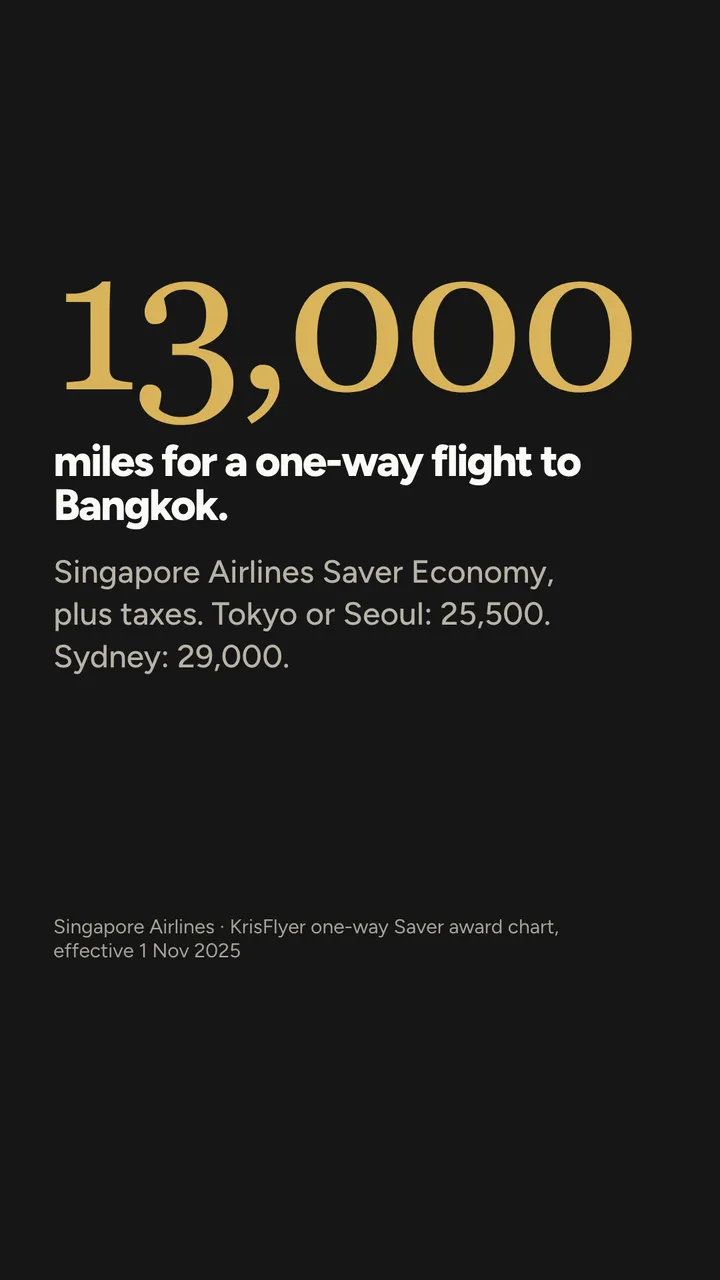
Before comparing cards, it helps to know what you're aiming for. On Singapore Airlines' KrisFlyer award chart (effective 1 November 2025), a one-way Saver Economy flight from Singapore costs:
- Bangkok: 13,000 miles
- Tokyo or Seoul: 25,500 miles
- Sydney: 29,000 miles
Plus taxes and charges, which you pay in cash. And Saver seats are limited, so they aren't always there on the dates you want.
How much spending that takes
Here's the arithmetic for a one-way flight to Bangkok:
- At 2.4 miles per $1: 13,000 ÷ 2.4 = about $5,417 of spending
- At 4 miles per $1: 13,000 ÷ 4 = $3,250
And for Tokyo, 25,500 ÷ 2.4 = about $10,625, or 25,500 ÷ 4 = $6,375. A return trip is two one-ways, so double it.
What this means for you: miles reward spending you were going to do anyway. If you'd need to spend more than usual to reach a flight, the maths stops working. The rate matters, but so does how much of your normal spending you can actually put on the card.
Why top-ups usually earn no miles
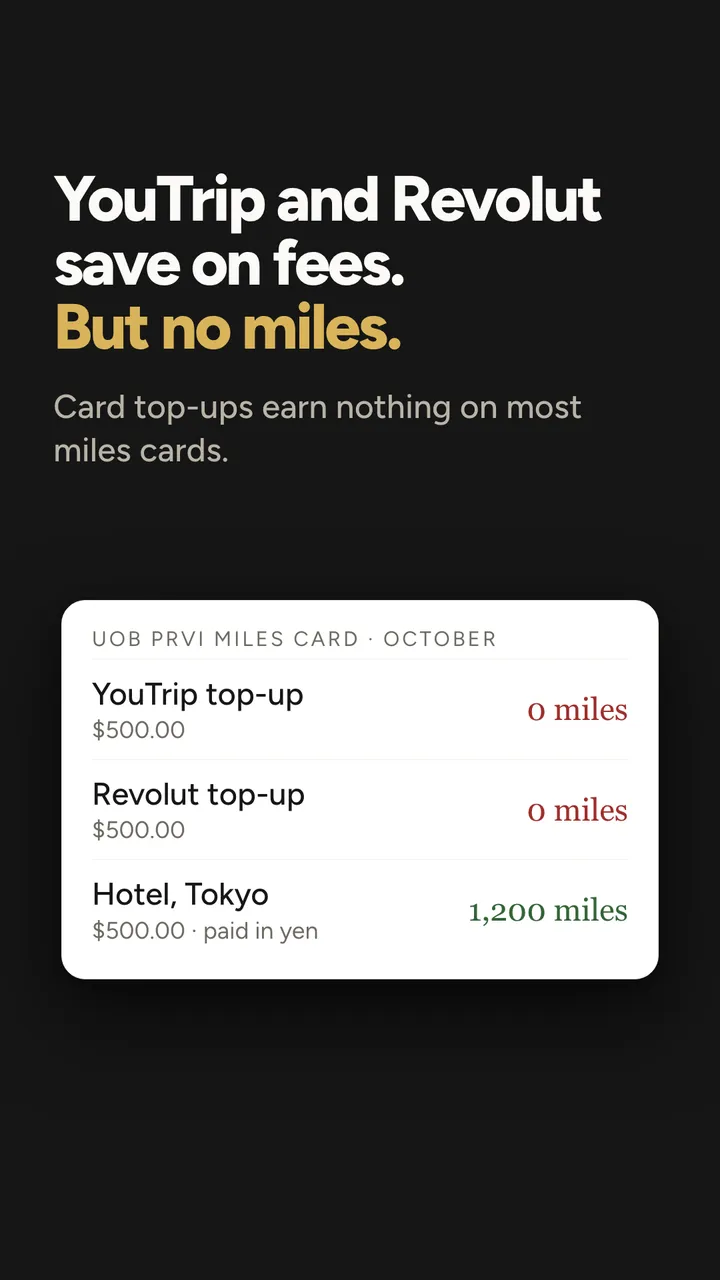
Multi-currency wallets like YouTrip and Revolut genuinely save on foreign exchange fees. The trade-off is that topping them up with a credit card usually counts as a top-up, not a purchase, and most miles cards exclude top-ups from earning anything.
The slide's example
The slide shows three $500 transactions on a UOB PRVI Miles card in October (sample data):
| Transaction | Amount | Miles |
|---|---|---|
| YouTrip top-up | $500 | 0 |
| Revolut top-up | $500 | 0 |
| Hotel in Tokyo, paid in yen | $500 | 1,200 |
The hotel earns $500 × 2.4 = 1,200 miles. The top-ups earn nothing. If all $1,500 had been spent directly in foreign currency on the card, it would have earned $1,500 × 2.4 = 3,600 miles.
Fees saved versus miles earned
To compare the two honestly: paying $1,000 directly in foreign currency costs a 3.25% foreign currency fee at DBS, OCBC, UOB, Citi or HSBC, which is $1,000 × 3.25% = $32.50, and earns $1,000 × 2.4 = 2,400 miles. So in that example, you're paying about $32.50 for 2,400 miles, or roughly 1.4 cents a mile.
What this means for you: neither choice is wrong. It's fees saved on one side, miles earned on the other. The useful question is whether those miles are worth the fee to you, given where you actually want to fly.
Cards with the most miles on overseas spend
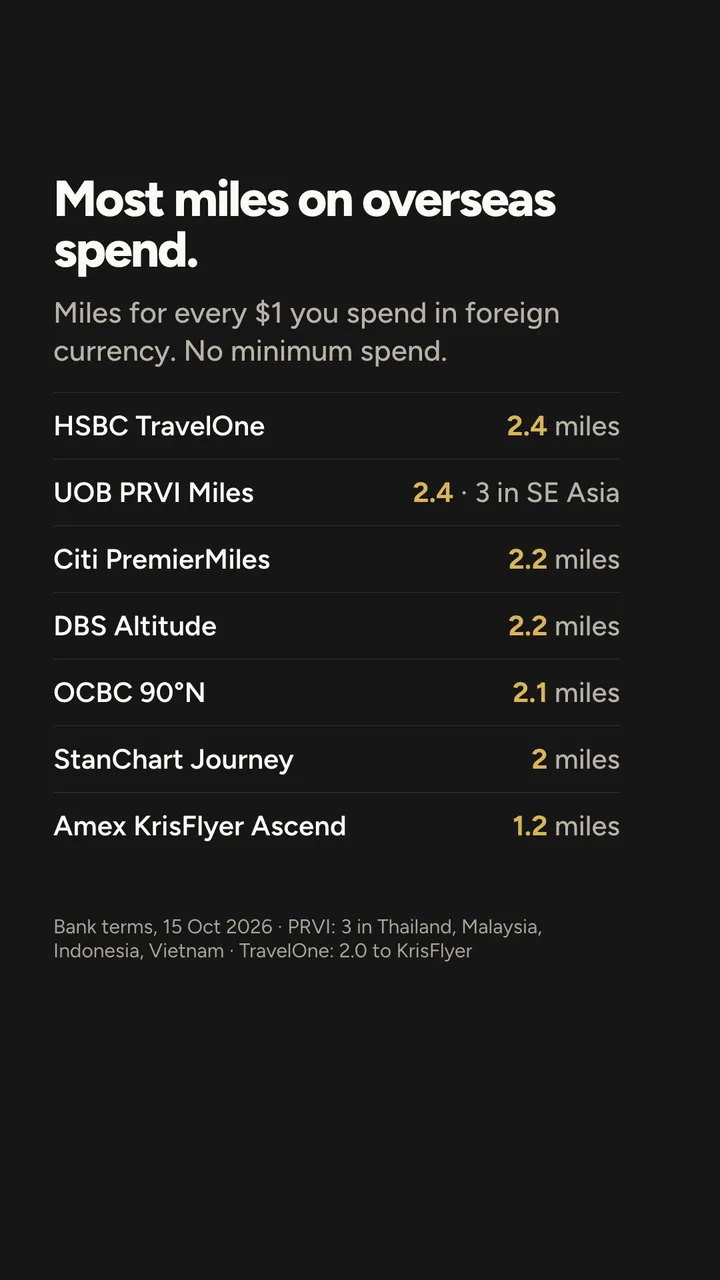
These are general travel cards. They earn a set rate on foreign currency spend, with no minimum spend and no category to pick. Ranked by miles per $1 spent in foreign currency, as at 15 October 2026:
| Card | Miles per $1, foreign currency | Note |
|---|---|---|
| HSBC TravelOne | 2.4 | 2.0 when converted to KrisFlyer |
| UOB PRVI Miles | 2.4 | 3 in Thailand, Malaysia, Indonesia and Vietnam |
| Citi PremierMiles | 2.2 | |
| DBS Altitude | 2.2 | |
| OCBC 90°N | 2.1 | |
| StanChart Journey | 2 | |
| Amex KrisFlyer Ascend | 1.2 |
A worked example
Say Daniel spends $2,000 in foreign currency on a December trip. Here's what each card would earn at the rates above:
| Card | Calculation | Miles |
|---|---|---|
| HSBC TravelOne | $2,000 × 2.4 | 4,800 (4,000 as KrisFlyer) |
| UOB PRVI Miles | $2,000 × 2.4 | 4,800 |
| Citi PremierMiles | $2,000 × 2.2 | 4,400 |
| DBS Altitude | $2,000 × 2.2 | 4,400 |
| OCBC 90°N | $2,000 × 2.1 | 4,200 |
| StanChart Journey | $2,000 × 2 | 4,000 |
| Amex KrisFlyer Ascend | $2,000 × 1.2 | 2,400 |
If Daniel's trip is to Bangkok, the PRVI's 3 miles per $1 in Thailand applies instead: $2,000 × 3 = 6,000 miles.
The conversion catch
The headline number can hide something. HSBC TravelOne earns 2.4 miles per dollar overseas, but 2.0 if you convert to KrisFlyer specifically, because the conversion ratio differs by airline. On $2,000, that's 4,800 versus 4,000.
What this means for you: check the rate for the airline you actually fly, not just the headline. And remember these rates apply to foreign currency spend only; at home, the same cards earn their (lower) local rate.
Cards that earn up to 4 miles per $1, and their limits
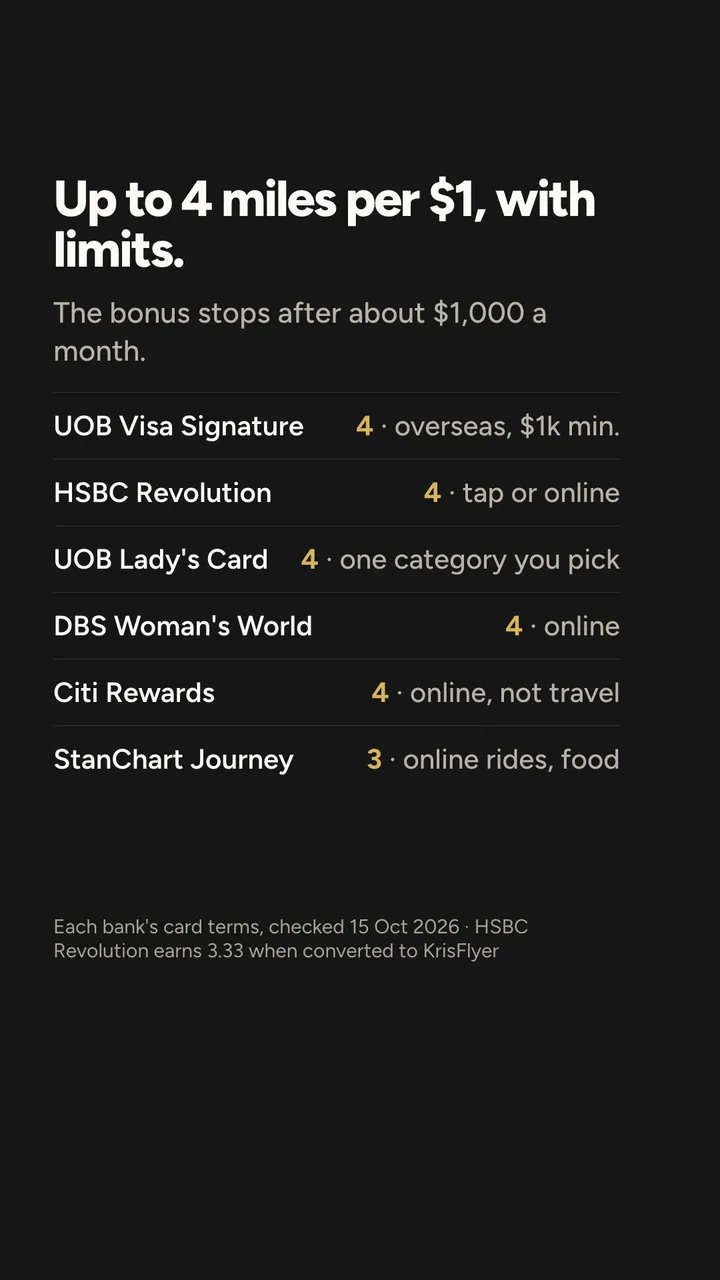
The second group earns more, but only on certain kinds of spending, and only up to a cap. As at 15 October 2026:
| Card | Miles per $1 | On what |
|---|---|---|
| UOB Visa Signature | 4 | Overseas spend, with a $1,000 minimum |
| HSBC Revolution | 4 | Contactless or online (3.33 converted to KrisFlyer) |
| UOB Lady's Card | 4 | One category you pick |
| DBS Woman's World | 4 | Online |
| Citi Rewards | 4 | Online, excluding travel |
| StanChart Journey | 3 | Online rides and food |
Three conditions to read closely
The cap. The bonus stops after about $1,000 of spend a month on these cards. Anything above that earns the card's much lower base rate.
The minimum. UOB Visa Signature's 4 miles per $1 overseas needs at least $1,000 of overseas spend. Spend less than that and the bonus doesn't apply.
The exclusions. Citi Rewards earns 4 online, but not on travel. Booking your flight online with it doesn't count.
A worked example
Say Daniel spends $1,500 online in a month and has two cards that each earn 4 miles per $1 online, with a bonus cap around $1,000:
- All $1,500 on one card: the first $1,000 earns $1,000 × 4 = 4,000 miles, and the remaining $500 earns only the base rate.
- Split $1,000 and $500 across the two cards: $1,000 × 4 = 4,000, plus $500 × 4 = 2,000, for 6,000 miles.
The conversion catch applies here too: HSBC Revolution's 4 becomes 3.33 when converted to KrisFlyer, so $1,000 earns 4,000 in the bank's terms but $1,000 × 3.33 = 3,330 KrisFlyer miles.
What this means for you: this is where a lot of people lose miles without noticing. They keep using the card after the cap, assuming it's still earning 4. It isn't.
Paying in SGD overseas earns fewer miles
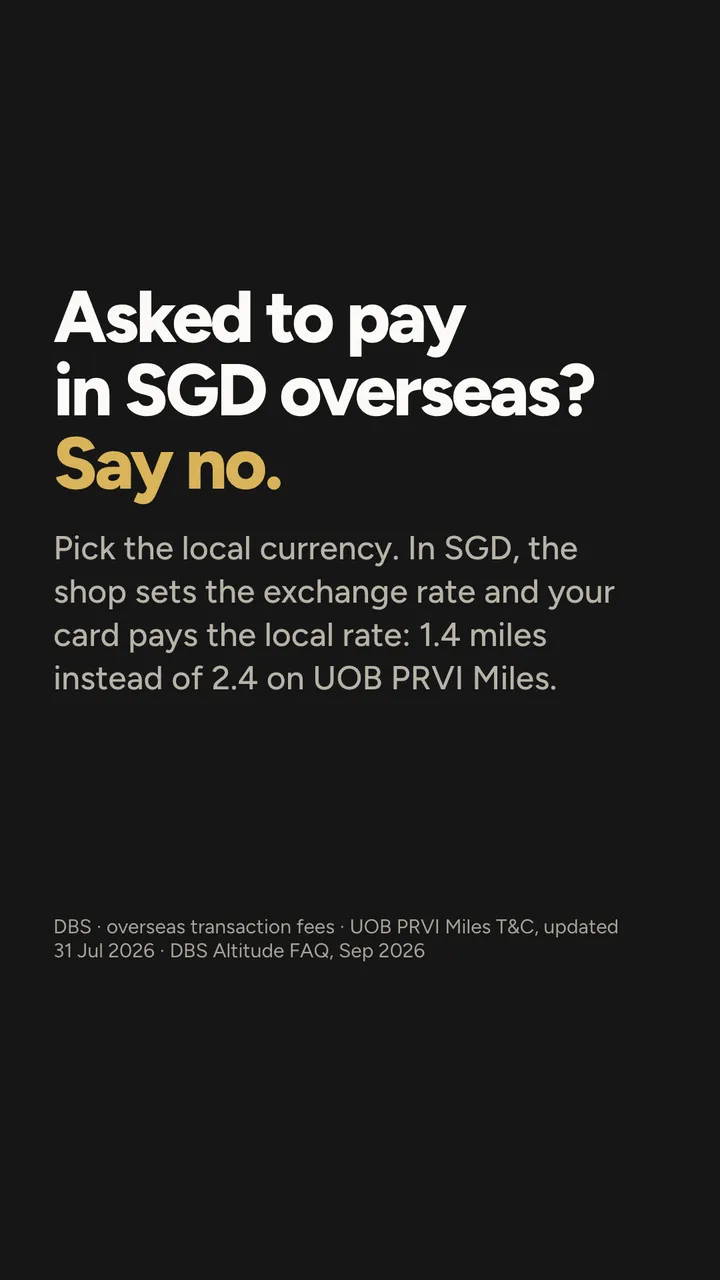
Back to my moment in Tokyo. When a terminal or website overseas offers to charge you in SGD, that's called dynamic currency conversion. Paying in SGD feels safer, because you see the exact amount. But it costs you in two ways.
First, the miles. Your card treats an SGD transaction as local spend, even though you were in Japan, so it earns the local rate. On UOB PRVI Miles, that's 1.4 miles per dollar instead of 2.4.
Second, the rate. In SGD, the shop or its payment provider sets the exchange rate, not your bank or the card network (Visa or Mastercard).
A worked example
Take that $500 Tokyo hotel on UOB PRVI Miles:
- Paid in yen: $500 × 2.4 = 1,200 miles
- Paid in SGD: $500 × 1.4 = 700 miles
- Miles lost by choosing SGD: 1,200 − 700 = 500
What this means for you: when asked, pick the local currency. It also happens online: hotel and airline sites sometimes offer to show and charge the price in SGD.
The 3.25% fee, and why local currency still comes out ahead
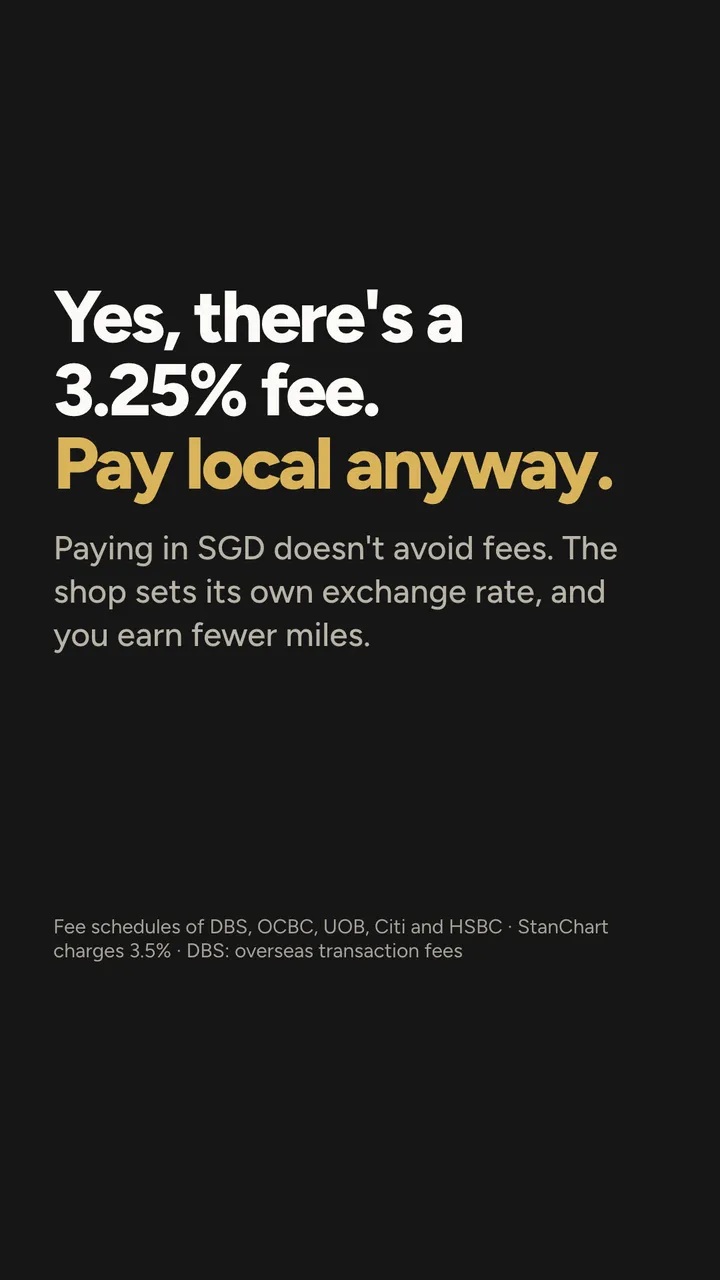
Paying in local currency does mean a foreign currency fee: 3.25% at DBS, OCBC, UOB, Citi and HSBC, and 3.5% at StanChart. That's what makes SGD look tempting. But paying in SGD doesn't make fees go away. DBS, for example, lists a 1% card network fee on these SGD transactions processed overseas (checked 19 October 2026). And the shop's exchange rate is set by the shop.
Putting the $500 hotel side by side
| Paid in yen | Paid in SGD | |
|---|---|---|
| Exchange rate | Card network's | The shop's |
| Fee | $500 × 3.25% = $16.25 | $500 × 1% = $5, plus whatever is built into the shop's rate |
| Miles on UOB PRVI Miles | 1,200 | 700 |
On StanChart, the local currency fee would be $500 × 3.5% = $17.50.
The fee in SGD looks smaller, but the shop's rate is the part you can't see. You'd only know what it cost by comparing it with the network's rate afterwards. Paying in local currency, you know the fee, you get the network's rate, and you keep the overseas miles rate.
What this means for you: the 3.25% is real, and it's fair to weigh it. Just weigh it against the full cost of the alternative, not against zero.
If you only remember three things
- Rank cards by miles per $1 on the spending you actually do, and check the rate for the airline you fly.
- Bonus rates have caps, around $1,000 a month on the 4-miles cards. After that, the card earns its base rate.
- Overseas, pay in the local currency. In SGD you earn the local rate and the shop sets the exchange rate.
How I keep track of this
I'll admit something: I check my card caps more often than I'd like to say. Not because it's fun, but because the cap is the thing that quietly decides whether a card is earning 4 miles per dollar or just its base rate. And I'm not great at remembering, halfway through a month, how much I've already put on which card.
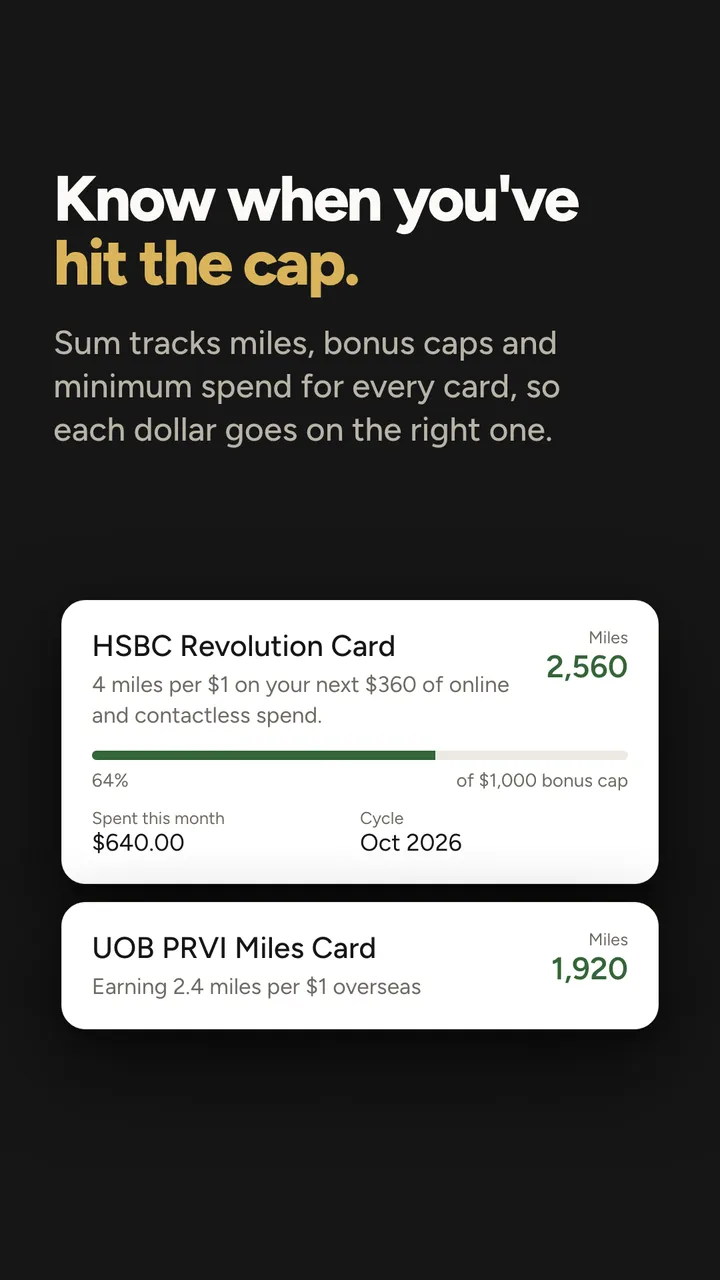
That's what the card tracker in Sum is for, and it's part of the card optimiser on the free plan. For each card, it shows how much you've spent this cycle, how far you are from the bonus cap or the minimum spend, and the miles earned. On the slide (sample data):
- The HSBC Revolution card has $640 of a $1,000 bonus cap used: $640 × 4 = 2,560 miles so far.
- There's $1,000 − $640 = $360 left at 4 miles per dollar, worth $360 × 4 = 1,440 more miles before the rate drops.
- The UOB PRVI Miles card shows 1,920 miles, which at 2.4 per dollar is $1,920 ÷ 2.4 = $800 of overseas spend.
When the first card reaches its cap, that's my cue to switch.
If you'd rather compare cards on your own spending first, our cashback and miles calculator ranks cards by what they'd earn on a typical month, with minimum spend and caps applied. And if you're juggling a few cards already, I wrote about keeping track of too many bills and cards.
Safe travels, and enjoy the holiday. Pick the local currency for me.
Talk soon, Brandon
Try the numbers yourself

Sum is launching in Singapore soon.
Your banks, cards, CPF and HDB flat, added up into one net worth. Statements sorted, card caps tracked, bills remembered.
Brandon · Finance team, Sum
Brandon is on Sum's finance team in Singapore. Brandon reads the CPF Board, IRAS and MAS updates so you don't have to, and turns our carousels into the longer version. Questions, corrections or something to share? Email Brandon at [email protected].
Got something interesting to share?
A money story, a question, something we got wrong, or a tip other Singaporeans should hear. Reach out to me at [email protected], or leave your email and I'll write to you.
Sources: Singapore Airlines: KrisFlyer one-way Saver award chart, effective 1 Nov 2025 (PDF); HSBC: TravelOne Credit Card; HSBC: Revolution Credit Card; UOB: PRVI Miles Card; UOB: Terms governing the UOB PRVI Miles Card (PDF); UOB: Visa Signature Card; UOB: Lady's Card; Citi: PremierMiles Card; Citi: Rewards Card; DBS: Altitude Card; DBS: Woman's World Card terms (PDF); OCBC: 90°N Card programme terms (PDF); Standard Chartered: Journey Credit Card; American Express: Singapore Airlines KrisFlyer Ascend Credit Card; DBS: Overseas transaction fees.
Any app screens shown use sample data, not a real person's. Sum is free to start; some features need a paid plan.
Information only, not financial advice.